A Storm's Coming: AI Is Replacing Coding Jobs Faster Than Anyone Predicted
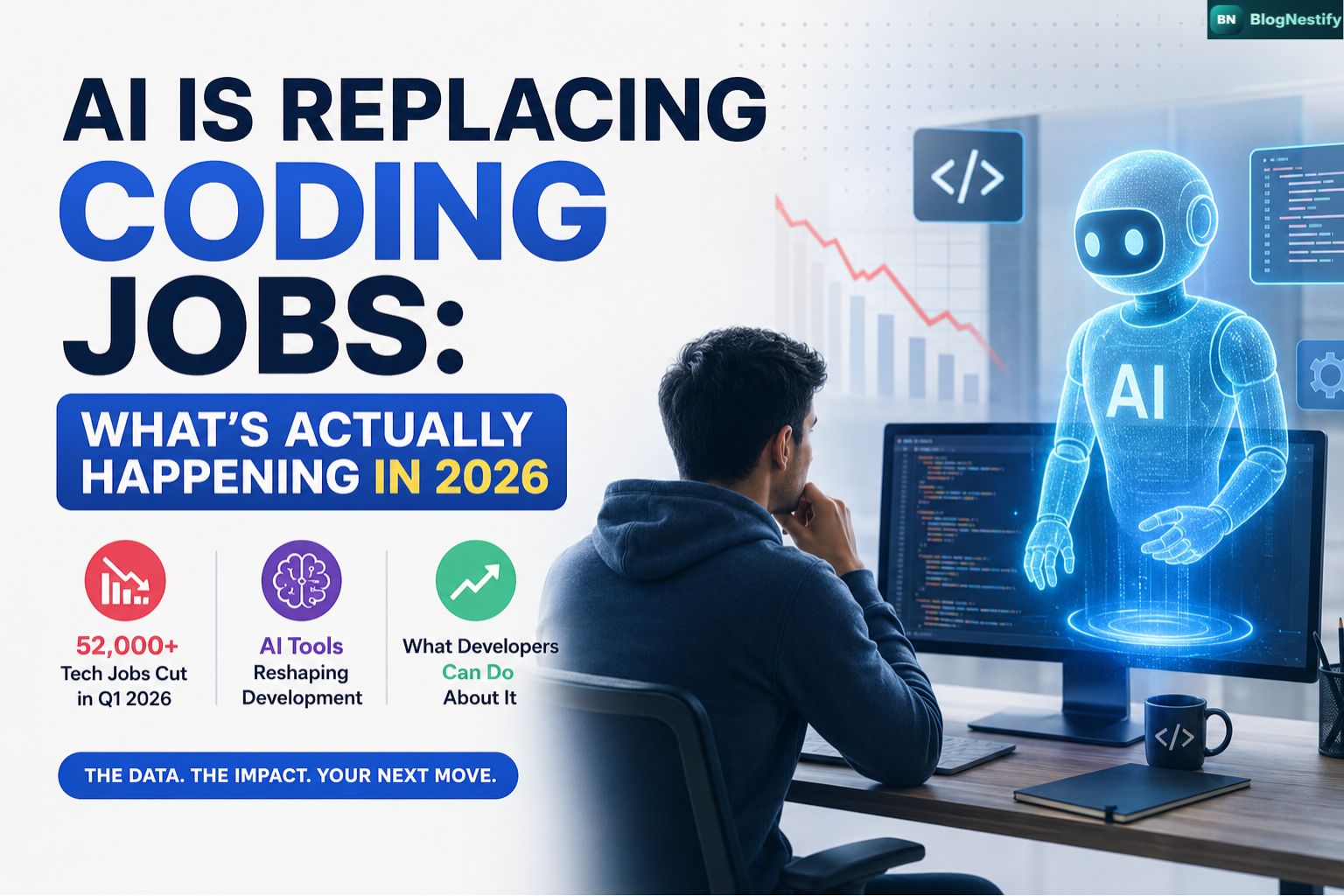
52,000 tech workers lost their jobs in the first three months of 2026. CEOs are openly saying AI did it. Here's what the numbers actually tell us — and what comes next for developers.
Something shifted in early 2026 that most tech coverage missed. It wasn't just another round of post-pandemic downsizing, and it wasn't a market correction. It was something more structurally uncomfortable: companies started being honest about why they were cutting jobs. The word "AI" began appearing in layoff memos with a frankness that executives had spent the previous two years carefully avoiding.
Block's CEO Jack Dorsey made it explicit in February when his company cut roughly 4,000 roles — a 40% reduction — with a public memo that stated the layoffs were "not driven by financial difficulty, but by the growing capability of AI tools to perform a wider range of tasks." That sentence changed the conversation. You couldn't reframe it as restructuring. You couldn't dress it up as rightsizing. He said the machine can do the work now.
This piece examines what's happening — with real numbers, honest caveats, and a clear-eyed look at what developers should actually do about it.
The Numbers Are Harder to Ignore Now
Executive coaching firm Challenger, Gray & Christmas put a number to what the tech industry was feeling: the US tech sector recorded 52,050 job cuts in Q1 2026, a 40% jump from the same three-month stretch in 2025. Their chief revenue officer, Andy Challenger, was unambiguous: "Companies are shifting budgets toward AI investments at the expense of jobs. The actual replacing of roles can be seen in technology companies, where AI can replace coding functions."
The year before wasn't quiet either. Between January and June 2025, roughly 78,000 tech job cuts were directly connected to AI adoption — hundreds of people losing jobs every day. And about 1 in 6 employers expected AI to reduce headcount further heading into 2026.
"This is not driven by financial difficulty, but by the growing capability of AI tools to perform a wider range of tasks."
— Jack Dorsey, CEO of Block, February 2026
Meta's situation makes the pattern clearer. The company cut roughly 8,000 positions in 2026 — about 10% of its workforce — while simultaneously pouring billions into AI infrastructure. Its internal AI coding assistants are writing and fixing production code. Meta's stated goal is smaller, AI-powered "pods" where one engineer directs systems that used to require a team. Wall Street responded to the layoff news by pushing Meta's stock up. Efficiency, not downsizing, was the read.
What AI Tools Are Actually Doing to Developer Workflows
The productivity shift is real and it's been measured. Companies using AI coding assistants like GitHub Copilot, Cursor, and Claude report that developers produce 40–55% more code per sprint with comparable quality. GitHub Copilot had 4.7 million paid subscribers by January 2026, up 75% year-over-year. About half of the code written in teams using these tools is now AI-generated.
The math that makes companies nervous is simple: a team of 10 developers with AI tools can produce what a team of 15 produced without them. That creates pressure to justify the 5 extra seats — and in a cost-focused environment, it's not a pressure that usually resolves in favor of headcount.
According to Stack Overflow's 2024 survey, AI tools now integrate into 70% of developer workflows. GitHub Copilot generates an estimated 46% of code in teams that use it. LinkedIn data shows AI skills now appear in 42% of software engineering job descriptions — up from just 8% in 2022.
But there's a caveat that productivity evangelists tend to gloss over. GitHub can say developers "accept 30% of suggestions," but acceptance is not correctness, and correctness is not business value. The tools are good at boilerplate. They're less reliable at knowing when they're wrong. Engineers who disable AI assistants or review every suggestion carefully tend to do so for reasons that don't show up in sprint metrics.
Which Roles Are Genuinely at Risk
The displacement isn't uniform, and that distinction matters enormously if you're trying to plan a career rather than just absorb news cycles.
| Role / Function | AI Displacement Risk | Trend in 2026 |
|---|---|---|
| Entry-level / junior developers | ▲ High | Postings down 28–73% from 2022 peaks |
| Basic front-end (templating, UI copy) | ▲ High | Increasingly handled by AI generation |
| Junior QA / manual testing | ▲ High | Automated testing tools reducing demand |
| Mid-level full-stack generalists | ◆ Medium | Stable for now; depends on AI proficiency |
| Senior system architects | ▼ Low | Growing demand; AI cannot replace design judgment |
| AI/ML engineers | ▼ Low | Strong growth; among fastest-growing roles |
| Cloud & infrastructure engineers | ▼ Low | Sustained demand across sectors |
| Security engineers | ▼ Low | Growing; AI creates more attack surface to defend |
Entry-level software engineering job postings dropped 28% from 2022 peaks and have not recovered. A separate report from Ravio found a 73% drop in junior hiring in a single year. That's the sharpest compression, and it's where the pain is most immediate. The top of the profession looks different: AI/ML engineering, cloud architecture, and security engineering are all hiring.
The Honest Case for Optimism (It's Not What You Think)
There is a reasonable counter-argument to the doom framing, but it requires more nuance than "AI will create new jobs." The Bureau of Labor Statistics still projects 17% growth in software developer jobs through 2033, adding roughly 328,000 new positions. That is not nothing. And Gartner's analysis suggests more than 80% of engineering organizations now use AI-assisted workflows — meaning AI is expanding the scope of what developers build, not just replacing them.
Morgan Stanley research suggests AI will ultimately create more software jobs, not fewer — but the timing and skill distribution of that transition is where things get complicated. The jobs AI is eliminating are available now. The jobs AI is creating require skills that most current developers don't yet have.
AI is not ending programming as a career. It is ending certain kinds of programming tasks — and creating new, higher-value ones in their place.
Gartner predicts 80% of engineers will need reskilling for AI collaboration by 2027. That is an extraordinary number. It means the question for most working developers isn't whether their current role survives — it's whether they move fast enough to occupy the new ones before someone else does.
The Skills That Are Actually in Demand Right Now
Proficiency in AI coding tools now appears in 60% of senior engineering job descriptions, according to LinkedIn data through 2025. That's not about knowing how to run GitHub Copilot — every developer does that now. The employers who are still hiring want engineers who can reason about AI outputs, catch failure modes, and make architectural decisions the model can't.
Building, fine-tuning, and deploying LLMs and ML systems. The fastest-growing engineering discipline in 2026.
Designing scalable infrastructure for AI workloads. AWS, GCP, and Azure all show growing demand for senior-level cloud engineers.
AI expands the attack surface. Security engineers who understand AI-native threat vectors are in short supply.
Knowing how to reliably extract correct outputs from LLMs is now a professional skill, not a party trick.
Reviewing model outputs, catching errors, and ensuring AI tools produce correct business logic — increasingly a distinct engineering responsibility.
High-level architecture decisions that require context, judgment, and organizational knowledge remain firmly human work.
The Messy Reality: AI Layoffs Aren't Always About AI
One thing worth noting — and analysis from several workforce researchers has flagged this — is that "AI layoffs" is a complicated label. Some of the 2025–2026 cuts are real productivity substitution: one engineer with AI tools genuinely does the work of three. But some of it is COVID-era overhiring finally being corrected, dressed up with AI language because that's what gets shareholders excited and deflects harder questions about management decisions.
One forecast suggests that by 2027, roughly half of companies that cut workers citing AI efficiency will rehire to fill talent gaps — because the gains often prove more modest than the initial productivity claims. The tools are powerful, but the 40–55% productivity boost tends to apply to specific tasks rather than everything an engineer does in a day. Debugging, stakeholder communication, business logic translation — those don't compress the same way.
Dario Amodei, CEO of Anthropic, stated in January 2026 that AI could handle full coding work for software engineers within 6 to 12 months. He also suggested AI could eliminate roughly half of white-collar jobs within one to five years — a claim that generated significant coverage and debate about its timeline, scope, and assumptions.
These projections are worth knowing, but they represent the most aggressive end of the forecasting range. Most labor economists expect a longer, messier, more uneven transition.
What This Means for Anyone Starting Out in Tech
The hardest read here is for people early in their careers or currently studying computer science. The traditional path — junior developer role → mid-level → senior — compressed badly in 2024 and 2025. Entry-level hiring was down sharply across the board. That apprenticeship pipeline, where you learned the fundamentals through doing basic work on real systems, is thinner than it was.
There isn't a clean answer to that, but there are a few practical observations. First, the people landing jobs in 2026 are those who can credibly demonstrate AI-collaboration skills, not just coding skills. Internships, side projects, and portfolios that show you built something with AI tools — not just code you wrote by hand — read differently to hiring managers now.
Second, the geographic and sector distribution of tech hiring is shifting. AI infrastructure, health tech, defense tech, and fintech are all still hiring engineers. Pure-play consumer software companies — where the layoffs have been most dramatic — are not representative of the whole market.
Third, the people who understood that "writing code" was never really the job — that the job was solving problems, communicating with stakeholders, and making good design decisions — are finding the transition less disorienting. The tool changed. The underlying work didn't.
Key Takeaways
- 52,050 tech jobs were cut in Q1 2026 — a 40% jump from Q1 2025, with AI cited as a primary cause
- Entry-level software engineering postings are down 28–73% from 2022 peaks; senior AI roles are growing
- Companies using AI coding tools report 40–55% more code output per developer, reducing headcount pressure
- 80% of engineers will likely need reskilling for AI collaboration by 2027 (Gartner)
- Not all "AI layoffs" are purely AI-driven — COVID overhiring corrections are mixed in
- BLS still projects 17% growth in software developer jobs through 2033, adding ~328,000 positions
- Skills in highest demand: AI/ML engineering, cloud architecture, security, prompt engineering, system design
The Bottom Line
The storm is real. But "storm" doesn't mean "extinction event." It means conditions have changed rapidly enough that what was safe before isn't safe anymore, and what looked like a career path a few years ago has a different shape now.
The developers who are struggling most in 2026 are the ones who bet their entire value on the ability to write code — because that specific ability has become significantly cheaper. The ones doing reasonably well are those who understood that writing code was always in service of something else: building systems that work, solving problems that matter, communicating with teams and clients who don't speak the language of compilers.
AI handles a growing share of the typing. It doesn't handle the judgment about what to type, or whether the thing being built is the right thing to build. That gap is where software engineering's next decade lives.
Frequently Asked Questions
Stay Ahead of the Curve
Get Blognestify's analysis on AI, tech, and the future of work — straight to your inbox.
Visit Blognestify →
0 Comments
Leave a Comment