US Lifts Export Ban on Anthropic's Advanced AI Tools: What Changed and Why It Matters
By Khushal Charaniya · Updated July 1, 2026 · 7 min read
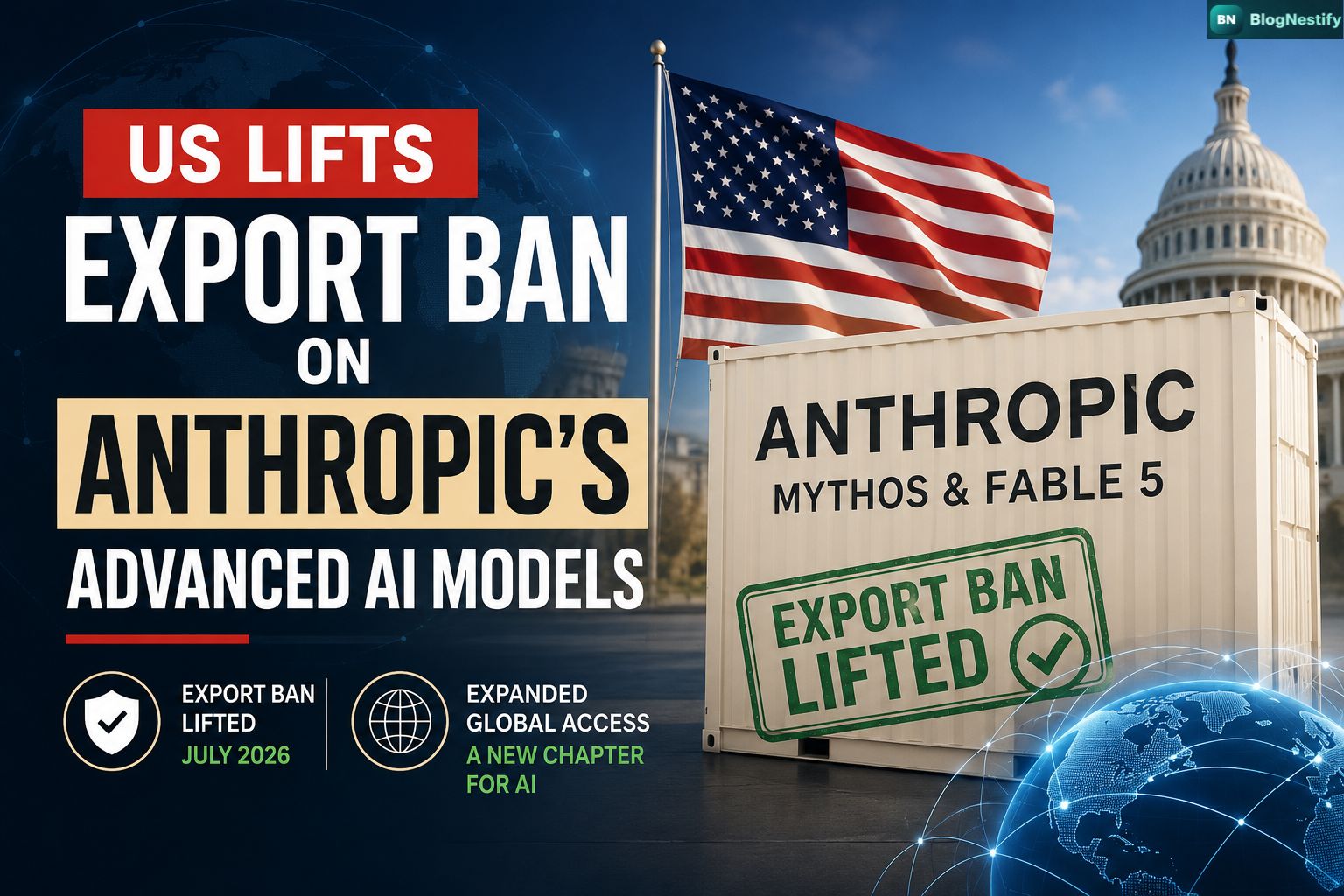
The US government has lifted export controls on Anthropic's most advanced AI models, clearing the way for a select group of American companies to use both Mythos and Fable 5 after weeks of national-security scrutiny over their cybersecurity capabilities.
Key takeaways
- Anthropic disabled foreign access to Mythos and Fable 5 in early June 2026 after the Commerce Department imposed an export ban.
- The ban followed the discovery of a jailbreak that could bypass Fable 5's safety guardrails.
- The Commerce Department reinstated limited access to Mythos for vetted US companies first, then lifted controls on Fable 5 on June 30.
- Commerce Secretary Howard Lutnick confirmed the decision, saying the government worked closely with Anthropic over two weeks to approve the model's release.
- OpenAI faces a comparable review process for its own advanced cybersecurity-capable model.
Why Washington Banned Anthropic's Models in the First Place
In early June 2026, Anthropic released two models built on its Mythos architecture: Claude Mythos 5, aimed at frontier research and select enterprise partners, and Claude Fable 5, a version fitted with extra guardrails for broader public use. Both were positioned as capable of finding and patching software vulnerabilities far faster than human security teams, a genuinely useful capability for defenders, but also a risky one if it ended up in the wrong hands.
That risk stopped being theoretical within days. A trusted external partner brought in to stress-test the models, reported to be Amazon, discovered a jailbreak that could get around Fable 5's safety guardrails, effectively unlocking capabilities the model was designed to withhold from general users. The Commerce Department responded fast: it ordered Anthropic to suspend access for all foreign nationals, including the company's own overseas employees, until the vulnerability was addressed.
The Two-Stage Reversal
The rollback happened in two distinct steps rather than all at once, which is worth understanding if you're trying to track exactly who can use what.
Step one: Mythos, for a short list of firms. Roughly a week after the ban took effect, the Commerce Department sent a letter permitting a small number of American companies, plus their foreign staff, to resume using Mythos. Anthropic framed this as a way to get the model into the hands of firms working on critical software security, without reopening it to the general public.
Step two: Fable 5 cleared on June 30. The broader, public-facing model remained blocked for longer while Anthropic and federal officials worked through the underlying jailbreak issue. That changed when Commerce Secretary Howard Lutnick announced on social media that the government had approved Fable 5 following two weeks of joint review with Anthropic, describing the move as a way to strengthen the country's position in AI while keeping oversight in place. Anthropic said in a statement that it welcomed the decision and would keep coordinating with regulators going forward.
Not a Full Reopening Just Yet
It's worth being precise about what "lifted" actually means here. This isn't a return to unrestricted global availability. Access is still limited to a list of companies the government has approved, along with their staff, including foreign employees who work for those approved firms. Anyone outside that list, in the US or abroad, still can't use Mythos or Fable 5 the way they could before the ban.
That distinction matters for businesses outside the approved circle. Some allied governments have pushed back on the arrangement. Austria, for instance, has asked the European Union to look into hosting Anthropic's infrastructure locally so European companies aren't left dependent on Washington's approval list for access to frontier AI tools.
OpenAI Is Facing the Same Playbook
Anthropic isn't alone in this. OpenAI has agreed to let the government screen the list of companies that get early access to its own advanced, cybersecurity-capable model. In a public statement, OpenAI said this vetting process was currently the fastest route to wider availability, but added that it shouldn't become a permanent arrangement, warning that government-gated access risks keeping powerful tools out of the hands of developers, enterprises, and cyber defenders who could put them to good use.
Taken together, the Anthropic and OpenAI situations point to a new normal for how the US government intends to treat frontier AI releases, less hands-off than the earlier phase of the AI boom, and closer to how export-controlled technology has historically been managed.
What This Means Going Forward
For enterprise security teams, the practical upshot is that Mythos-class tools are back on the table, provided your organization is on the approved list. For everyone else, it's a signal that the most capable AI models are increasingly likely to pass through a government checkpoint before wide release, at least while cybersecurity risk remains the primary justification. Expect this kind of vetting to keep showing up as new frontier models roll out from Anthropic, OpenAI, and likely others.
Worth watching: Whether this vetting model becomes standard practice for every major AI lab, or a temporary measure tied specifically to this generation of cybersecurity-capable models, will shape how AI companies plan releases for the rest of 2026.
Frequently Asked Questions
Why did the US government ban Anthropic's AI models in the first place?
A trusted testing partner found a way to bypass Fable 5's safety guardrails, raising concern that the model's vulnerability-finding abilities could be misused at scale.
Which Anthropic model had its export ban lifted?
Both. Mythos access was restored first for a short list of vetted companies, and Fable 5's export control was lifted separately on June 30.
Does this mean anyone outside the US can now use these models?
No. Access is still restricted to companies the government has approved, along with their staff.
Is OpenAI facing similar restrictions?
Yes, OpenAI has agreed to a comparable government vetting process for early access to its own advanced model.
Khushal Charaniya
Founder and Editor of Blognestify, covering technology, AI, cybersecurity, business, and global affairs. Khushal focuses on translating fast-moving AI policy news into clear, practical breakdowns for readers who need to stay current without wading through jargon.
0 Comments
Leave a Comment