Apple M6 and M5 Ultra: Inside Apple's Biggest Leap in Performance and AI Compute
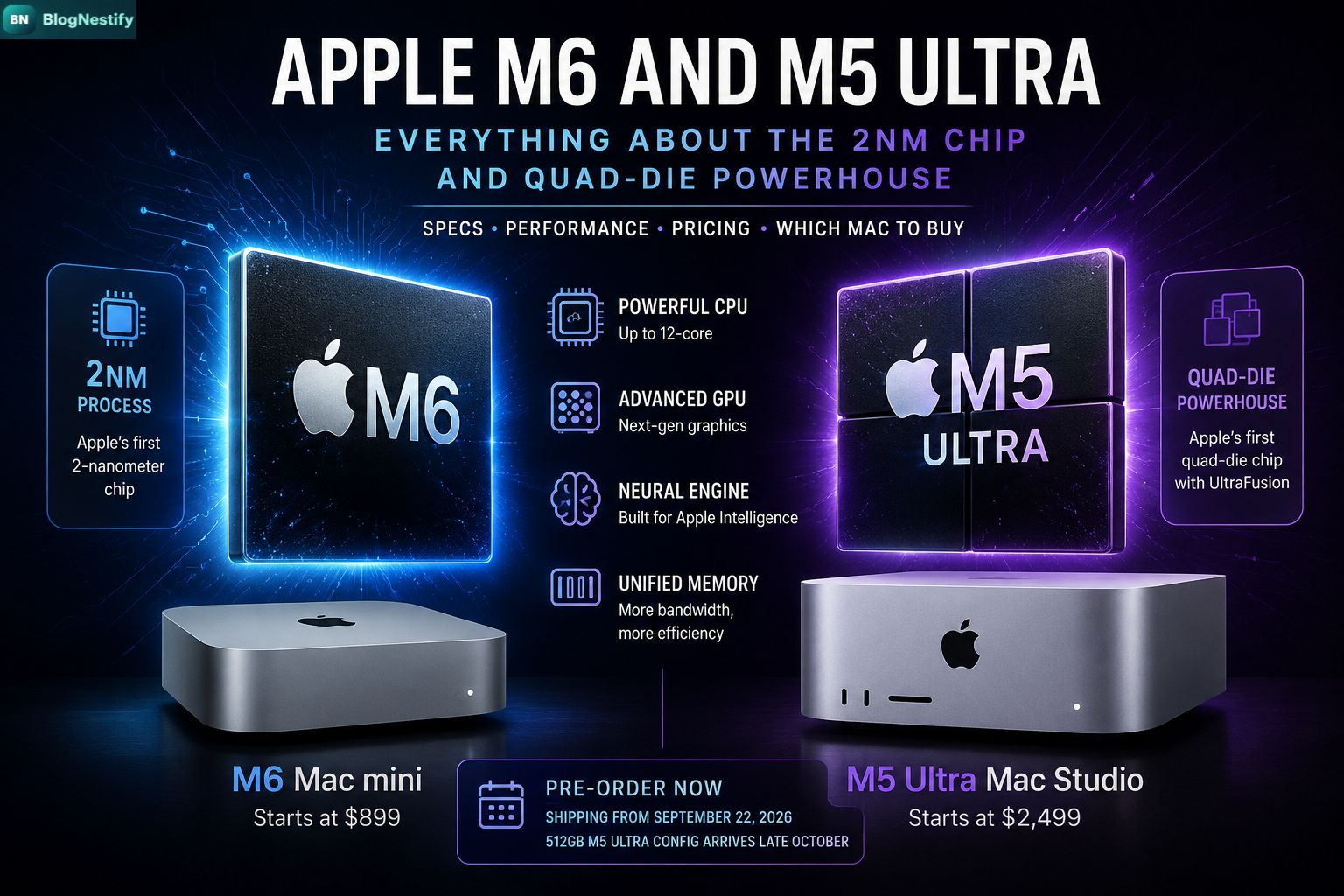
Apple didn't wait for its usual autumn keynote to make one of its biggest silicon announcements of the year. In a pair of surprise press releases, the company confirmed the M6 and M5 Ultra chips, calling them "the next giant leap in performance and AI compute for Apple silicon." Both processors land in refreshed Mac mini and Mac Studio models, and together they represent two very different kinds of progress: one is about doing more with less silicon, and the other is about brute-force scale.
What Is the Apple M6 Chip?
The M6 is Apple's first chip manufactured on a 2-nanometer process, a jump that lets Apple pack more transistors into the same die space while improving power efficiency. It's built for everyday users, students, and developers rather than professional workstations, and it debuts in the standard configuration of the new Mac mini.
M6 Key Specifications
- Process: 2nm — Apple's first chip at this node
- CPU: 12 cores — 2 super cores, 4 performance cores, 6 efficiency cores (Apple's first chip with all three core types)
- GPU: 12 cores, each with a built-in Neural Accelerator
- Neural Engine: Dual 16-core Neural Engine
- Memory: Up to 32GB unified memory, up to 170GB/s bandwidth
- Claimed gains: World's fastest single-threaded performance; up to 1.2x faster multithreaded performance than M5; up to 2.4x faster than the original M1; roughly 30% faster peak GPU compute for AI than M5
In practical terms, Apple says the extra CPU cores and the new Neural Accelerators mean faster prompt processing when running large language models on-device — a signal that even Apple's mainstream chip is now being tuned around AI workloads, not just traditional apps.
What Is the M5 Ultra, and Why Is a "Quad-Die" Chip a Big Deal?
Where M6 is about efficiency, the M5 Ultra is about raw scale. It's Apple's first chip built on a quad-die architecture, created by fusing two dual-die M5 Max chips together using a next-generation version of Apple's UltraFusion interconnect. Apple says this new interconnect delivers over 4.4TB/s of inter-die bandwidth and more than six times the connection density of the previous design, letting all four dies behave as one unified processor.
M5 Ultra Key Specifications
- Architecture: Quad-die, via next-gen UltraFusion (2x dual-die M5 Max)
- CPU: Up to 36 cores — 12 super cores, 24 performance cores
- GPU: Up to 80 cores, each with a Neural Accelerator
- Neural Engine: Up to 32 cores
- Memory: Up to 512GB unified memory, 1.2TB/s bandwidth (50% more than M3 Ultra)
- Claimed gains: Up to 1.25x single-threaded and 1.3x multithreaded performance versus M3 Ultra; up to 4.3x peak AI compute versus M3 Ultra; supports up to 33 simultaneous 8K ProRes 422 video streams
Apple is explicitly positioning M5 Ultra for professionals running frontier AI models locally — the kind of workload that used to require a rack of GPUs. With up to 512GB of unified memory, the chip can hold enormous datasets and large open-weight models entirely on-device, which is as much a message to AI developers as it is to video editors.
M6 vs. M5 Ultra: How the Two Chips Compare
| Spec | M6 | M5 Ultra |
|---|---|---|
| Process | 2nm | Built on M5 architecture (quad-die) |
| CPU cores | 12 | Up to 36 |
| GPU cores | 12 | Up to 80 |
| Neural Engine | Dual 16-core | Up to 32-core |
| Max unified memory | 32GB | 512GB |
| Memory bandwidth | 170GB/s | 1.2TB/s |
| Ships in | Mac mini | Mac Studio |
| Starting price | $899 (Mac mini) | $5,499 (Mac Studio) |
Pricing and Availability
Both chips arrive inside refreshed desktops, not as standalone upgrades. Here's how the new lineup breaks down for buyers deciding where to spend.
| Model | Chip | Starting Price |
|---|---|---|
| Mac mini | M6 | $899 |
| Mac mini | M5 Pro | $1,699 |
| Mac Studio | M5 Max | $2,499 |
| Mac Studio | M5 Ultra | $5,499 |
All four configurations are available to pre-order now, with general availability beginning September 22, 2026. The 512GB unified memory configuration of the M5 Ultra Mac Studio is the exception — it won't ship until late October, and Apple hasn't yet confirmed its price. Every new model ships with Wi-Fi 7, Bluetooth 6, and macOS 27.
Which Chip Should You Actually Care About?
Key Takeaways
- Everyday users, students, and developers: the M6 Mac mini covers most needs and introduces 2nm efficiency at a mainstream price.
- Creative professionals: the M5 Max Mac Studio balances strong CPU/GPU performance with a lower entry price than the Ultra tier.
- AI developers and heavy compute users: the M5 Ultra's 512GB memory ceiling is the real draw — it's built to run large models locally without cloud infrastructure.
- Don't judge by name alone: M6 is not "better" than M5 Ultra; they serve entirely different tiers of the lineup.
Frequently Asked Questions
What is Apple's M6 chip?
The M6 is Apple's first chip built on a 2-nanometer process. It has a 12-core CPU (two super cores, four performance cores, six efficiency cores), a 12-core GPU with a Neural Accelerator in every core, and a Dual 16-core Neural Engine. It debuts in the 2026 Mac mini.
What makes the M5 Ultra different from previous Ultra chips?
M5 Ultra is Apple's first quad-die chip. It fuses two dual-die M5 Max chips using next-generation UltraFusion, giving it up to a 36-core CPU, an 80-core GPU, and 1.2TB/s of unified memory bandwidth. It ships exclusively in the 2026 Mac Studio.
How much do the new M6 Mac mini and M5 Ultra Mac Studio cost?
The M6 Mac mini starts at $899, with an M5 Pro configuration starting at $1,699. The Mac Studio starts at $2,499 for M5 Max and $5,499 for M5 Ultra. All models are available to pre-order now, shipping from September 22, 2026, with the 512GB M5 Ultra configuration arriving in late October.
Is the M6 better than the M5 Ultra?
No. M6 is Apple's mainstream chip built for everyday users and everyday Macs like the Mac mini, while M5 Ultra is a separate, far more powerful workstation-class chip built for the Mac Studio and demanding professional or AI workloads. The naming reflects generation, not a direct performance ranking.
0 Comments
Leave a Comment