RBI Simplifies FPI Rules for Government Securities: What Changed and Why It Matters for India
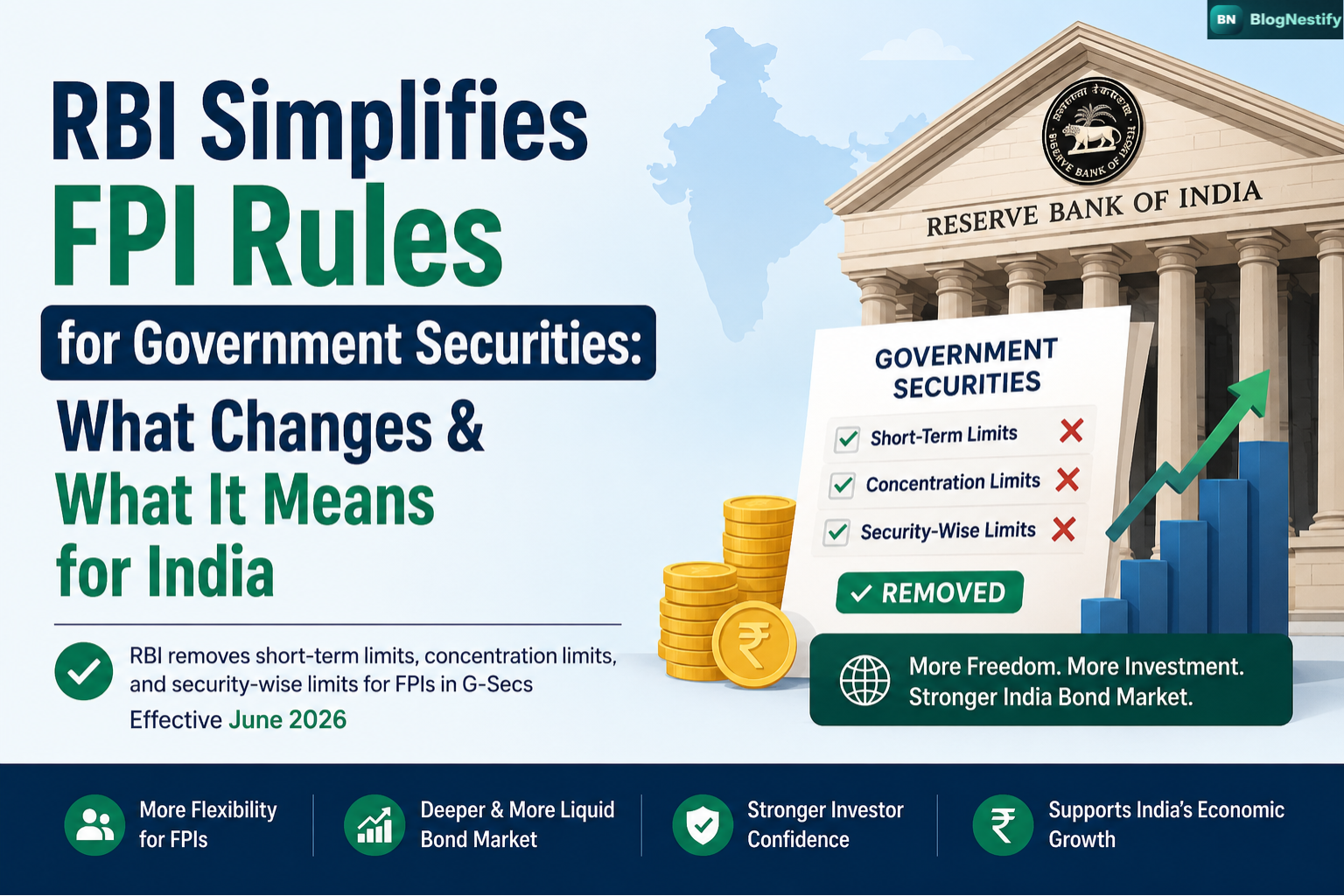
In a significant policy move on June 5, 2026, the Reserve Bank of India removed three long-standing investment restrictions for Foreign Portfolio Investors in government securities — making it easier for global capital to flow into India's bond market at a time when overseas investors have been pulling back.
📌 Quick Summary
- RBI removed short-term investment limits, security-wise limits & concentration limits for FPIs in G-Secs
- The 'general' and 'long-term' sub-categories are now merged into a single consolidated investment limit
- FAR (Fully Accessible Route) expanded to include 15-year, 30-year, 40-year bonds & Sovereign Green Bonds
- VRR (Voluntary Retention Route) effectively merged into General Route from April 1, 2026
- FPI interest income and capital gains on G-Secs are now tax-exempt under Income-tax Amendment Ordinance 2026
- FPI investment limits for FY 2026-27 set at ₹4,62,490 crore (H1) and ₹4,77,006 crore (H2) for Central G-Secs
What Did the RBI Actually Change?
The Reserve Bank of India, acting under the Foreign Exchange Management Act (FEMA), announced a sweeping set of amendments to its regulatory framework governing FPI investments in government securities. The circular, issued on June 5, 2026, specifically targets the General Route — the channel through which most foreign portfolio investors participate in India's government bond market.
Until now, FPIs investing through the General Route had to operate within three separate compliance guardrails in addition to the overall investment cap. These were bureaucratic friction points that many institutional investors flagged as operationally inconvenient, especially when managing large or rapidly rebalancing portfolios.
Short-Term Investment Limit — Removed
FPIs were previously restricted from holding more than a certain percentage of their G-Sec portfolio in short-tenure bonds. This restriction has been fully withdrawn.
Security-Wise Limit — Removed
The cap on how much a single FPI could hold in any one government security has been eliminated, giving investors full flexibility to concentrate in preferred instruments.
Concentration Limit — Removed
Restrictions on how much of a single bond issue FPIs could collectively own have been withdrawn, enabling deeper participation without forced diversification.
Beyond the three removals, the RBI also restructured the investment limit architecture. Previously, there were two sub-categories under the General Route — 'general' and 'long-term' — each with separate caps. These have now been merged into a single unified limit for both Central Government Securities and State Government Securities (SGSs). This simplification is significant because investors no longer need to track or allocate between two buckets.
The New FPI Investment Limits for FY 2026-27
With the sub-categories now merged, here is the revised limit structure for the current financial year. The overall percentage limit — 6% of outstanding stock for G-Secs and 2% for SGSs — remains unchanged, but the absolute rupee values have grown due to the increase in outstanding securities.
| Security Type | H1 FY 2026-27 Limit | H2 FY 2026-27 Limit |
|---|---|---|
| Central Government Securities (G-Secs) | ₹4,62,490 crore | ₹4,77,006 crore |
| State Government Securities (SGSs) | ₹1,53,043 crore | ₹1,64,242 crore |
| Corporate Bonds (General Route %) | 15% of outstanding stock (unchanged) | |
| Fully Accessible Route (FAR) | No investment ceiling — unlimited | |
Importantly, the incremental annual increase in G-Sec limits continues to be split 50:50 between what were previously the 'general' and 'long-term' sub-categories — but for operational purposes from the investor's perspective, it is now a single consolidated number. For SGSs, the full increment has been allocated to the (formerly) general sub-category.
Expanding the Fully Accessible Route (FAR)
Alongside the General Route changes, the RBI and Ministry of Finance expanded the scope of the Fully Accessible Route — the channel that carries zero investment ceiling and has been central to India's inclusion in global bond indices like the JP Morgan Government Bond Index-Emerging Markets (GBI-EM).
Three new categories of government securities are now eligible under FAR:
- All new issuances of 15-year government securities
- All new issuances of 30-year government securities
- All new issuances of 40-year government securities
- Sovereign Green Bonds (SGrBs) of tenors already eligible under FAR
The inclusion of longer-duration bonds (15, 30, and 40 years) is particularly notable. These tenors are preferred by pension funds, insurance companies, and sovereign wealth funds — the exact investor profile that India wants to attract for stable, long-term capital. Market participants noted that these measures, combined with the new tax exemption on FPI interest income from G-Secs, could meaningfully boost demand for longer-tenure Indian government bonds.
End of the Voluntary Retention Route (VRR) as a Separate Channel
Perhaps the most structural change in this reform cycle was the effective closure of the Voluntary Retention Route as a distinct investment channel. Introduced by the RBI in March 2019, the VRR was designed to attract investors willing to commit to a minimum three-year retention period in exchange for fewer macro-prudential restrictions.
With effect from April 1, 2026, all existing VRR investments were automatically migrated to the General Route limits. The VRR no longer operates with its own separate quantitative cap. The RBI's decision to absorb VRR into the General Route reflects confidence that India's bond market has matured sufficiently — and that maintaining a separate "commitment route" is no longer necessary to attract stable investors.
"The consolidation of limits is consistent with India's broader market development objectives, including efforts to broaden foreign participation in government and corporate bond markets." — EY India, Analysis of RBI Circular on Debt Investment Rationalization
FPIs who had opted for retention periods beyond the minimum three years retain the right to exit their holdings fully or partially after the minimum retention period has elapsed. The RBI has ensured no forced exit disruptions from this migration.
The Tax Relief: A Game-Changer for Long-Term FPI Flows
Running parallel to the RBI's regulatory changes, the Ministry of Finance announced a significant fiscal sweetener. Under the Income-tax (Amendment) Ordinance 2026, FPI investments in government securities will now be exempt from both interest income tax and capital gains tax. This is a departure from earlier treatment, where such income was subject to withholding tax — a persistent concern for overseas institutional investors comparing Indian bonds against other emerging market alternatives.
Combined with zero-ceiling access through FAR and fewer operational restrictions under the General Route, this tax exemption is expected to make Indian G-Secs considerably more attractive in terms of net yield-to-foreign-investor calculations.
Why Is the RBI Doing This Now? The Context Behind the Move
Understanding the timing of these reforms requires looking at the broader capital flow picture. Between April 1 and June 2, 2026, foreign portfolio investors pulled out a net $13.4 billion from Indian equity markets and $0.3 billion from debt markets. This sustained outflow put pressure on the Indian rupee and raised concerns about India's attractiveness as an investment destination relative to other emerging markets offering higher real yields or simpler access frameworks.
At the same time, India is executing an ambitious foreign trade agenda. The country recently signed trade agreements with the United Kingdom and New Zealand, while agreements with the European Free Trade Association (EFTA) and Oman came into force on October 1, 2025 and June 1, 2026, respectively. Liberalising the capital markets access framework alongside trade liberalisation signals a coherent policy direction — making India not just easier to trade with, but also easier to invest in.
The RBI's measures also address long-standing industry feedback. For years, foreign fund managers had pointed to India's layered investment limits — with separate general, long-term, and VRR buckets — as operationally complex compared to simpler access frameworks in markets like South Korea or Indonesia. The consolidation addresses this directly.
Expanded Access for NRIs, OCIs, and Overseas Individual Investors
The June 5 package was not limited to institutional FPIs. The RBI and Ministry of Finance also announced expanded market access for individual investors resident outside India:
- Investment limits for Non-Resident Indians (NRIs) and Overseas Citizens of India (OCIs) in listed equity instruments without SEBI registration have been increased
- The same facility has been extended to all individual Persons Resident Outside India (PROIs) — putting them on par with NRIs and OCIs for the first time
- This is expected to boost retail-level foreign participation and improve liquidity in domestic equity markets
This extension to PROIs is a meaningful structural expansion. Previously, NRIs and OCIs had certain investment privileges that other foreign individual investors lacked. By extending these benefits to all individual PROIs, the RBI has simplified the framework and opened Indian equity markets to a broader universe of overseas individuals.
What This Means for India's Bond Market — Big Picture
India's government bond market has been on a trajectory of gradual internationalisation since its inclusion in JP Morgan's GBI-EM Global Diversified Index began in June 2024. Bloomberg Aggregate indices and FTSE Russell's Emerging Market Government Bond Index (EMGBI) tracks are also relevant milestones in this journey. Each inclusion triggers passive fund buying from index-tracking ETFs and mutual funds — capital that flows in as a structural mandate, not a discretionary bet.
The latest RBI reforms strengthen this journey in two ways. First, expanding FAR to include longer-duration bonds increases the stock of index-eligible securities, which can raise India's weight in global indices over time. Second, removing operational friction from the General Route reduces the cost — both financial and administrative — of maintaining active positions in Indian G-Secs for global fund managers.
In absolute terms, the total FPI debt limit for India rises from ₹14,70,655 crore in FY 2025-26 to ₹16,32,640 crore by H2 FY 2026-27 — an increase of over ₹1.6 lakh crore. This expanded headroom, combined with simpler access rules, sets up India to absorb significantly larger foreign bond inflows as global rate cycles evolve.
🎯 Key Takeaways for Readers
- Three restrictions on FPI G-Sec investments under the General Route have been permanently removed
- Investment limit sub-categories are now consolidated — simpler tracking, fewer compliance burdens
- FAR eligibility expanded to longer-duration bonds and Sovereign Green Bonds
- VRR effectively wound down and absorbed into the General Route framework
- FPI income from G-Secs is now tax-exempt under the 2026 IT Amendment Ordinance
- Individual overseas investors (PROIs) now get equity access on par with NRIs and OCIs
- Total FPI debt headroom grows to over ₹16.3 lakh crore by H2 FY27
Frequently Asked Questions
Conclusion: A Meaningful Step Toward a More Open Bond Market
The RBI's June 2026 reforms represent one of the most comprehensive simplifications of India's FPI investment framework in recent years. By removing the three sub-limits under the General Route, merging sub-categories into a single consolidated cap, absorbing VRR into the mainstream, and expanding FAR to longer-duration bonds, the central bank has addressed the primary operational complaints of global fund managers.
Whether this translates into immediate capital inflows depends heavily on global factors — particularly the trajectory of US interest rates and dollar strength. But as a regulatory foundation, India's government bond market is now structurally more accessible, more straightforward, and more competitive than it was a week ago. Paired with the new tax exemption on FPI income from G-Secs, this package makes a compelling case for renewed attention from global bond investors.
For domestic observers, the broader message is also significant: India is deliberately choosing openness over complexity in its capital markets architecture. That is a policy direction with compounding returns over time.
0 Comments
Leave a Comment