Windows 11 26H2 Release Date Confirmed: Fall 2026, Supported PCs, and What Actually Changes
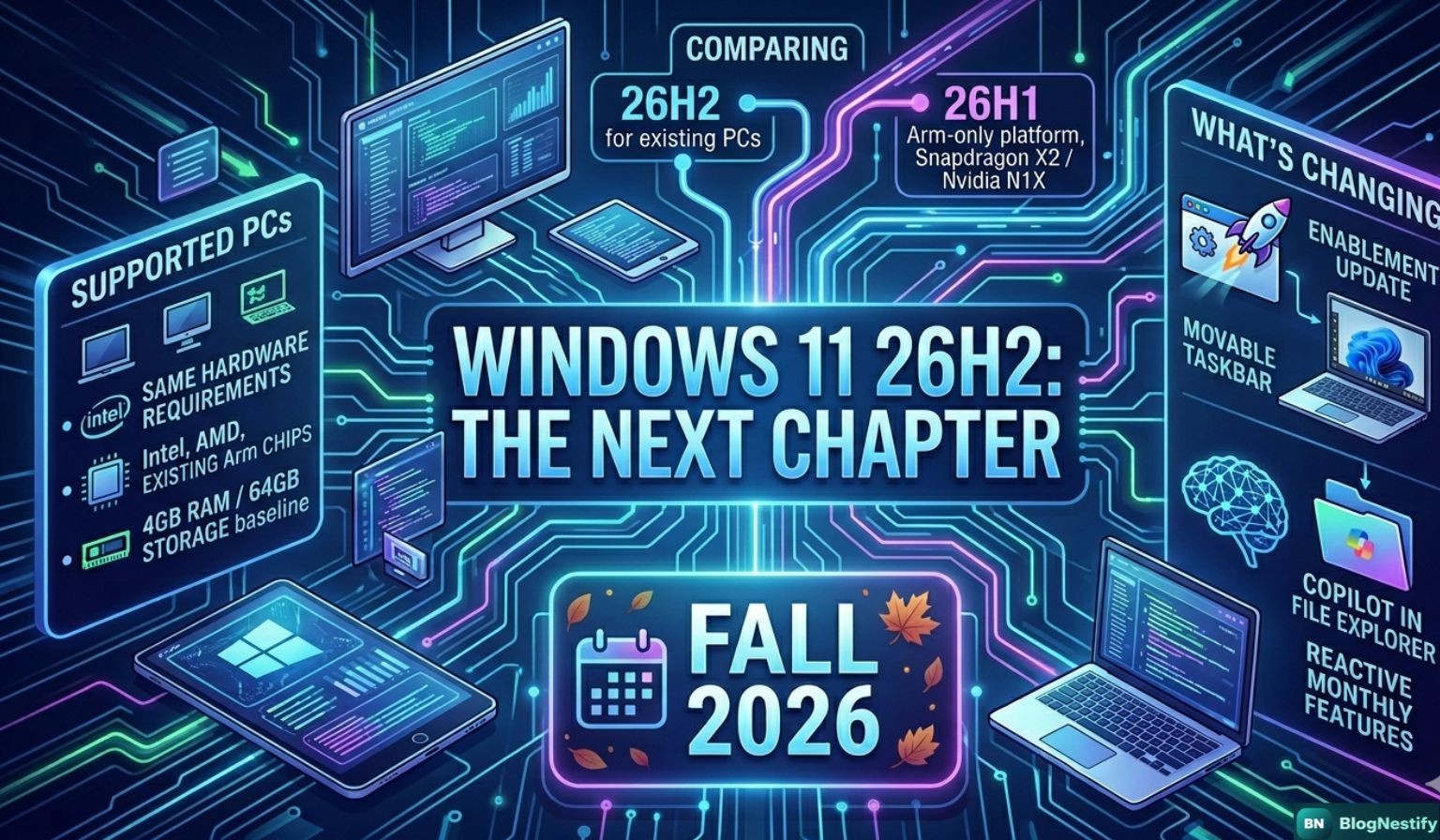
Microsoft has confirmed that Windows 11 26H2 is rolling out in fall 2026, and the short version is: don't expect much to look different. It's another enablement package, not a ground-up feature update, and it'll land on PCs already running 24H2 or 25H2 in roughly two minutes.
When Will Windows 11 26H2 Release?
Microsoft hasn't published a hard date. In its own update, the company said only that "the next annual update for Windows 11 is coming soon" as part of a push toward predictable, low-disruption updates for IT teams. Going by past pattern, that's a fairly safe bet to land in October: Windows 11 25H2 arrived at the end of September 2025, and 24H2 began rolling out on October 1, 2024.
Most outlets tracking Microsoft's release notes expect the rollout window to open in the last week of September or first week of October 2026, with the bulk of eligible PCs receiving it through the following weeks rather than all at once.
Why Windows 11 26H2 Won't Feel Like a Big Update
Windows 11 hasn't shipped a genuinely new platform build since 24H2 in October 2024. Both 25H2 and the upcoming 26H2 are enablement packages — tiny files, often under 500KB, that simply flip a switch already sitting dormant inside your existing Windows installation. There's no new core code to download.
That means if you're already on 24H2 or 25H2, 26H2 will install in about two minutes, ask for a single restart, and leave your desktop looking identical. Microsoft has shifted its actual feature rollout strategy: new capabilities, like the recently added Low Latency Profile and an upcoming movable taskbar, now arrive through regular monthly cumulative updates instead of being bundled into one annual release.
| Version | Released | Type | Consumer support ends |
|---|---|---|---|
| 24H2 | Oct 1, 2024 | Major platform update | Oct 13, 2026 |
| 25H2 | Sept 2025 | Enablement package | Oct 12, 2027 |
| 26H1 | Feb 2026 | New Arm platform (Snapdragon X2 / N1X only) | Mar 14, 2028 |
| 26H2 | Expected fall 2026 | Enablement package | Oct 2028 |
Windows 11 26H2 System Requirements: Which PCs Qualify
If your machine is already on 24H2 or 25H2, it qualifies for 26H2 with zero changes to the hardware bar. The baseline stays exactly what it's been since Windows 11 launched:
- 1GHz or faster processor with 2 or more cores, on a compatible 64-bit CPU
- 4GB of RAM minimum
- 64GB of storage minimum
- UEFI, Secure Boot capable, and TPM 2.0
The one group this doesn't apply to: new Arm-based laptops built around Qualcomm's Snapdragon X2 or Nvidia's N1X silicon. Those ship with the separate 26H1 build instead, and Microsoft has confirmed that 26H1 devices won't be getting 26H2 this year — they're on their own track until both branches merge into version 27H2 sometime in 2027.
26H1 vs 26H2: Don't Mix These Up
Microsoft picked a confusing naming scheme this cycle, so it's worth being precise about what each version actually is:
- Windows 11 26H1 — a targeted release that only ships preinstalled on new Arm devices with Snapdragon X2 or Nvidia N1X chips. It runs on a different underlying platform than 24H2/25H2, so there's no upgrade path to it from an existing PC, and you can't manually install it on Intel or AMD hardware.
- Windows 11 26H2 — the actual annual update for the hundreds of millions of PCs already running 24H2 or 25H2. This is what almost everyone reading this will get.
A laptop on 26H1 this year will not get bumped to 26H2 later — Microsoft has been explicit that the two stay separate until 27H2 arrives in 2027.
How Long Is Windows 11 26H2 Supported?
Support length follows the same split Microsoft has used since 24H2:
- Home, Pro, Pro Education, Pro for Workstations: 24 months — security updates through October 2028
- Enterprise, Education, IoT Enterprise, Enterprise Multi-session: 36 months — through October 2029
Worth flagging if you're still on 24H2: that version's consumer support ends October 13, 2026, which lines up almost exactly with when 26H2 is expected to roll out. If you haven't moved to 25H2 yet, 26H2 will effectively be your next mandatory stop to stay on security updates.
What's Actually New?
Nothing ships exclusively with the 26H2 toggle itself — that's the whole point of an enablement package. But Microsoft has been steadily rolling real changes into Windows 11 through monthly cumulative updates ahead of and around the 26H2 timeframe, including a movable taskbar, Copilot integration inside File Explorer, a redesigned Run dialog, and the option to search your apps directly instead of routing queries through Bing. None of that is gated behind 26H2 specifically — it's already reaching 24H2 and 25H2 machines as Patch Tuesday updates land.
Should You Upgrade as Soon as It Lands?
Honestly, there's not much decision to make here. Because 26H2 is a near-instant enablement flip rather than a full platform swap, the usual "wait a few weeks to dodge early bugs" advice doesn't really apply the way it did for 23H2 or 24H2. The bigger risk profile sits with 24H2's October support cutoff — that's the date worth circling, not the 26H2 launch itself.
IT administrators managing fleets should still treat it like any update: test in Insider builds first, confirm app compatibility, and stage rollout rings, since Microsoft itself is encouraging exactly that ahead of the fall window.
Frequently Asked Questions
When will Windows 11 26H2 release?
Microsoft hasn't named an exact date but confirms fall 2026, with late September to early October 2026 the likeliest window based on past release patterns.
Does Windows 11 26H2 require new hardware?
No. PCs already on 24H2 or 25H2 qualify with no changes: 4GB RAM, 64GB storage, and a 1GHz dual-core 64-bit processor remain the floor.
What's the difference between Windows 11 26H1 and 26H2?
26H1 is a separate Arm-only platform for new Snapdragon X2 and Nvidia N1X devices. 26H2 is the annual update for existing Intel/AMD and current Arm PCs. The two don't merge until version 27H2 in 2027.
How long will Windows 11 26H2 be supported?
24 months for Home/Pro editions (until October 2028), and 36 months for Enterprise/Education editions (until October 2029).
0 Comments
Leave a Comment