8,500 Daily Steps — Not 10,000 — May Be the Sweet Spot to Prevent Weight Regain After Dieting
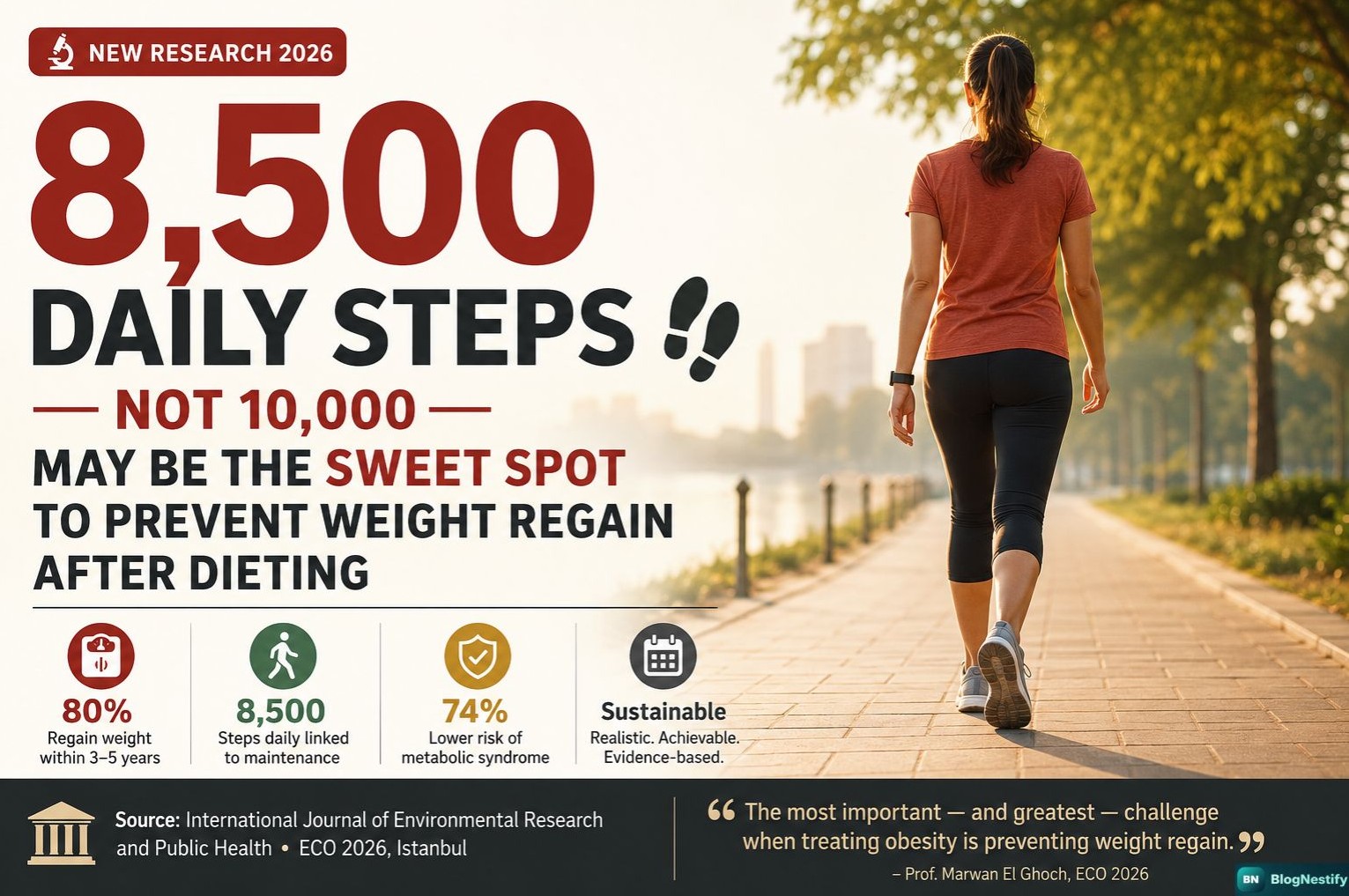
New research says you don't need to hit 10,000 steps. The number that actually keeps weight off after dieting is closer to 8,500 — and there's a good reason the difference matters.
Most of us have been chasing the wrong number. For years, 10,000 steps a day has been the default target — baked into fitness trackers, health apps, and well-meaning advice from doctors. The problem is that 10,000 was never a medical recommendation. It came from a pedometer ad in 1960s Japan. The actual science points to a different figure, and a new study from the European Congress on Obesity is putting a specific one on the table: 8,500 steps.
That might not sound like a dramatic revelation. But for anyone who has lost weight only to watch it creep back — which is most people — this distinction is genuinely useful. The research isn't about losing weight. It's about keeping it off. And for that specific problem, the step count you sustain matters more than most other lifestyle variables.
- Walking ~8,500 steps daily is strongly linked to preventing weight regain after dieting
- This benefit held across both the active weight-loss phase AND the maintenance phase
- Extra steps were not associated with greater weight loss during dieting itself (calories matter more then)
- Around 80% of people who lose weight regain it within 3–5 years — this may help change that
- The study was published in the International Journal of Environmental Research and Public Health
Why 8,500 — Where This Number Comes From
The research behind this figure comes from a team led by Professor Marwan El Ghoch at the University of Modena and Reggio Emilia, Italy. Their analysis, presented at the European Congress on Obesity in Istanbul in May 2026, tracked participants through a structured lifestyle modification program — measuring step counts during both the dieting phase and the follow-up maintenance period.
What they found was a clear pattern: people who built their daily steps up to roughly 8,500 during weight loss, then kept that level up afterward, were significantly better at holding their new weight. The connection held even after accounting for other variables.
"The most important — and greatest — challenge when treating obesity is preventing weight regain."
— Prof. Marwan El Ghoch, University of Modena and Reggio Emilia, ECO 2026What's interesting is what the data did not show. Increased step counts weren't strongly tied to weight loss during the active dieting phase. Calorie restriction drives that. Steps matter most later, during maintenance — which is where most weight-management efforts quietly fall apart.
What the Study Actually Found
The researchers tracked a group of individuals going through a structured obesity management program. Participants wore step-counting devices throughout both phases: the active weight-loss period and the follow-up maintenance window. Statistical analysis then looked for links between step counts and how much (if any) weight people regained.
The link was consistent: sustaining step counts at around 8,500 during maintenance was directly associated with less weight regain. Participants who increased their steps during weight loss and then kept that up were considerably more likely to hold their results.
The researchers are careful not to call it a cure. Weight regain is complicated — sleep, stress, hormones, and eating patterns all play roles. But as a practical, trackable behavior that people can actually control, 8,500 steps stands out as one of the clearest levers available.
The 10,000-Step Goal Was Always Marketing
Here's something worth knowing: the famous 10,000-step target was invented by a Japanese company called Yamasa in 1965 to market a pedometer called the Manpo-kei, which literally translates to "10,000-step meter." It was chosen because the Japanese character for 10,000 looks vaguely like a person walking — not because anyone had studied whether it was the optimal number.
That marketing number got picked up by health organizations globally, embedded into fitness trackers, and eventually became received wisdom. But rigorous science has been quietly undermining it for years. Researchers at the University of Queensland have noted that a target in the 5,000–7,500 range is often more realistic for sedentary adults, and even earlier guidance from the U.S. President's Challenge program had already suggested 8,500 steps as the recommended adult target — not 10,000.
None of that means 10,000 is harmful to aim for. More movement is generally better. But for the specific goal of not regaining weight after a diet, the new research suggests you don't need to reach a number that was never scientifically grounded in the first place.
NEAT: Why Walking Is Different From "Exercise"
Walking 8,500 steps isn't really exercise in the traditional sense. It's what scientists call NEAT — Non-Exercise Activity Thermogenesis. That's a technical way of saying: all the energy you burn doing everything that isn't sleeping, eating, or deliberate sport.
NEAT is one of the most variable components of human energy expenditure. Research published in the Mayo Clinic Proceedings found that NEAT can account for energy differences of up to 2,000 kilocalories per day between individuals — more than most people burn in an entire workout. Agricultural workers versus desk workers. People who fidget versus people who sit still. It adds up over hours and days in ways that a 45-minute gym session simply cannot match.
NEAT decreases during calorie restriction — and that's exactly when staying active matters most.
— Mayo Clinic Proceedings, Nonexercise Activity Thermogenesis in Obesity ManagementHere's where it gets particularly relevant for weight maintenance: NEAT naturally drops when you diet. Your body, sensing reduced fuel, unconsciously reduces fidgeting, standing time, and incidental movement. This is sometimes called "adaptive thermogenesis" and it's part of why weight regain happens even when people haven't changed their eating habits much. Deliberately maintaining your step count counteracts this drift.
Research from PubMed shows that lipoprotein lipase — an enzyme central to fat storage — is more active with sustained low-to-moderate movement than with short bursts of intense exercise. Sustained walking activates your metabolism in a way that a single gym session simply doesn't replicate.
How Different Step Counts Compare
| Daily Steps | Category | Evidence-Based Outcome | Realistic For Most People? |
|---|---|---|---|
| < 5,000 | Sedentary | Higher risk of metabolic syndrome, cardiovascular disease | Too low — needs improvement |
| 5,000 – 7,500 | Low Active | Modest health benefit vs. sedentary; some weight management benefit | Good starting point |
| 8,000 – 9,000 Research Sweet Spot | Active | 74% reduction in metabolic syndrome risk; strongest link to weight maintenance | Yes — achievable without structured exercise |
| 10,000+ | Highly Active | Additional benefit; diminishing returns beyond 12,000 steps for some markers | Harder to sustain long-term |
A Japanese study tracking 5-year incidence of metabolic syndrome found that 8,000 steps per day was associated with a 74% reduction in risk — and benefits diminished beyond 12,000. Every additional 1,000 steps mattered, but the biggest gains came in the 6,000–9,000 range. That puts 8,500 squarely in the zone where effort-to-benefit ratio is strongest.
How to Reach 8,500 Steps Without Obsessing Over It
The honest reality is that most working adults average somewhere between 4,000 and 6,000 steps on a typical desk-job day. Closing that gap to 8,500 takes some intentionality — but not a complete lifestyle overhaul.
- Morning anchor walk (15–20 min): A short walk before work adds 1,500–2,000 steps and sets a positive tone. You don't need to go far.
- Post-meal walks (10 min × 2): Walking after lunch and dinner isn't just good for steps — research shows it helps regulate blood sugar. That's roughly 2,000 more steps.
- Active phone calls: Stand or pace whenever you're on a call. Most people spend 30–60 minutes a day on calls. That's your NEAT opportunity.
- Stairs over lifts: This one's obvious, but the compounding effect over weeks is real. Three flights of stairs twice daily is a few hundred steps you never had to think about.
- Evening wind-down stroll (10–15 min): Keeps you active without disrupting sleep and pushes you comfortably over 8,500 if the rest of your day was average.
- Use a tracker — but don't worship it: The goal is to build habits that produce the steps, not to watch a number all day. Check once in the evening; adjust the next morning.
You don't need a gym. You don't need workout gear. You need consistent, unspectacular movement distributed across your day. That's precisely what the research is tracking — not athletic performance, but sustainable, everyday activity that your body can maintain indefinitely.
Professor El Ghoch's conclusion from the study is worth sitting with: lifestyle modification programs that build step counts to around 8,500 and sustain them through maintenance lead to meaningful long-term results. The key word is "sustain." One-month walking challenges don't move the needle. Daily habits do.
Frequently Asked Questions
The 10,000-step goal came from a 1960s Japanese marketing campaign — not medical research. A 2026 study published in the International Journal of Environmental Research and Public Health found that 8,500 daily steps was the threshold most clearly linked to preventing weight regain after dieting. It's evidence-based, and it's achievable for most people without adding formal exercise to their routine.
Probably not in isolation. The same research found that increased steps were not significantly linked to weight loss during the active dieting phase — calorie intake is the dominant factor there. Where 8,500 steps clearly helps is in the maintenance phase: keeping weight off after you've already lost it. Think of it as your maintenance engine, not your weight-loss driver.
Roughly 255–340 calories, depending on your weight, walking pace, and terrain. A 150-pound person burns approximately 30–40 calories per 1,000 steps. The bigger picture is that consistent walking also boosts NEAT (Non-Exercise Activity Thermogenesis), which can meaningfully increase total daily calorie burn over time — in ways that are hard to measure step-by-step but real in aggregate.
There's no single optimal time — and the NEAT research actually suggests spreading movement across the day is more beneficial than one long walk. Short post-meal walks (10–15 minutes) are particularly useful for blood sugar regulation. Morning walks build momentum. Evening walks wind the day down. What matters most is consistency across the week, not the clock.
At a comfortable walking pace, 8,500 steps takes roughly 70–90 minutes of total movement — but that doesn't mean a 90-minute walk. Spread across the day as incidental activity (trips to the kitchen, standing meetings, parking farther away, evening strolls), most people are already getting 4,000–6,000 steps. Closing the remaining gap takes maybe 25–40 minutes of intentional walking.
About 80%, according to research cited at ECO 2026. Most people who lose weight put some or all of it back within three to five years. This isn't a willpower problem — it's a physiology problem. The body actively works to restore lost weight through hormonal changes, reduced NEAT, and increased appetite. Sustained physical activity (like maintaining 8,500 daily steps) is one of the most effective known countermeasures.
0 Comments
Leave a Comment