Amazon Replaces Rufus with Alexa for Shopping — Here's What Actually Changed
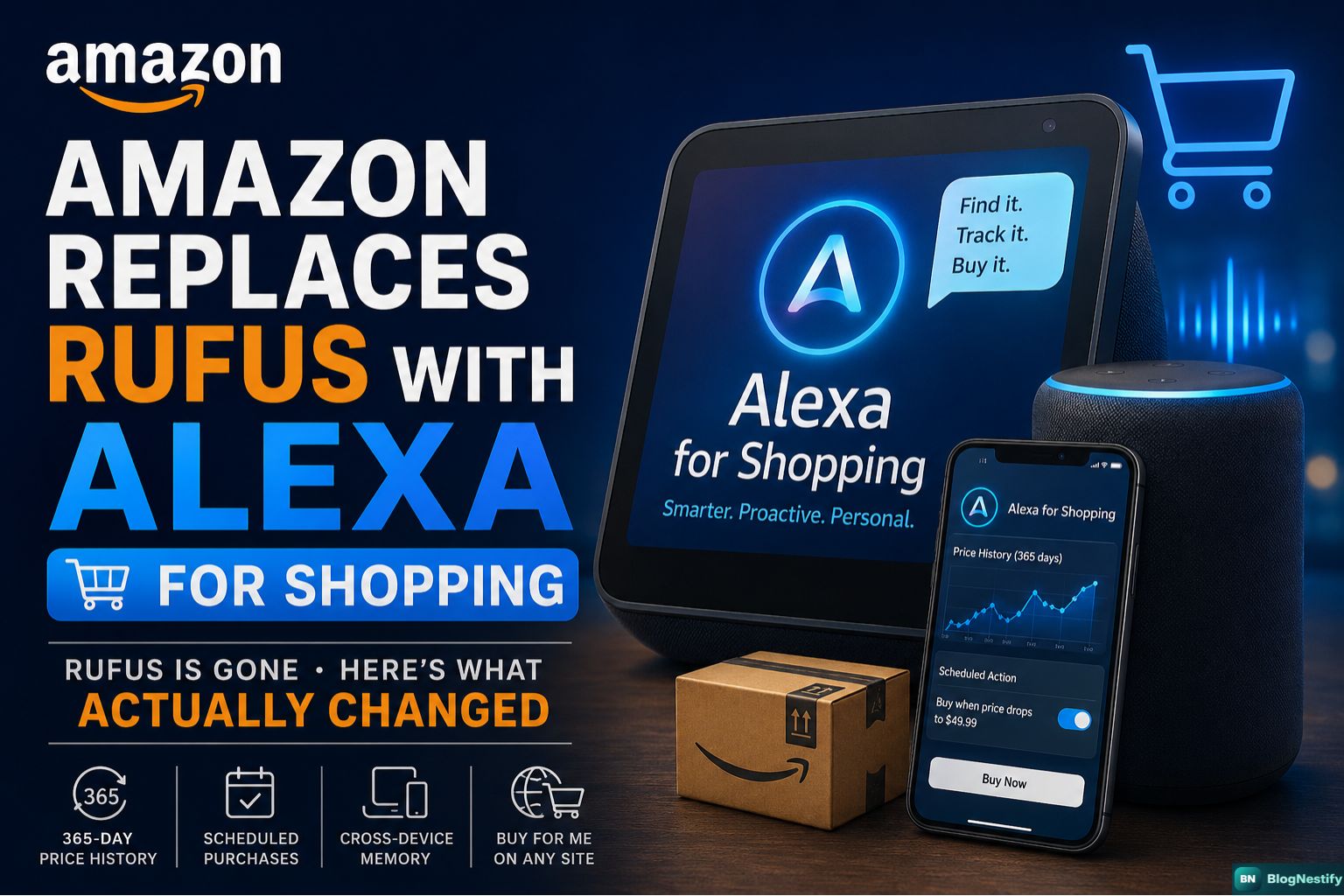
Amazon just retired Rufus — the shopping chatbot it launched two years ago — and replaced it with something considerably more ambitious. Alexa for Shopping does not just answer questions. It tracks prices for a full year, schedules purchases on your behalf, and follows you seamlessly from your Echo speaker to your phone to your laptop.
What Actually Happened with Rufus
On May 13, 2026, Amazon's vice president of Conversational Shopping, Rajiv Mehta, announced the launch of Alexa for Shopping — a unified AI assistant that merges the product expertise of Rufus with the generative AI backbone of Alexa+. The standalone Rufus chatbot is being discontinued.
If you're wondering why Rufus got axed after only two years, the honest answer is that it worked — almost too well. By the end of 2025, more than 300 million customers had used it, and it helped drive nearly $12 billion in incremental sales. Amazon even noted that Rufus users were 60% more likely to complete a purchase. That's not a product getting killed for underperformance. That's a product getting absorbed because two things were doing similar jobs, and running them as separate experiences stopped making sense.
Amazon ran both Rufus (a shopping AI) and Alexa+ (a generative voice assistant) simultaneously. As their capabilities converged, keeping them as two separate products with two separate names created confusion — and missed the opportunity to combine their data streams into a single, smarter experience.
A Quick Timeline
Rufus vs Alexa for Shopping: The Real Differences
Rufus was useful for answering questions — comparing products, summarizing reviews, looking up past orders. But it was essentially a smarter search bar. It answered queries. It did not take actions. Alexa for Shopping is something different.
| Feature | Rufus | Alexa for Shopping |
|---|---|---|
| Product Q&A | ✔ Yes | ✔ Yes (enhanced) |
| Review Summaries | ✔ Yes | ✔ Yes |
| Price History (365 days) | ✘ No | ✔ Yes |
| Automated / Scheduled Purchases | ✘ No | ✔ Yes |
| Side-by-Side Product Comparison in Search | ✘ No | ✔ Yes |
| Cross-Device Context (Echo ↔ App) | ✘ No | ✔ Yes |
| Buy on Third-Party Sites ("Buy for Me") | ✘ No | ✔ Yes |
| Available on Echo Show | ⚡ Limited | ✔ Full store experience |
| Requires Prime Membership | Not required | Not required |
| Questions in Main Search Bar | ✘ No | ✔ Yes |
6 New Features That Change How You Shop
These are the additions that actually matter — the things Rufus never could do.
Look for the cursive "A" icon on Amazon's website or app. The feature is live for all U.S. Amazon account holders. If you don't see it yet, try restarting the app or your browser session — Amazon said the rollout completes within a week of launch.
Why Amazon Made This Move Now
The timing is not accidental. OpenAI launched Instant Checkout on ChatGPT late last year, followed quickly by Walmart integrating that same system into its own AI-first shopping flow. Google and Perplexity have both rolled out product research tools with buy links. The race to own the first step of the shopping journey — the question before the purchase — is genuinely competitive right now.
Amazon's bet is that it has something nobody else does: a closed loop. Your purchase history, your voice searches on Echo, your wish lists, your reorder patterns — all of it feeds into one assistant that gets more useful the more you use it. That cross-surface data advantage is hard for a ChatGPT plugin to replicate.
"Amazon wants shopping conversations to follow customers from device to device, cutting down on repeated searches and questions across platforms."
— Rajiv Mehta, VP of Conversational Shopping, AmazonThe consolidation also makes internal sense. Running two separate AI products with overlapping capabilities — Rufus in the app, Alexa on devices — meant split engineering teams, split data pipelines, and a confusing customer experience. Merging them into one surface is actually the more disciplined move, even if it felt sudden.
What This Means for Amazon Sellers
If you sell on Amazon, the shift from keyword-based discovery to recommendation-layer discovery is the single most important thing to understand here. Research from Workflow Labs in April 2026 found that the recommendation layer — not the keyword layer — is already the primary filter between a product and a customer in a growing share of sessions.
Alexa for Shopping expands where that recommendation filter applies: from the app, to the main search bar, to Echo Show, to the website. A customer can mention a brand to their Echo speaker and see it appear in a shopping recommendation in the app days later. That kind of cross-surface personalization was theoretically possible before, but it was split across two disconnected products.
Strong review velocity, accurate product data, and complete A+ Content matter more now — not less. The AI recommendation engine surfaces products it can confidently match to a shopper's history and intent. Thin listings with weak data get filtered out earlier in the funnel.
Privacy Concerns Worth Knowing
There is a reasonable concern embedded in all of this. An assistant that remembers your conversations across every Amazon device, tracks what you browse, monitors what you buy, and can execute purchases on your behalf — with or without you clicking "confirm" — is a significant amount of autonomy to hand to a corporate AI system.
Amazon confirmed that users retain control over privacy settings and voice recordings through the Alexa Privacy Dashboard. The company says it provides transparency around how data is stored and managed. The "Buy for Me" feature — which can complete purchases on external retailers — raises the most open-ended questions, since Amazon has not publicly detailed what limits exist on autonomous action.
The short version: read the privacy settings before you enable Scheduled Actions, especially if the idea of an AI placing orders in the background gives you pause. The feature is opt-in, and the controls exist. Using them is on you.
Frequently Asked Questions
Amazon replaced Rufus with Alexa for Shopping in May 2026. The new assistant combines Rufus's product knowledge and shopping history with the conversational and agentic capabilities of Alexa+, making it far more proactive and personalized.
Yes. Alexa for Shopping is free for any user signed into an Amazon account. No Prime membership is required to access the core features, including price history and product comparisons.
The key new capabilities include Scheduled Actions (automated, condition-based purchases), 365-day price history on product pages, side-by-side product comparisons inside search results, cross-device context between Echo and the app, and Buy for Me — which can complete purchases on external websites.
Yes. It works on Amazon's website, the Shopping app, and Echo Show devices. Conversations started on Echo carry over to the app — so you do not have to repeat your research when you switch devices.
Yes, through Scheduled Actions. You can set up conditional automations — for example, "add this to my cart if the price drops to $10 and I haven't bought it in the last two months." The assistant monitors and executes the action when your conditions are met.
Amazon discontinued the standalone Rufus chatbot in May 2026. However, Rufus's underlying recommendation features and shopping history data were absorbed into Alexa for Shopping, so that intelligence still powers the new experience.
The Bottom Line
Rufus was a good chatbot. Alexa for Shopping is something with more ambition behind it — an AI that does not wait for you to ask a question, but acts on conditions you've set, remembers what you care about, and follows you from device to device without losing context.
Whether that level of convenience is worth the data trade-off is a personal call. But for anyone who has ever set a price alert in a browser extension, or manually added something to a wishlist to remember it later, the core pitch is straightforward: this assistant tries to handle that friction for you.
What Amazon is actually building — slowly, piece by piece — is a commerce layer that sits on top of your entire digital life. Alexa for Shopping is the clearest version of that idea yet.
Stay ahead of every AI & tech shift
More breakdowns like this, every week — at blognestify.net
0 Comments
Leave a Comment