Anthropic's AI Now Writes 90% of Its Code — And Hiring Is Still Going Up
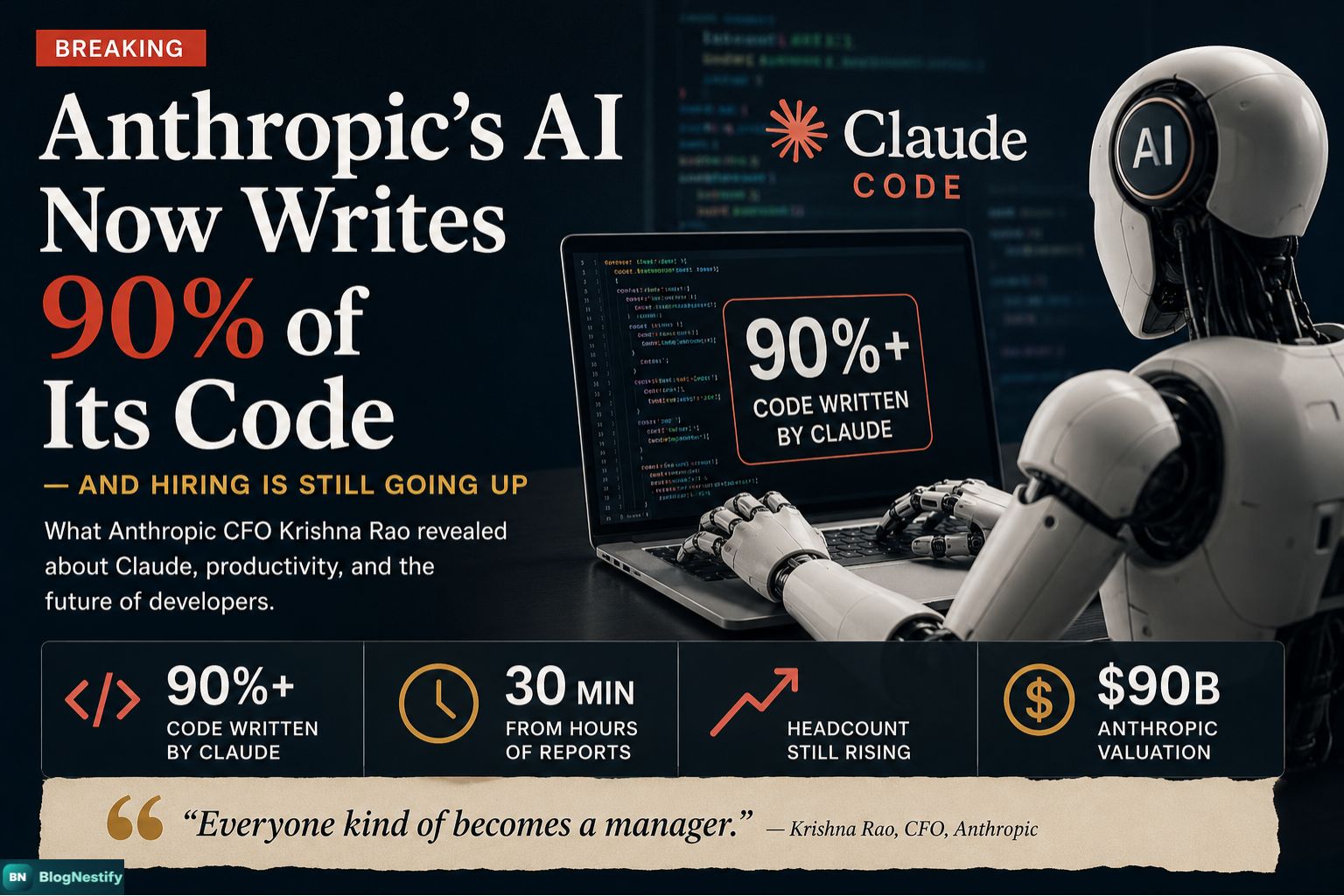
Anthropic CFO Krishna Rao just told the world that Claude handles over 90% of the company's internal code. The part people aren't talking about? Headcount is growing, not shrinking.
There's a statement Anthropic's CFO made on a podcast this week that's been ricocheting around tech circles, and depending on who you ask, it either confirms every fear about AI or completely flips those fears on their head.
Krishna Rao appeared on Patrick O'Shaughnessy's Invest Like the Best podcast and said, plainly, that more than 90% of Anthropic's code is now produced by Claude Code — the company's own AI coding assistant. Not 10%. Not half. Over ninety percent.
The instinctive reaction is to think: so developers are done. But that's not quite what's happening at Anthropic — and the gap between instinct and reality here is worth sitting with for a moment.
"90 plus percent of our code is actually written by Claude Code."— Krishna Rao, CFO, Anthropic (Invest Like the Best podcast, May 2026)
What Rao Actually Said
The podcast covered a lot of ground — compute infrastructure, Anthropic's upcoming IPO plans, the company's $90 billion valuation — but the code figure is what landed hardest. Rao described a workplace where AI handles the execution layer of knowledge work: writing software, generating financial statements, producing internal reports that once required entire afternoons to assemble.
The finance team is running a similar experiment. Anthropic uses Claude to draft financial statements. By the time a human actually opens the monthly review document, it's already 90 to 95% complete. Tasks that used to eat three or four hours now wrap up in about 30 minutes.
That's a real shift. Not hypothetical. Not projected. Happening now, inside one of the most closely watched AI companies on earth.
Rao's statements come from a verified primary source — a public podcast appearance — and align with what Anthropic has disclosed in other contexts. This is not an anonymous claim or leaked memo. The CFO of a $90B company said it on the record.
The Hiring Paradox
Here's the part that gets lost in the headline. Rao said Anthropic has hired more people because of these productivity gains — not fewer. His framing: AI acts as a productivity accelerant, and when everyone on the team can do more, there's no shortage of new work to fill that capacity.
"That actually means that we can get a lot more done," he said, "and that even as we grow the team, those people are more productive as they come up the curve on how to use Claude within our company."
He also made a comment that's stuck with me: "Everyone kind of becomes a manager." The idea being that when AI handles execution, the human job is oversight, judgment, and interpreting outputs — work that looks less like coding and more like having good taste and strong strategic instincts.
That's a real shift in what it means to be a developer. It's not obviously worse. But it is different, and the transition isn't frictionless for everyone.
How Anthropic Compares to the Rest of the Industry
Anthropic's 90%+ figure is the loudest number right now, but it's not alone. Tech companies have been quietly (and sometimes loudly) disclosing how much of their internal work AI now handles. Here's where things stand as of mid-2026:
| Company | AI-Written Code | Source |
|---|---|---|
| Anthropic | 90%+ | CFO Krishna Rao, Invest Like the Best, May 2026 |
| ~75% | Internal disclosure, May 2026 (up from 25% in Oct 2024) | |
| Airbnb | ~60% | CEO Brian Chesky |
| Shopify | 50%+ | President Harley Finkelstein |
| Microsoft | 20–30% | CEO Satya Nadella |
The trajectory is pretty clear. What was a 25% figure at Google less than two years ago is now 75%. If these numbers keep compressing upward at this rate, the 90% bar Anthropic is at today might be where most frontier tech companies sit by 2027 or 2028.
What the Critics Are Saying
It would be easy to just run with the optimistic framing — AI makes everyone more productive, companies hire more, everyone wins. But there's a harder version of this story worth taking seriously.
A nonprofit research group called METR ran a randomized controlled trial on AI's effect on experienced developers in 2025 and found that developers using AI tools were actually 19% slower on their tasks — while simultaneously believing they had sped up by 20%. The gap between perceived and actual productivity gain was 39 percentage points. That's a significant measurement problem that makes it hard to know what's real.
Meanwhile, Anthropic CEO Dario Amodei has himself warned that AI could eliminate half of all entry-level white-collar jobs within one to five years. Microsoft has let go 15,000 workers. About 55,000 job cuts in 2025 were attributed, at least in part, to AI-related automation, according to employment consultancy Challenger, Gray & Christmas.
"I think of it as accentuating and accelerating the talent that we already have. Talent density beats talent mass."— Krishna Rao, CFO, Anthropic
There's a tension here that doesn't resolve neatly. Anthropic is hiring more people while its CEO warns about mass displacement. That's not necessarily contradictory — frontier AI labs occupy a different position than the average company deploying AI tools — but it means the experience of a developer at Anthropic and a developer at a mid-sized enterprise are probably very different right now.
What Shifts When AI Writes the Code
Whether or not the broader job market narrative is optimistic, something concrete has changed about what the job of software development looks like day-to-day.
The lower half of the work — boilerplate code, routine bug fixes, repetitive modules, first-draft financial reports — is increasingly AI territory. Industry data suggests routine coding tasks have already declined by around 40% at companies aggressively adopting AI tools. The average employee using AI saves roughly 2.5 hours per day on routine work, though actual productivity gains at the team level vary widely.
What stays with humans, at least for now: architecture decisions, code review, judgment calls when something the AI produces looks right but isn't, and any task where context and institutional knowledge are irreplaceable. Anthropic's framing of "everyone becomes a manager" captures something real about that shift — though "manager" undersells the technical depth still required to catch what AI gets wrong.
See: Anthropic's 90% AI code figure surfaces a shift people can observe now, not in some distant future. Think: The real question is whether this model (AI executes, humans supervise) scales beyond frontier labs. Do: Developers should start building skills around AI output review, prompt architecture, and system-level thinking. Care: The companies that thrive will be ones where humans and AI complement each other — not where one fully replaces the other.
The Compute Angle Rao Didn't Oversell
One other thing from the podcast worth noting: Rao called compute resources the "lifeblood" of Anthropic's business. He said, "It is the canvas on which everything else gets built." That's not just a metaphor — Anthropic has signed infrastructure deals with Google and Broadcom for TPU deployments beginning in 2027, alongside a separate agreement with Amazon for Trainium.
The reason that matters here is simple: the more compute Anthropic can access, the more capable Claude becomes, and the higher that code-generation percentage is likely to climb. The 90% figure is probably not the ceiling. It's closer to a waypoint.
What This Means if You're a Developer Right Now
Honestly? The picture is genuinely mixed, and anyone who tells you it's obviously fine or obviously catastrophic is oversimplifying. Some entry-level coding work is disappearing or at least getting much harder to land. UC system undergraduate CS enrollment dropped 6% in 2025 — the first decline since the dot-com bust — which suggests the anxiety is registering even before people enter the job market.
At the same time, experienced engineers who can work with and alongside AI systems are increasingly valuable. The people best positioned are those who treat AI-generated code the way a good editor treats a rough draft: not something to be printed, but something to be interrogated. That skill — knowing when to trust the output, when to push back, and when to throw it out entirely — is genuinely hard and genuinely human.
Rao's point about talent density is probably right in the narrow context he was describing. Whether it applies across the whole labor market is a much harder question, and one that won't be answered by what's happening inside a single AI company using its own product.
0 Comments
Leave a Comment