Anthropic Releases Claude Opus 4.8 With New 'Dynamic Workflow' Tool — What Developers Need to Know
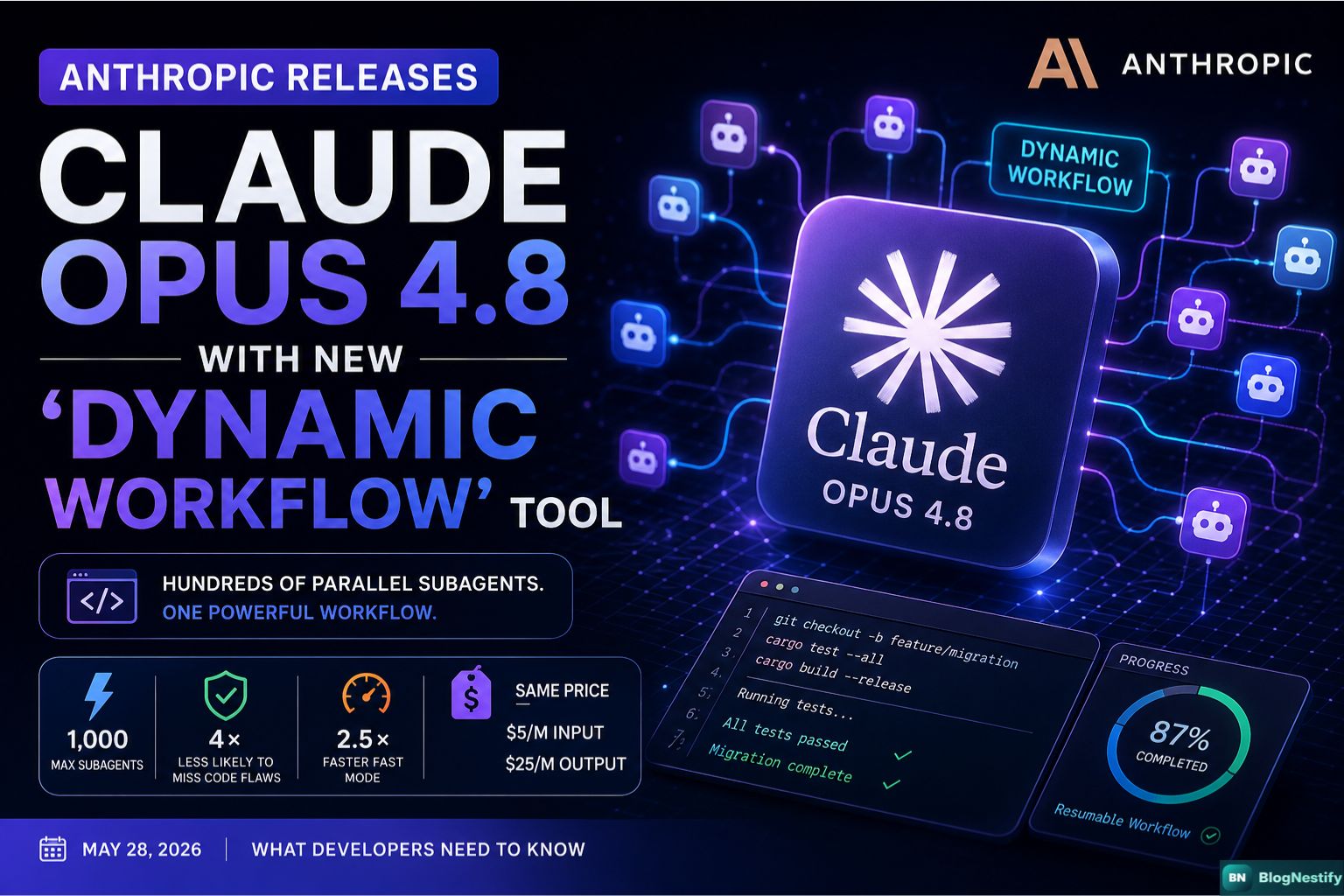
On May 28, 2026, Anthropic shipped Claude Opus 4.8 just 41 days after Opus 4.7. The headline isn't speed — it's what comes with it: a research-preview feature called Dynamic Workflows that turns Claude Code into a full multi-agent orchestration platform, and a behavioral overhaul that makes the model four times less likely to let coding flaws slip through unannounced.
Why This Release Arrived So Fast
Anthropic's typical release rhythm is measured. The Sonnet model is about three months old; Haiku is closer to seven. Forty-one days between flagship models isn't a cadence — it's a response.
A lukewarm reception to Opus 4.7 played a clear role. Some developers on forums reported reverting to Opus 4.6, saying they couldn't feel meaningful improvement in day-to-day tasks. That kind of feedback, combined with OpenAI shipping GPT-5.5 improvements and Google releasing updates to Gemini Flash in the same stretch, pushed Anthropic to move faster than it normally would.
The competitive math is simple: coding tools are where enterprises are making buying decisions right now. Whoever wins the "trust your model with my codebase" question wins significant contract value. Anthropic clearly decided it couldn't wait another month.
What Dynamic Workflows Actually Does
This is the part that matters most for developers building production pipelines. Before Opus 4.8, running multi-agent agentic systems required external scaffolding — frameworks like LangChain, custom orchestrators, or hand-rolled retry logic. That meant latency overhead, inflated token costs from redundant context re-processing, and maintenance burden.
Dynamic Workflows moves the orchestration layer inside the model itself. Here's what that looks like in practice:
- Planning: Claude evaluates the incoming task and maps an execution plan — which subtasks exist, what dependencies they have, which can run in parallel.
- Subagent spawning: Up to 1,000 parallel subagents are spun up to handle different parts simultaneously. A large codebase migration, for example, can fan out across modules instead of processing them sequentially.
- Resumable progress: Interrupted workflows don't start over. Runs save progress, so a session cutoff or timeout doesn't throw away completed work.
- Self-verification: Before returning results, the model checks its own outputs. Anthropic put a concrete benchmark on this: Opus 4.8 uncritically reports flawed results 0% of the time — the first Claude model to hit that mark.
- Delivery: Finished, verified results come back as a single coherent output, not a patchwork of agent responses the developer has to stitch together.
Anthropic's own benchmark for the feature: Claude Code with Opus 4.8 can carry out codebase-scale migrations across hundreds of thousands of lines of code — from kickoff to merge — using the existing test suite as its quality bar. The company tested this on a ~750,000-line Rust codebase.
Everything Else That Shipped on May 28
Dynamic Workflows got the headline, but three other changes arrived at the same time.
Cheaper Fast Mode
Fast mode now runs at 2.5× the speed of the standard model. It still bills at double the base rate ($10/M input, $50/M output) but is three times cheaper than fast mode was on previous model generations.
Effort Controls
Users on claude.ai and Cowork can now set how much effort Claude puts into a response. High effort means longer thinking and better output. Lower effort means faster, cheaper responses that burn through rate limits more slowly.
Prosocial Alignment Gains
Anthropic's Alignment team reports that Opus 4.8 reaches new highs on measures of supporting user autonomy and acting in the user's best interest. Rates of deceptive behavior are close to those of the still-restricted Claude Mythos Preview.
Same Base Pricing
$5 per million input tokens and $25 per million output tokens — identical to Opus 4.7. Anthropic is explicitly positioning this as a same-cost upgrade, not a tier bump.
How Opus 4.8 Stacks Up Against the Competition
Benchmarks aren't everything, but they're what enterprise procurement teams put in spreadsheets. Here's where Opus 4.8 landed on the evaluations Anthropic reported at launch.
| Benchmark | Opus 4.8 | Opus 4.7 | GPT-5.5 | Gemini 3.1 Pro |
|---|---|---|---|---|
| SWE-bench Pro | 69.2% | 64.3% | — | — |
| SWE-bench Verified | 88.6% | 87.6% | — | — |
| USAMO 2026 Math | 96.7% | 69.3% | — | — |
| GraphWalks 1M Ctx (F1) | 68.1% | 40.3% | — | — |
| GPQA Diamond | 93.6% | 94.2% | — | — |
| Agentic Terminal Coding | High | — | Best | — |
| Overall Multi-Benchmark | Leads | — | Trails | Trails |
A few honest caveats here. Anthropic changed its benchmark comparison set for this release, dropping GPQA Diamond and SWE-bench Verified from its head-to-head table. The GPQA regression is worth noting — Opus 4.8 scores 93.6% vs 94.2% for Opus 4.7, a small but real decline on a near-saturated benchmark. And OpenAI still leads on agentic terminal coding tasks specifically.
The Bigger Picture: Why This Matters for the AI Industry
The Dynamic Workflow feature isn't just a product update. It's a strategic move that reshapes where value lives in the generative AI stack.
Until now, the "orchestration layer" was something developers built on top of foundation models — using external tools, custom wrappers, and frameworks like LangChain. That ecosystem had its own vendors, its own pricing, and its own complexity. By internalizing orchestration natively into the model architecture, Anthropic is making a bid to own that layer too.
The consequence, as analysts at StartupFox noted, is significant: if this becomes the new market standard, competitors will have to bake orchestration natively into their own models. That accelerates commoditization of raw intelligence and shifts the competitive battleground entirely to system-level cost efficiency and workflow integration.
- For enterprises: Less external tooling means fewer failure points, lower infrastructure complexity, and reduced engineering overhead to deploy reliable AI agents.
- For mid-tier orchestration vendors: Products that sit between foundation models and enterprise applications face real margin pressure if the model does the orchestration itself.
- For developers: The barrier to building multi-agent pipelines drops substantially. You don't need to architect an orchestration layer — you describe the task and the model plans the execution.
- For OpenAI and Google: Both now have a defined capability gap to close. Codex and Gemini have their own agentic tooling, but native in-model orchestration at this scale is new territory.
Bridgewater Associates, one of Anthropic's early testers, framed the most commercially relevant change cleanly: the improvement they noticed was the model's proactive identification of input and output issues that competitors typically overlook. That's reliability, not raw capability. And reliability is what enterprise IT budgets are built around.
Availability, Pricing, and How to Access Opus 4.8
The rollout is immediate and broad. Here's the access picture at launch.
- Plans: Available on Max, Team, and Enterprise plans via claude.ai, as well as the Anthropic API directly.
- Cloud platforms: Supported on Amazon Bedrock and Google Vertex AI from day one.
- Dynamic Workflows: Research preview on Enterprise, Team, and Max — not available on free or Pro-only plans at launch.
- Effort controls: Available to all users on claude.ai and Cowork.
- Default effort setting: Set to "high" out of the box, positioning the model for production-grade tasks from the start.
- Fast mode: Available at $10/M input and $50/M output tokens, running at 2.5× standard speed.
Key Takeaways
- Claude Opus 4.8 shipped 41 days after Opus 4.7, driven by competitive pressure and user feedback.
- Dynamic Workflows is the headline feature: native in-model orchestration of up to 1,000 parallel subagents in Claude Code.
- The model is 4× less likely than Opus 4.7 to let code flaws pass unremarked — the most commercially relevant behavioral change.
- Pricing is unchanged at $5/M input and $25/M output. Fast mode is now 3× cheaper than it was on previous generations.
- Prompt-injection robustness is slightly weaker than Opus 4.7 in agentic settings — review sandboxing before production deployment.
- Mythos, Anthropic's most advanced model, is still in restricted preview but expected broadly in coming weeks.
0 Comments
Leave a Comment