Category: Cybersecurity | Published: April 24, 2026 | Read time: 7 min
Apple Patches iOS Flaw That Let the FBI Recover Deleted Signal Messages
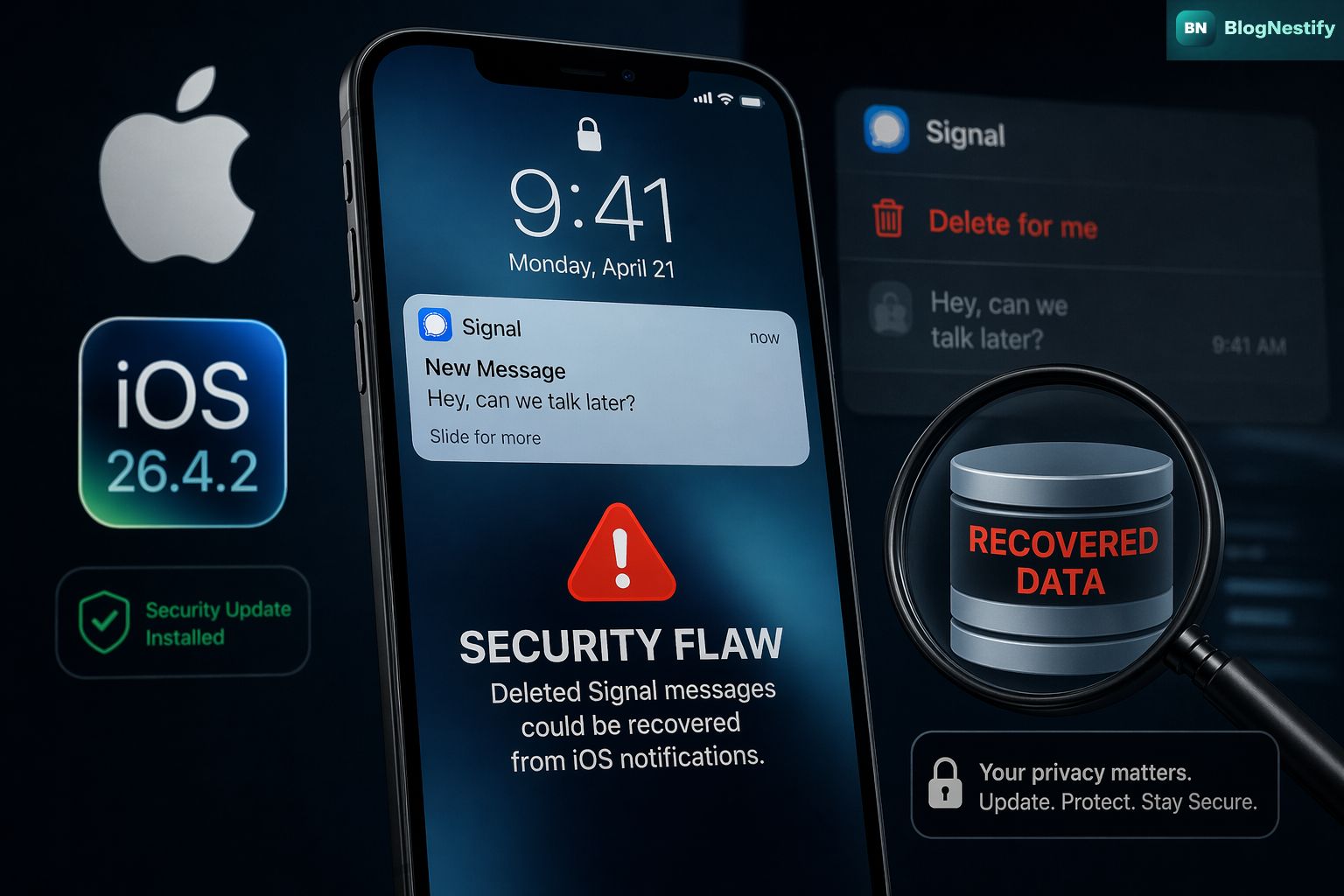
A silent notification logging bug — CVE-2026-28950 — allowed forensic tools to extract message previews from iPhones long after users believed they had permanently deleted them.
⚠ Action Required: Go to Settings → General → Software Update and install iOS 26.4.2 immediately to protect your device.
Apple has released an emergency security update for iOS and iPadOS addressing a previously unknown vulnerability that allowed deleted notification data — including previews of encrypted Signal messages — to remain silently stored on iPhones. The flaw, tracked as CVE-2026-28950, was already being exploited in at least one active law enforcement investigation before the patch was issued.
The discovery is forcing a critical re-examination of what “deleting” data on a smartphone actually means in practice — and raising uncomfortable questions about the invisible gap between an app’s security guarantees and the operating system underneath it.
1. What Happened: The FBI Case That Exposed the Flaw
The vulnerability came to widespread public attention following reports that the Federal Bureau of Investigation successfully recovered message data from a suspect’s iPhone during an investigation into an attack on the Prairieland ICE detention facility. The suspect had deleted Signal — one of the world’s most privacy-focused messaging apps — yet investigators were still able to extract fragments of incoming messages.
Key Finding: Forensic tools retrieved message content from the iPhone’s push notification database, where copies of message previews had been silently stored by iOS — even after Signal was fully uninstalled from the device.
The revelation struck at the heart of a long-held assumption: that deleting an app erases all associated data. In this case, the operating system had been quietly preserving notification previews in a separate database entirely outside Signal’s control — a database the app had no way to wipe upon deletion.
Apple acknowledged in its security advisory that notifications marked for deletion could be “unexpectedly retained on the device,” though the company stopped short of disclosing how long the flaw had existed, how many devices were affected before the patch, or whether it had been exploited in any other investigations.
2. CVE-2026-28950: Technical Details
| CVE ID | CVE-2026-28950 |
|---|---|
| Component | Apple Notification Services Framework |
| Type | Logging Issue / Improper Data Redaction |
| Impact | Notification data persists on device after deletion |
| Affected Devices | iPhone XR through iPhone 16 lineup; multiple iPad models |
| Fixed In | iOS 26.4.2 · iPadOS 26.4.2 · iOS 18.7.8 |
| CVSS Score | Not published (under assessment) |
| Exploited in the Wild | Yes — confirmed in law enforcement context |
Apple described the underlying issue as a “logging flaw” resolved through improved data redaction. The Notification Services framework was not correctly honoring deletion requests. When a user deleted an app or cleared its notifications, residual previews and metadata were retained in the device’s local push notification database.
Critically, no CVSS severity score has yet been published for CVE-2026-28950. While the technical mechanism may appear relatively contained, its real-world impact — enabling the recovery of encrypted communications after users had taken deliberate steps to remove them — places it firmly in the high-impact category from a privacy standpoint.
“For most app notifications, there’s no simple way to determine what metadata might be exposed, or whether that data is encrypted. Users should also reconsider whether certain apps need to send notifications at all.”
— Electronic Frontier Foundation (EFF)
3. Affected Devices & iOS Versions
The patch has been distributed broadly, covering a wide range of Apple hardware. If you own any of the devices listed below and have not yet updated, your notification data may still be at risk of forensic extraction with physical access to the device.
| Device | Affected iOS | Patched In | Status |
|---|---|---|---|
| iPhone XR, XS, XS Max | All versions before patch | iOS 18.7.8 | Patched |
| iPhone 11 / 12 / 13 Series | All versions before patch | iOS 18.7.8 / 26.4.2 | Patched |
| iPhone 14 Series | All versions before patch | iOS 26.4.2 | Patched |
| iPhone 15 Series | All versions before patch | iOS 26.4.2 | Patched |
| iPhone 16 Lineup | All versions before patch | iOS 26.4.2 | Patched |
| iPad (multiple models) | All versions before patch | iPadOS 26.4.2 | Patched |
4. End-to-End Encryption vs. System-Level Exposure
This incident crystallizes a fundamental — and often misunderstood — limitation of app-level encryption. Signal’s protocol ensures that only the sender and recipient can read messages within the app itself. The cryptographic guarantees are strong, peer-reviewed, and industry-leading. But they stop at the app boundary.
When a message arrives and iOS generates a notification, a preview of that message content must be briefly decrypted and passed to the operating system to display on screen. At that moment, the content leaves Signal’s encrypted environment and enters Apple’s Notification Services framework — territory the app developer cannot directly control or audit.
The Security Gap: End-to-end encryption protects messages in transit and at rest within the app. It does not protect notification previews that are processed by the operating system — a surface that, in this case, was retaining data longer than intended.
The EFF has long flagged this distinction, noting that users typically have little visibility into how notification data is processed, cached, or logged at the OS level. The Signal/iOS incident makes that abstract concern concrete: even a world-class security tool cannot fully compensate for a vulnerability in the platform it runs on.
5. How Signal and Apple Have Responded
Both companies have moved swiftly since the flaw became public. Apple’s rapid deployment of iOS 26.4.2 across all supported devices — including legacy hardware as far back as the iPhone XR — signals the company’s recognition of the severity of the privacy implications, even if its public communications have been characteristically measured.
Signal, for its part, emphasized that no action beyond installing the software update is required from users. In a statement, the company confirmed that once the patch is applied, all inadvertently preserved notifications will be permanently deleted from the device, and that future notifications for uninstalled apps will no longer be retained by iOS.
“It takes an ecosystem to preserve the fundamental human right to private communication.”
— Signal Foundation
Signal also praised Apple’s handling of the disclosure, describing the patch as a necessary step in safeguarding private communications. Security researchers have broadly agreed, though many note that the lack of transparency around how long the flaw existed — and how many investigations may have used it — remains an open and troubling question.
6. How to Protect Your Privacy Right Now
While the vulnerability is now patched, the episode offers a broader set of lessons for anyone relying on encrypted messaging apps for sensitive communications. Here are the most effective steps you can take today:
-
Install iOS 26.4.2 Immediately
Go to Settings → General → Software Update. This is the single most important action. The update will delete all previously retained notification data and prevent future retention. -
Disable Message Previews in Signal Notifications
Open Signal → Settings → Notifications → Show → select “No Name or Message.” This prevents future message content from ever reaching the OS notification layer. -
Restrict Lock Screen Notification Access
Go to Settings → Face ID & Passcode and disable notification preview on the lock screen. A locked screen should show as little information as possible. -
Reconsider Which Apps Can Send Notifications
As the EFF notes, the safest notification is one that was never sent. For highly sensitive communications, consider disabling notifications entirely and opening the app manually. -
Audit Installed Apps Regularly
Physical access is still the key risk vector. The less data stored on-device by unused or forgotten apps, the smaller the forensic footprint.
7. Frequently Asked Questions
What exactly is CVE-2026-28950?
CVE-2026-28950 is a vulnerability in Apple’s iOS Notification Services framework where deleted notification data — including message previews from encrypted apps like Signal — could persist on the device’s local push notification database. The data remained accessible to forensic analysis tools even after users deleted the app.
Which iOS version fixes the Signal notification bug?
The flaw is fully patched in iOS 26.4.2 and iPadOS 26.4.2. Apple also backported the fix to older devices through iOS 18.7.8. Update via Settings → General → Software Update.
Can law enforcement still recover deleted Signal messages after the patch?
After installing iOS 26.4.2, Apple states that all inadvertently preserved notifications will be permanently deleted. Future notifications for uninstalled apps will no longer be retained. The specific avenue exploited in this incident will be closed.
Does this mean Signal’s encryption was broken?
No. Signal’s end-to-end encryption protocol remains intact and was not compromised. The vulnerability existed at the iOS operating system level — specifically in how Apple’s Notification Services handled and stored notification previews. This is an OS-layer issue, not a flaw in Signal’s cryptography.
How long had the flaw existed before it was patched?
Apple has not publicly disclosed when CVE-2026-28950 was introduced. Security researchers describe this lack of transparency as a significant gap, as it makes it impossible for users or organizations to assess the full scope of potential exposure over time.
8. Broader Implications for Digital Privacy
The CVE-2026-28950 episode is a case study in what security researchers call the “ecosystem problem” of digital privacy: a message can be perfectly encrypted from sender to recipient, and yet still leak through the platform that delivers it.
Physical access to a device remains the single most significant risk factor in mobile security. Advanced forensic tools used by law enforcement and intelligence agencies are sophisticated enough to recover residual data from locations most users don’t know exist — notification databases, system logs, cached previews, and temporary files. Even if Signal had been correctly purging all its own data, iOS was independently maintaining a copy.
For developers, the lesson is that privacy guarantees must be communicated honestly and humbly. No app can fully protect users from vulnerabilities in the OS beneath it. For policymakers and advocates, it raises deeper questions: how transparent should platform companies be about forensic capabilities built into their operating systems, even inadvertently?
Apple’s swift response deserves credit. But the company’s silence on the flaw’s origin, duration, and known exploitation history leaves a significant accountability gap — one that will likely face continued scrutiny from privacy researchers, civil liberties organizations, and the legislative bodies increasingly focused on digital rights.
For users, the fundamental takeaway is simple but significant: true digital privacy is not a single product feature — it is the combined result of every layer of the technology stack working correctly, all at once. In that ecosystem, every silent bug is a potential window.
0 Comments
Leave a Comment