Apple Just Posted a Record Q2 — $111.2 Billion Revenue, 17% Growth, and Analysts Undershoot by $1.7B
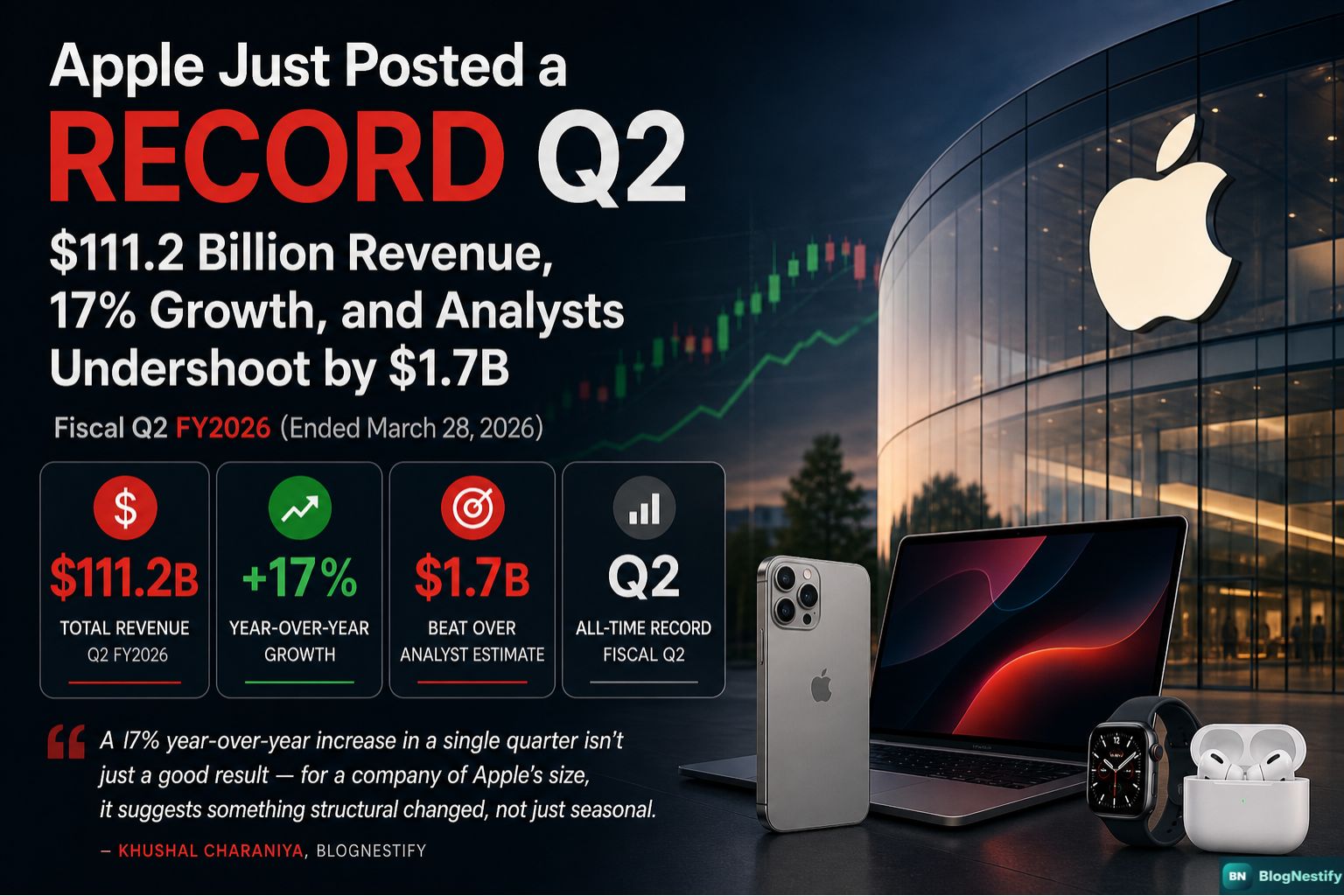
Apple's fiscal 2026 second quarter ended March 28, and the numbers are hard to argue with. Here's what actually happened — and why Wall Street got the estimate wrong.
Apple doesn't usually break records in its second fiscal quarter. The holiday season pushes Q1 revenue to stratospheric levels — it's always been the monster quarter. Q2 is traditionally quieter, the hangover period. So when the company reports $111.2 billion for a March quarter, that's worth paying attention to.
The street had penciled in roughly $109.5 billion. Apple came in $1.7 billion ahead of that. More importantly, the company exceeded its own internal guidance. That combination — beating both external and internal expectations — doesn't happen every quarter.
"A 17% year-over-year increase in a single quarter isn't just a good result — for a company of Apple's size, it suggests something structural changed, not just seasonal."
— Khushal Charaniya, BlognestifyWhat Exactly Is Apple's Q2 FY2026?
Apple runs on a fiscal year that doesn't match the calendar year. Its fiscal 2026 second quarter covers the period from late December 2025 through March 28, 2026. This window includes the tail end of holiday demand, the post-Christmas upgrade cycle, and early spring buying in key markets — particularly China, Europe, and emerging economies.
When Apple says "Q2 FY2026," it means the three-month window ending March 28, 2026. The results reported cover iPhone sales, Mac, iPad, Wearables, and its growing Services segment across that entire stretch.
Breaking Down the $111.2 Billion
Apple's revenue comes from five major segments. The Q2 FY2026 results show strength that wasn't spread evenly — some product lines clearly pulled more weight.
| Segment | Role in Portfolio | YoY Trend |
|---|---|---|
| iPhone | Still the core — typically 50–55% of total revenue | ↑ Significant |
| Services | App Store, iCloud, Apple TV+, Apple Pay, licensing | ↑ Fastest-growing |
| Mac | Boosted by M-chip lineup and PC refresh cycle | ↑ Steady |
| iPad | Education and enterprise demand | ↑ Moderate |
| Wearables, Home & Accessories | AirPods, Apple Watch, accessories | → Flat–Mixed |
Services is the one to watch. It carries some of the highest margins in the entire company — much higher than hardware — so even moderate growth there disproportionately helps the bottom line. iPhone volume matters for top-line revenue. Services margins matter for everything else.
Why Analysts Got It Wrong
$109.5 billion was the consensus estimate. It was a reasonable number — based on historical Q2 patterns, currency headwinds, and concern about consumer spending in a higher-rate environment. The miss wasn't embarrassing for analysts, but it was meaningful.
A few things likely drove the gap. China, which has been unpredictable for Apple over recent quarters, appears to have contributed better-than-feared results. The iPhone 17 lineup — whatever configuration Apple was selling through this period — held stronger-than-expected pricing power. And Services continues to grow in ways that are somewhat insulated from hardware cycles.
There's also a subtler point worth making: Apple's guidance ranges tend to be conservative. The company has a long history of guiding to numbers it can beat. That's not unique to Apple among large-cap tech, but it's worth factoring in when assessing how surprising this beat actually is.
What This Means If You Follow Apple
For Investors
A 17% revenue increase at Apple's scale — north of $100 billion in a single quarter — is genuinely rare. The company is not a startup. Growth at this rate in a mature product category signals either market share gains, pricing power, or services expansion. Probably some combination of all three. The question that follows any strong quarter like this is whether it's repeatable. One quarter doesn't confirm a trend.
For Consumers
Strong earnings don't automatically mean better products or lower prices. What they do signal is that the ecosystem is healthy, that developer investment will continue, and that Apple has the financial runway to keep building out the services layer — which is increasingly where the daily-use value of Apple devices actually lives.
Apple's $111.2B Q2 FY2026 result matters not just as a quarterly number but as a signal. A company of this size growing at 17% year-over-year — and beating its own guidance — is running well. The next thing to watch is Q3 FY2026 guidance and whether Services growth holds its pace.
The Broader Picture: Apple in 2026
Apple's trajectory in 2026 looks different from a few years ago. The company has spent years building out its services infrastructure — and that investment is now visibly contributing to quarterly results. When Services grows, it helps margins. When margins improve, the company has more room to invest in hardware R&D, maintain pricing discipline, and return capital to shareholders.
There's also the question of AI. Apple Intelligence — the company's AI layer integrated across iOS, macOS, and beyond — started rolling out in late 2024 and has continued expanding. Whether it's driving upgrade cycles is still an open question, but the Q2 FY2026 numbers suggest it's at least not hurting iPhone demand.
China remains the variable. Relations with Beijing, local competition from Huawei and other domestic brands, and regulatory pressure all create uncertainty. Apple navigating that environment while still posting 17% growth says something about how it's managing risk geographically.
0 Comments
Leave a Comment