AI & Cybersecurity
Barracuda Launches AI-Powered Email Protection for Microsoft 365
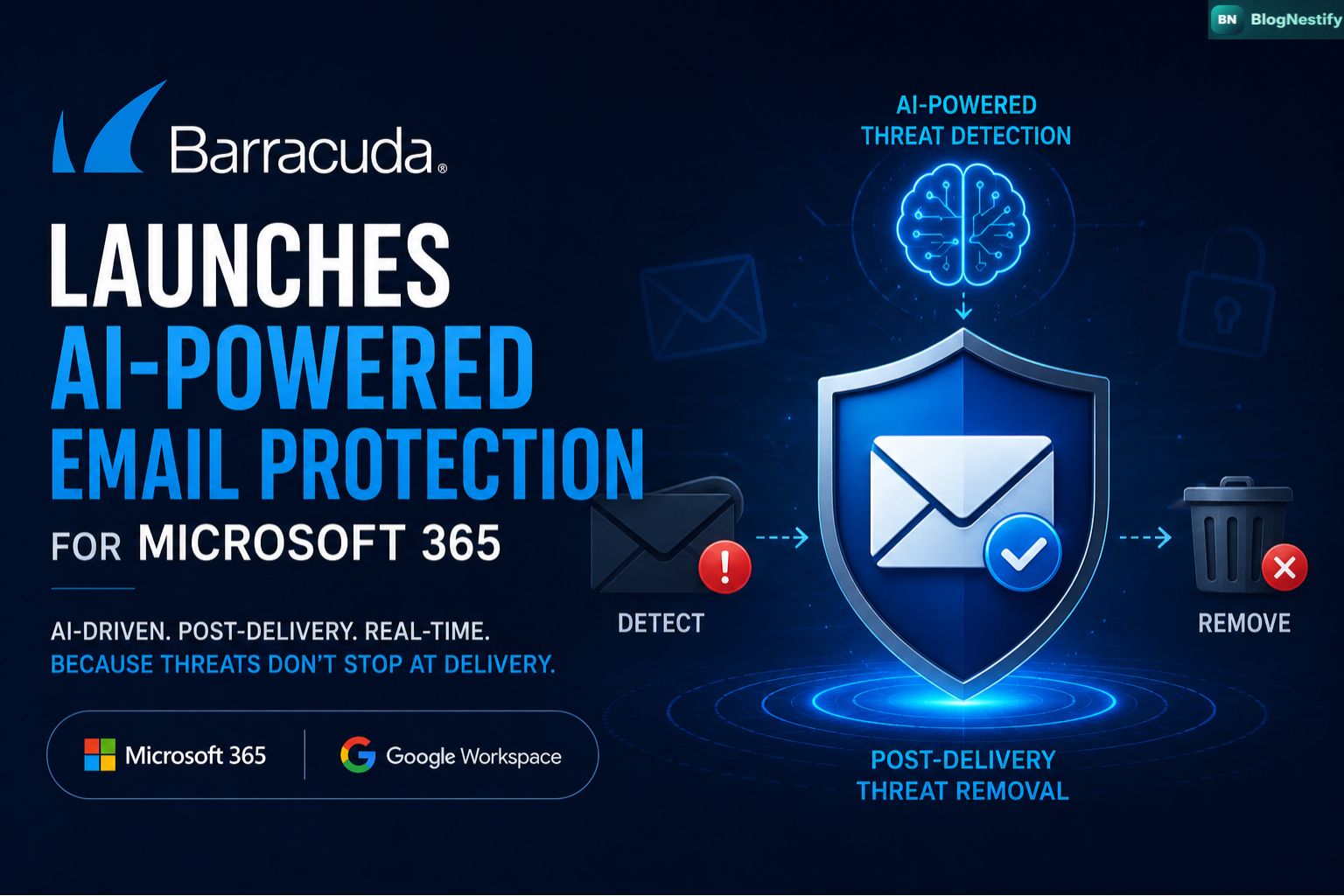
A red-team test showed a single phishing email leading to identity theft, MFA bypass, and endpoint compromise in five minutes — and that's the gap Barracuda's new product is built to close.
Key takeaways
- Barracuda Integrated Email Protection adds AI-driven detection and automatic post-delivery message clawback to Microsoft 365 and Google Workspace.
- It deploys via API integration, with no MX record changes required.
- Barracuda's red team simulated an attack chain that went from phishing email to endpoint compromise in five minutes.
- Microsoft's own 2026 telemetry shows threat detection now takes under 15 minutes, but full remediation across an organization averages more than 48 hours — the exact gap this category of tool targets.
Barracuda Networks has rolled out a new email security product built around a problem most companies haven't fully priced in: what happens after a phishing email already lands in someone's inbox. The product, called Barracuda Integrated Email Protection, layers AI-driven detection on top of Microsoft 365 and Google Workspace. Its core pitch is post-delivery cleanup, not just pre-delivery blocking.
The timing lines up with research Barracuda published alongside the launch. The company's red team simulated an attack and got from a single phishing email to identity theft, MFA bypass, and endpoint compromise in five minutes. That number explains why "block it before it arrives" stopped being a sufficient strategy a while ago.
What Barracuda Shipped
Integrated Email Protection falls into a category called Integrated Cloud Email Security, or ICES — a term Gartner started using a few years ago once it became clear that native Microsoft 365 and Google Workspace defenses, plus a traditional secure email gateway, were leaving gaps attackers had learned to route around on purpose.
The product connects through APIs rather than MX record changes, so IT teams don't have to reroute mail flow to get it running. Barracuda says deployment takes minutes, which is the standard claim in this category, but the API-only approach does cut the operational risk compared with gateway products that insert themselves directly into the mail path.
Three things stand out:
Post-delivery clawback. If a link looks safe at delivery and turns malicious an hour later, or an account gets compromised and starts sending mail from the inside, Integrated Email Protection is built to catch that and pull the message back out of mailboxes automatically.
Cross-platform verdict explanations. Through an AI assistant called Bailey, the product explains, in plain language, why Microsoft 365 made one call and Barracuda made another on the same message. Anyone who has tried to reconcile two security tools disagreeing with each other at 2am knows why that matters more than it sounds like it should.
BarracudaONE telemetry. The product pulls in signals from identity, network, data, and application layers, not just the inbox. An email attack rarely stays an email attack for long.
Why Blocking at Delivery Stopped Being Enough
For most of the last two decades, email security meant filtering: scan the message, check it against known bad signatures, block or allow. That worked fine against mass spam and commodity malware. It works much worse against attacks built to look clean at the moment of delivery and only turn hostile afterward.
Barracuda CEO Rohit Ghai put it plainly in the launch materials, describing email as having shifted from a human communication channel into what he called an operational fabric where people and AI agents both act on messages. Generative AI has made it cheap to write phishing emails with no typos, no broken English, and convincing context pulled from public data about a target. The old heuristics that flagged bad grammar or generic greetings don't catch much anymore.
The data backs this up. Microsoft's own telemetry from early 2026 shows detection has gotten fast — usually under 15 minutes — but full remediation, actually clearing a malicious message out of every inbox it reached, is taking organizations more than 48 hours on average. That's the gap Barracuda is selling a fix for, and Barracuda isn't the only one making this argument. Several vendors in the ICES space are converging on post-delivery response as the next thing they compete on.
Why this matters: A 15-minute detection time means little if the message stays live in mailboxes for two more days. The detection-to-remediation gap, not raw detection speed, is the metric worth watching when evaluating any email security tool in 2026.
The Account Takeover Problem
One number from Barracuda's research is worth sitting with longer than the rest: one in seven compromised email accounts now gets reused to launch further attacks, and the company expects that ratio to climb as attackers lean harder on automation. That's the mechanic that turns a single successful phish into a multi-victim incident. Someone clicks a bad link, their account gets taken over, and now that account is sending convincing internal phishing to coworkers who have no reason to distrust an email from someone they actually work with.
Catching that requires watching account behavior after the fact, not scanning messages as they arrive. Integrated Email Protection's account takeover detection looks for the kind of post-compromise behavior that shows up once an account is already in the wrong hands — outbound sending patterns that don't match the user's history, or inbox rules quietly forwarding mail somewhere it shouldn't go.
Where This Sits in a Crowded Market
Barracuda isn't alone here. Abnormal Security, Mimecast, IRONSCALES, KnowBe4 Defend, and several others all sell some version of API-based, AI-driven protection layered on Microsoft 365 and Google Workspace. The ICES category is projected to keep growing through the rest of the decade as more organizations decide native cloud email security plus an aging secure email gateway isn't covering the gap anymore.
What sets Barracuda's pitch apart is the BarracudaONE framing — the argument that email security shouldn't sit in its own silo when the same attacker is often pivoting into identity systems, file shares, and endpoints within minutes of the first compromise. Whether that cross-domain correlation produces meaningfully better outcomes than point solutions, or mostly just centralizes vendor lock-in, isn't something a press release can settle. It's worth testing in a pilot before taking it at face value.
What This Means If You Run Microsoft 365 or Google Workspace
A few practical questions are worth asking before adopting any tool in this category, Barracuda's or otherwise:
- How fast does it actually claw back a message after delivery, in minutes, not marketing copy?
- Does it watch for account takeover behavior specifically, or only scan incoming mail?
- Can it run without MX record changes, and what's the real deployment timeline once you account for tuning and false-positive cleanup?
- Does it explain its verdicts in a way your team can act on quickly, or does it just add one more dashboard to check?
None of this replaces the basics. Phishing-resistant MFA, DMARC enforcement, and user training still matter — Barracuda says as much in its own guidance alongside the launch. What's changed is that those basics are necessary but stop being enough on their own, because the attacks getting through now are built specifically to look fine until they don't.
Frequently Asked Questions
What is Barracuda Integrated Email Protection?
An AI-powered email security product from Barracuda Networks for Microsoft 365 and Google Workspace. It detects and removes threats before and after delivery, including messages that look safe on arrival and turn malicious afterward.
What does ICES mean in email security?
Integrated Cloud Email Security — a category Gartner defined for API-based tools that layer AI-driven detection on top of native cloud email platforms like Microsoft 365 and Google Workspace, rather than sitting in front of mail flow like a traditional gateway.
Does Barracuda Integrated Email Protection require changing MX records?
No. It connects through APIs, so there's no MX record change or mail flow rerouting involved — part of why Barracuda claims deployment without disrupting existing email infrastructure.
What is Bailey in Barracuda's product?
Barracuda's AI assistant, built to explain in plain language why a message was flagged or cleared, including reconciling differing verdicts between Microsoft 365, Google Workspace, and Barracuda's own systems.
Why does post-delivery email protection matter now?
Because modern phishing increasingly looks safe at the moment of delivery and turns malicious afterward. Microsoft's own 2026 telemetry shows organizations now take more than 48 hours on average to fully remediate threats they detect within 15 minutes.
Founder & Editor, Blognestify
Khushal Charaniya is the Founder and Editor of Blognestify, covering technology, AI, cybersecurity, business, and global affairs. He focuses on delivering accurate, source-checked reporting that helps readers understand fast-moving security and tech developments.
Sources: Barracuda Networks press release, "Barracuda Unveils Integrated Email Protection" (June 17, 2026); SecurityBrief Australia; MSSP Alert; Channel Insider; Microsoft Security Blog, "Email threat landscape: Q1 2026 trends and insights."
0 Comments
Leave a Comment