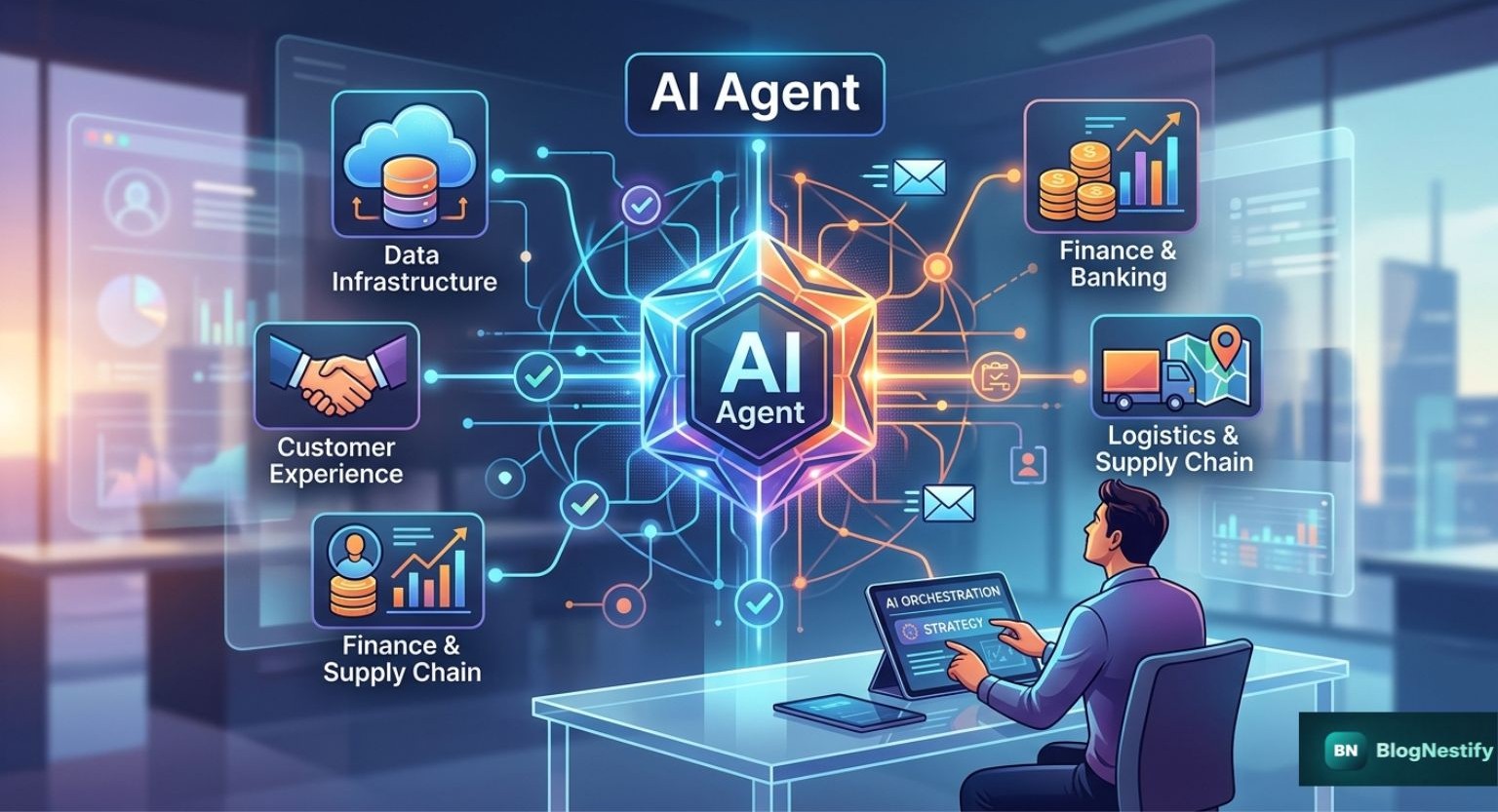
Something Actually Changed This Time
I've spent enough time watching AI hype cycles to be skeptical by reflex. But something genuinely shifted between late 2024 and now. The gap between "AI that helps you write faster" and "AI that does the work" quietly closed — and most organizations are still catching up to what that means.
Agentic AI isn't a marketing term for a smarter chatbot. These systems reason through goals, break them into steps, call external tools, and execute across multiple platforms — all without a human nudging them forward at every stage. Where generative AI gives you an answer, an agent takes an action.
"The question stopped being 'can it generate this?' and became 'can it get this done?' — and in 2026, the answer is increasingly yes."
What Agents Actually Do (Concretely)
The best way to understand an agent isn't the architecture — it's the scenario. A customer emails saying their shipment hasn't arrived. In the old model, a support rep logs in, checks the tracking system, writes back, escalates to logistics, waits, follows up. The whole thing takes hours if you're lucky, days if you're not.
An agent running the same process detects the delay flag automatically, checks inventory for a replacement unit, initiates a reroute or refund depending on customer history, sends a notification, and closes the ticket — in minutes, without anyone touching it. That's not hypothetical. Companies running these workflows now genuinely do report 70–80% reductions in resolution time.
Detect customer complaint → Query tracking API → Check inventory + CRM history → Decide: reroute or refund → Update CRM → Notify customer → Close ticket. Zero human steps in the middle.
Four Shifts Worth Paying Attention To
Not every 2026 AI trend deserves your attention, but these four have shown up consistently across the organizations I've talked to and the data I've read.
From Doing to Managing
Employees who used to run reports, process claims, or triage tickets are now reviewing what agents produced and deciding whether to approve it. The work isn't gone — it moved up a level. That's genuinely good for most people, though the transition has been rougher than the press releases suggest.
End-to-End, Not Step-by-Step
Early automation handled single steps — auto-fill this form, schedule this email. Agents handle chains. A finance agent that detects a suspicious transaction, freezes the account, notifies the user, logs the case, and opens a compliance ticket is doing six jobs in sequence. That's the difference.
Proactive Over Reactive
Reactive systems wait for a problem to surface before doing anything. Agents increasingly don't. They watch inventory levels, monitor log files, track sentiment patterns — and act before you even know there's an issue to resolve. In supply chain, this has quietly become the standard. Agents rerouting shipments around port congestion before the delay even registers in a human inbox.
Cross-System by Default
The silos between CRM, ERP, ticketing, and communication tools were always artificial — they existed because integration was hard. Agents don't care about silos. They read from wherever they need to read and write wherever they need to write. That cross-system fluency is actually one of the bigger productivity drivers, even though it rarely gets top billing in the coverage.
Where It's Taking Hold
The Human Role Isn't Disappearing — It's Recalibrating
There's a version of this story that's dystopian and a version that's credulous. The honest version is somewhere between them.
For most knowledge workers, the shift has been toward what's now called "AI orchestration" — setting goals, reviewing outputs, adjusting parameters, and making judgment calls on edge cases. The mechanical execution is handled. The strategic and ethical layer still needs a person.
That's actually a better use of human time, in most cases. But it's not a frictionless transition. People who built their expertise around knowing the steps — rather than knowing what the steps should achieve — are finding the adjustment harder. That's worth being honest about.
"The hardest part wasn't the technology. It was figuring out what we actually wanted the agents to do — which turned out to be a much harder question than we expected." — Head of Operations, mid-size logistics firm
Common Questions
What makes an AI agent different from a regular chatbot? +
A chatbot responds. An agent acts. Agents can use external tools, call APIs, remember context across steps, and complete multi-step tasks without being prompted at each stage. Chatbots generate text; agents produce outcomes.
Is agentic AI safe to deploy without human oversight? +
Mostly no, at least not yet for high-stakes decisions. Current deployments typically pair autonomous execution for routine tasks with human review for anything that touches money, legal risk, or customer relationships in significant ways. The oversight model matters a lot.
What does "AI orchestration" mean for regular employees? +
It means your job shifts from doing tasks to managing the systems that do them. You set goals, review outputs, handle exceptions, and make judgment calls that agents can't. The execution layer moves to the agent; the accountability layer stays with you.
0 Comments
Leave a Comment