Complete History of Apple iOS: Every Version from iPhone OS 1 to iOS 18 (2007–2024)
Blog cover image showing two iPhone eras side by side: iPhone OS 1 from 2007 on the left and iOS 18 from 2024 on the right
iPhone OS 1
14 apps · No App Store · 128 MB
iOS 18
1.8M apps · Apple Intelligence · 1.5B devices
Blog cover image showing two iPhone eras: iPhone OS 1 (2007) and iOS 18 (2024)
How a single software platform, born on a touchscreen in 2007, reshaped the way humanity communicates, creates, and connects — one version at a time.
The Beginning: A Phone That Changed Everything (2007)
On January 9, 2007, Steve Jobs stepped onto the Macworld stage in San Francisco and announced something that would permanently alter the landscape of mobile technology. "Today," he said, "we're going to make history." He wasn't exaggerating. The original iPhone — running what Apple then called iPhone OS — was not merely a new device. It was a philosophical statement about what a computer could be: something that fit in your pocket, responded to your fingertips, and felt genuinely intuitive to use.
The first version of iPhone OS shipped on . It was stripped down by today's standards — no App Store, no copy-paste, no MMS. But it had a capacitive multi-touch display, a full web browser (Safari), visual voicemail, and Google Maps. The software was built on a foundation of Darwin (Apple's open-source Unix core) and shared DNA with macOS, but it was reimagined from the ground up for a pocket-sized touchscreen.
"An iPod. A phone. And an internet communicator. Are you getting it? These are not three separate devices — this is one device."
— Steve Jobs, January 9, 2007
The original OS shipped with fourteen built-in apps: Phone, Mail, Safari, iPod, SMS, Calendar, Photos, Camera, YouTube, Stocks, Maps, Weather, Clock, and Calculator. Third-party developers were initially expected to build web apps — Apple had no intention of opening the platform. That would change very soon.
iPhone OS 2: The App Store Revolution (2008)
The launch of iPhone OS 2 on , alongside the iPhone 3G, fundamentally transformed the platform. Apple opened the App Store — and in doing so, it didn't just add a feature. It created an entire economy. Within a week, 10 million applications had been downloaded. Within a year, that number would reach 1 billion.
iPhone OS 2 also introduced push notifications, Exchange support for enterprise email, and the SDK (Software Development Kit) that opened the door to an entire generation of software builders. The App Store's foundational architecture launched in this version remains essentially unchanged today.
iPhone OS 3: Copy, Paste, and Maturing Features (2009)
With iPhone OS 3, Apple filled in many of the gaps that critics had pointed to since the original launch. Copy and paste — laughably absent in the first two versions — finally arrived. So did MMS (picture messaging), Spotlight search, push notifications for third-party apps, voice memos, and landscape keyboard support.
This version also introduced in-app purchases and peer-to-peer connectivity via Bluetooth, which became the backbone of a new wave of multiplayer mobile games. For the first time, users could search across their entire device rather than drilling into individual apps.
iOS 4: Multitasking Arrives (2010)
Apple rebranded the operating system from "iPhone OS" to simply iOS with version 4 — a name that acknowledged the platform was now running on more than just iPhones (the iPad had launched in April 2010). iOS 4 introduced limited multitasking: apps could run background processes for audio, location, and VoIP, while most were suspended to preserve battery life.
iOS 4 also introduced FaceTime, Apple's video calling service; the Game Center social gaming network; Folders for organizing apps; and HDR photography support. The iPhone 4 hardware paired with iOS 4 represented the first genuinely polished, mature expression of Apple's mobile vision.
iOS 5 & iCloud: The Post-PC Era (2011)
iOS 5 was a watershed moment. For the first time, activating an iPhone or iPad no longer required plugging into iTunes on a Mac or PC. iCloud arrived alongside iOS 5, enabling wireless backups, Photo Stream syncing, and seamless calendar and contact sync across all of a user's Apple devices.
iOS 5 also brought Siri, Apple's intelligent personal assistant, available initially as a beta feature exclusive to the iPhone 4S. Notification Center finally gave iOS a coherent system for managing alerts. This was the last major iOS release under Steve Jobs, who passed away on .
iOS 6–8: Maps, Design Revolution, and Openness (2012–2014)
iOS 6 in 2012 made headlines for replacing Google Maps with Apple's own mapping solution, which launched with significant inaccuracies. CEO Tim Cook publicly apologized — a rare move for Apple. The release also brought Passbook (now Wallet), improved Siri, FaceTime over cellular, and deeper Facebook integration.
iOS 7 (2013) was the most dramatic visual overhaul in the platform's history. Under the direction of Jony Ive, Apple abandoned skeuomorphic design — the leather-stitched calendars, the green felt Game Center — in favour of a flat, translucent aesthetic. iOS 7's design language became the template for mobile UI design globally for years to come.
iOS 8 (2014) brought the most significant developer-facing changes in years: third-party keyboards, extensibility through widgets and action extensions, Touch ID APIs, and HealthKit. Swift, Apple's new programming language, launched alongside iOS 8.
iOS 9–11: Intelligence, AR, and a New iPad Era (2015–2017)
iOS 9 (2015) focused on performance and intelligence — apps launched faster, battery efficiency improved, and Siri became proactive, surfacing suggestions based on usage patterns, location, and time of day. The iPad received Split View multitasking, positioning it as a genuine productivity device.
iOS 10 (2016) brought rich notifications, SiriKit for third-party apps, and turned iMessage into a platform with stickers and apps. The Home app arrived for smart home control. iOS 10 was the first version to run on the Apple Watch as watchOS.
iOS 11 (2017) was iPad-centric. A new Dock, drag-and-drop between apps, a revamped Files app, and a more powerful multitasking system transformed the iPad. For iPhones, iOS 11 brought a redesigned Control Center, machine learning-based photography enhancements, and most significantly — ARKit, Apple's augmented reality development framework, making iOS devices the world's largest installed base of AR-capable hardware overnight.
iOS 12–14: Speed, Privacy, and Pandemic-Era Features (2018–2020)
iOS 12 (2018) deliberately stepped back from ambition to focus on performance and stability. Older devices received meaningful speed improvements. Screen Time gave users visibility into and control over device usage. Memoji and Shortcuts automation launched.
iOS 13 (2019) introduced Dark Mode, a true system-wide dark colour scheme. Sign in with Apple — a privacy-focused alternative to Facebook and Google login — launched as a required option for apps offering third-party sign-in. Night Mode camera transformed iPhone photography in low light. iPadOS was introduced as a separate but parallel operating system branch.
iOS 14 (2020), released during the global COVID-19 pandemic, delivered the biggest home screen changes since 2007: Widgets on the home screen grid, App Library, App Clips, and Picture-in-Picture video. App Tracking Transparency — requiring explicit user permission for cross-app tracking — was one of the most consequential privacy policy moves in mobile industry history.
iOS 15–17: Focus, Fitness, and AI Foundations (2021–2023)
iOS 15 (2021) introduced Focus modes, allowing users to create context-specific notification profiles. FaceTime gained spatial audio and SharePlay for watching content together remotely. Live Text used on-device machine learning to recognise and interact with text in photos.
iOS 16 (2022) brought the most significant lock screen redesign since the original iPhone: customisable fonts, colours, widget stacks, and Live Activities displaying real-time information from apps directly on the lock screen. Crash Detection debuted on iPhone 14 hardware.
iOS 17 (2023) introduced StandBy mode — a full-screen ambient display when the iPhone charges horizontally. NameDrop allowed contact sharing by touching two iPhones together. Journal app provided a private, on-device journalling experience. Live Voicemail showed real-time transcription of incoming calls.
iOS 18: Apple Intelligence and the AI Era (2024)
iOS 18, announced at WWDC 2024 and released in September 2024, marked the beginning of the Apple Intelligence era. Writing tools powered by large language models were embedded throughout the OS. Image Playground let users generate images in distinct styles. Genmoji allowed users to create entirely custom emoji from text descriptions. Siri was rebuilt with deeper understanding of personal context, screen awareness, and the ability to take actions across apps.
Beyond AI, iOS 18 brought the most customisable home screen in iPhone history — icon tinting, dark mode icons, freely placed app grids, and a fully redesigned Control Center. RCS messaging arrived, finally enabling higher-quality messaging between iPhones and Android devices. Passwords became a standalone app. And the Calculator app — unchanged since 2007 — was completely rebuilt.
Full Apple iOS Version History Timeline
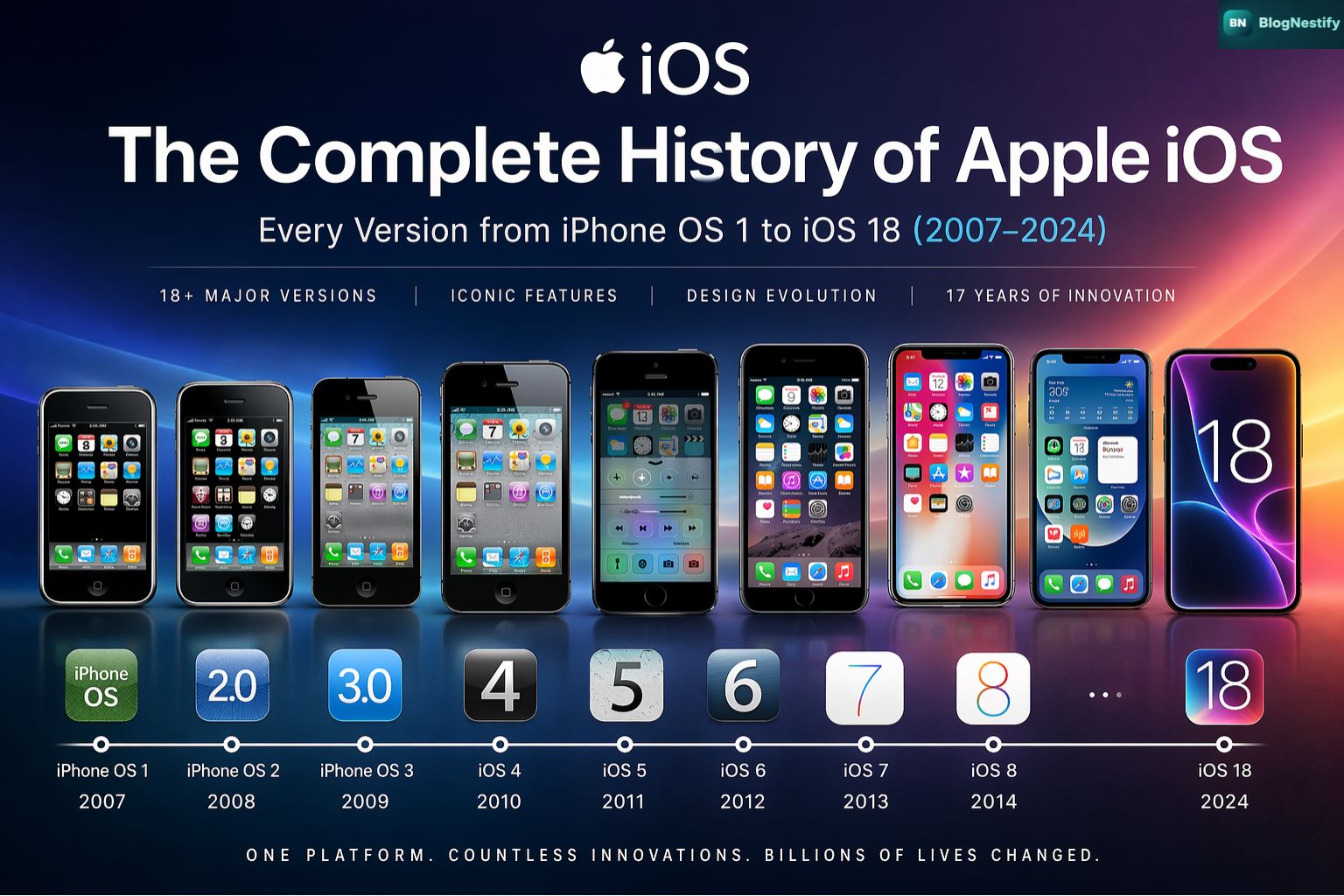
A complete reference table of every major iOS version, its release year, and the headline features that defined it.
| Version | Year | Headline features |
|---|---|---|
| iPhone OS 1 | 2007 | Multi-touch, Safari, Mail, Maps, Visual Voicemail, iPod |
| iPhone OS 2 | 2008 | App Store, SDK, Exchange support, Push Notifications |
| iPhone OS 3 | 2009 | Copy & paste, MMS, Spotlight, In-app purchases |
| iOS 4 | 2010 | Multitasking, FaceTime, Game Center, Folders, renamed to iOS |
| iOS 5 | 2011 | Siri, iCloud, Notification Center, Wireless activation |
| iOS 6 | 2012 | Apple Maps, Passbook/Wallet, Do Not Disturb, Shared Photo Streams |
| iOS 7 | 2013 | Flat UI redesign, Control Center, AirDrop, iTunes Radio |
| iOS 8 | 2014 | HealthKit, HomeKit, Third-party keyboards, Swift language |
| iOS 9 | 2015 | Proactive Siri, iPad Split View, News app, Low Power Mode |
| iOS 10 | 2016 | Rich notifications, SiriKit, iMessage apps, Home app |
| iOS 11 | 2017 | ARKit, iPad Dock, Files app, Drag & drop, HEIF/HEVC |
| iOS 12 | 2018 | Screen Time, Memoji, Shortcuts, Grouped Notifications |
| iOS 13 | 2019 | Dark Mode, Sign in with Apple, Night Mode camera, iPadOS split |
| iOS 14 | 2020 | Home screen widgets, App Library, App Clips, App Tracking Transparency |
| iOS 15 | 2021 | Focus modes, SharePlay, Live Text, iCloud Private Relay |
| iOS 16 | 2022 | Customisable lock screen, Live Activities, Crash Detection, Edit iMessage |
| iOS 17 | 2023 | StandBy mode, NameDrop, Contact Posters, Live Voicemail, Journal |
| iOS 18 | 2024 | Apple Intelligence, Genmoji, Image Playground, rebuilt Siri, RCS |
The Legacy and the Road Ahead
Nearly two decades after Steve Jobs unveiled the original iPhone, iOS stands as one of the most consequential pieces of software ever created. It did not merely improve on what came before — it redefined the category entirely. The touchscreen paradigm it introduced is now so universal that children who have grown up with iOS find the concept of a physical keyboard on a mobile device strange and antiquated.
iOS has catalysed entire industries: the app economy, mobile photography, mobile commerce, contactless payment, augmented reality, and increasingly, on-device artificial intelligence. It has given rise to companies like Uber, Instagram, Spotify, and TikTok that either did not exist or were unrecognisable before the iPhone created the platform on which they could build.
As of 2025, iOS powers over 1.5 billion active devices worldwide. The App Store hosts more than 1.8 million apps and generates hundreds of billions of dollars in developer revenue annually. iOS consistently holds over 55% smartphone market share in the United States.
Looking ahead, iOS 19 is expected to deepen Apple Intelligence further, weaving generative AI more seamlessly into every corner of the OS. The boundaries between iOS and other Apple operating systems continue to blur as the company works toward a unified ecosystem where software flows naturally across devices of every size and form factor.
What began as software for a phone that didn't even have an App Store has grown into the connective tissue of a trillion-dollar ecosystem and a daily companion for more than a billion people. From iPhone OS 1 running on a 128MB device to iOS 18 harnessing on-device neural engines capable of billions of operations per second, the story of iOS is ultimately the story of modern computing itself.
Frequently Asked Questions About Apple iOS History
When did Apple release the first iOS?
Apple released the first iPhone OS (later renamed iOS) on , alongside the original iPhone. It was publicly announced by Steve Jobs on January 9, 2007 at Macworld in San Francisco.
How many versions of iOS are there?
As of 2024, Apple has released 18 major versions of iOS — from iPhone OS 1 (2007) to iOS 18 (2024). Each major version includes significant new features, design changes, and security improvements.
What is the latest version of iOS?
The latest major version is iOS 18, released in September 2024. It introduced Apple Intelligence — a suite of AI-powered features including Genmoji, Image Playground, a rebuilt Siri, and system-wide writing tools.
When was iOS renamed from iPhone OS?
Apple renamed iPhone OS to iOS with the release of version 4 in 2010. The renaming reflected that the platform was now powering the iPad and iPod touch in addition to the iPhone.
Which iOS version introduced the App Store?
The App Store was introduced with iPhone OS 2, released on July 11, 2008, alongside the iPhone 3G. Within the first weekend, customers downloaded 10 million apps.
Which iOS version introduced Siri?
Siri was introduced in iOS 5 (2011) as a beta feature exclusive to the iPhone 4S. It was the first intelligent personal assistant on a major smartphone platform and marked Apple's entry into AI-powered computing.
0 Comments
Leave a Comment