Cabinet Approves Rs 10,000 Crore Fund Amid Rising Jet Fuel Prices: What It Means for Indian Aviation
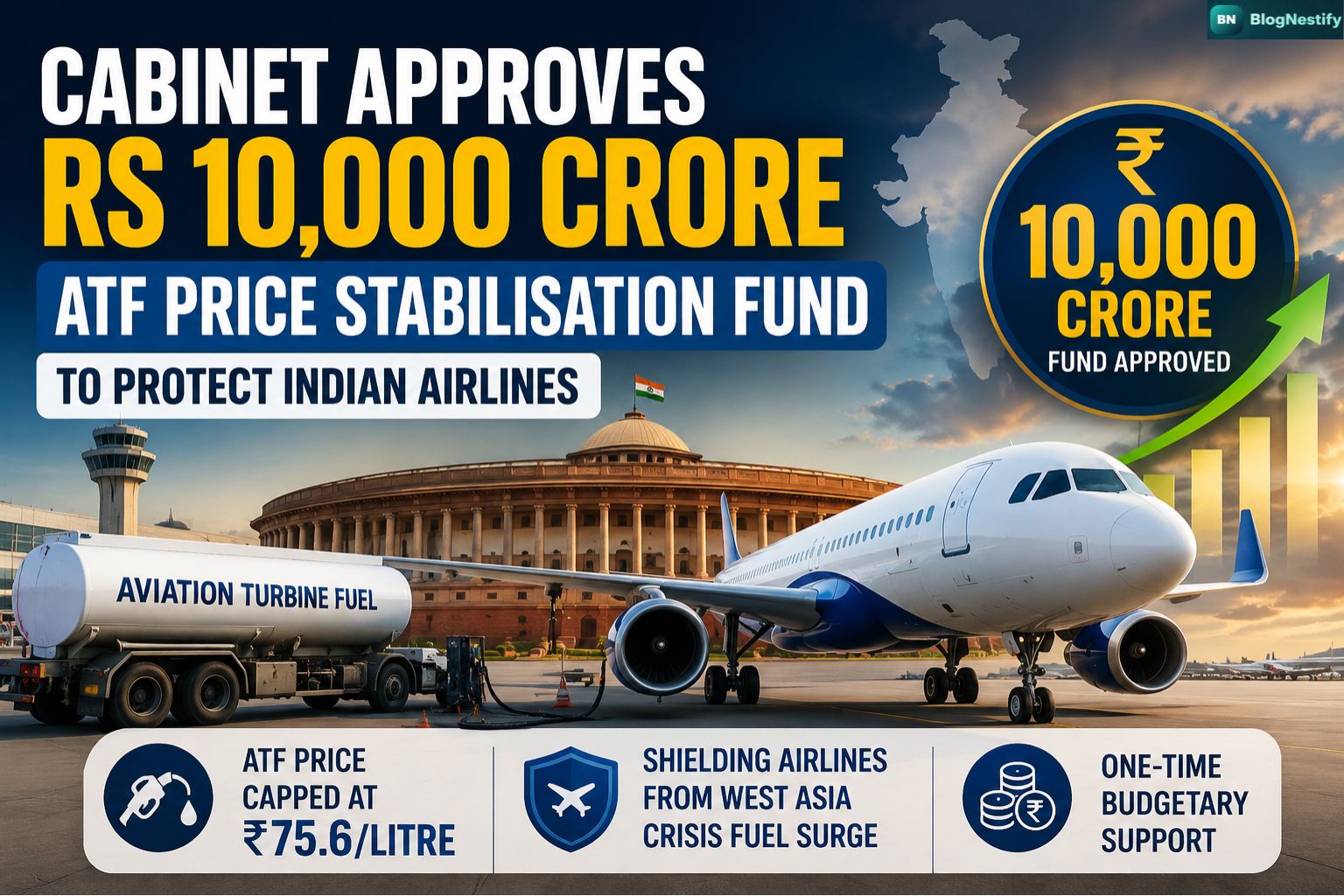
Key Takeaways
- Rs 10,000 crore one-time ATF Price Stabilisation Fund approved by Union Cabinet
- ATF price capped at Rs 75.6/litre for domestic carriers — well below the Rs 142/litre market rate in May 2026
- Interest-free advances disbursed to Oil Marketing Companies (OMCs) to offset under-recoveries
- Scheme active for up to 3 years, subject to annual review
- All scheduled Indian airlines — IndiGo, Air India, SpiceJet — are eligible
- Triggered by the West Asia crisis and Strait of Hormuz disruptions pushing Brent crude above $110/barrel
India's aviation sector just got some breathing room. The Union Cabinet, chaired by Prime Minister Narendra Modi, on Wednesday approved a Rs 10,000 crore Aviation Turbine Fuel (ATF) Price Stabilisation Fund — a direct government lifeline for an industry that has been bleeding under the weight of a near-historic fuel price shock. Information and Broadcasting Minister Ashwini Vaishnaw announced the decision, describing it as a measure to protect domestic and international air connectivity during a period of extraordinary global market stress.
The timing is not incidental. ATF prices, which were around Rs 60.50 per litre in March 2026, shot up to Rs 142 per litre by May — a spike of over 130% in roughly two months. The culprit: escalating tensions in West Asia and disruptions near the Strait of Hormuz, a chokepoint through which roughly 20% of global oil and gas flows. Brent crude briefly crossed $110 per barrel, sustaining pressure on fuel costs worldwide.
How the ATF Price Stabilisation Fund Works
The scheme is not a subsidy in the traditional sense — it's structured as an interest-free advance. Here's the mechanics: the government channels up to Rs 10,000 crore to Oil Marketing Companies like Indian Oil, BPCL, and HPCL. These OMCs then supply jet fuel to scheduled domestic carriers at the capped rate of Rs 75.6 per litre, absorbing the difference between that cap and actual procurement costs.
When international import parity prices exceed the government-set benchmark, OMCs are compensated from the fund. Once global fuel prices eventually settle, those advances get repaid through a defined true-up mechanism — the money flows back to the Consolidated Fund of India. The arrangement is capped at three years, reviewed annually.
Participating airlines must purchase ATF exclusively from OMCs under signed agreements overseen jointly by the Ministries of Civil Aviation and Petroleum. No exclusive OMC sourcing, no access to the cap.
There is a clear fiscal safeguard baked in: this is recoverable public money, not a grant. The government is essentially lending its balance sheet to buffer fuel price volatility, not writing it off. That matters for the politics of the decision, given the optics of the Centre stepping in to support an already well-funded industry.
Why Airlines Were Pushed to the Brink
Aviation fuel accounts for around 40% of an airline's operating costs under normal conditions — a figure that can balloon to 60% during periods of extreme price volatility. When ATF roughly doubled in price over eight weeks, the math became brutal for carriers already managing thin margins.
In April, the Federation of Indian Airlines (FIA), which represents Air India, IndiGo, and SpiceJet, wrote directly to the Ministry of Civil Aviation warning that "insurmountable losses" would lead to aircraft groundings and flight cancellations unless the government intervened. The letter sought immediate ATF price relief and a temporary deferment of the 11% excise duty on jet fuel.
IndiGo
Reported a net loss of Rs 2,536.9 crore in Q4FY26. Cut domestic capacity by 5–7% and international capacity by 17% for June–August 2026.
Air India
Announced a 22% reduction in domestic flights over June–August 2026, citing sustained impact of high fuel prices on operations.
SpiceJet
Joined FIA in seeking urgent ATF relief, with airline stocks falling up to 5% amid fears of operational shutdown without government support.
The problem was compounded by a second operational headache: the closure of Pakistani airspace to Indian carriers. Flights to Europe, North America, and Central Asia now take longer, burning more fuel on extended detour routes — layering another cost spike on top of the price surge.
The West Asia Crisis: What Drove Fuel to Rs 142 Per Litre
The Strait of Hormuz handles roughly a fifth of the world's oil and gas trade. When tensions in West Asia disrupted flows through the strait in early 2026, crude markets responded sharply. Brent crude rose above $110 per barrel — its seventh straight session of gains at one point — and ATF, priced at import parity, climbed in tandem.
India imports the vast majority of its crude, which means global price shocks transmit almost directly into domestic ATF pricing. Unlike petrol and diesel, jet fuel does not enjoy the same degree of domestic price management, making airlines uniquely exposed to global energy market swings.
| Period | ATF Price (₹/litre) | Trigger |
|---|---|---|
| March 2026 | ~₹60.50 | Stable global energy markets |
| April 2026 | Rapidly rising | West Asia conflict escalation |
| May 2026 | ~₹142 | Strait of Hormuz disruption, Brent >$110/barrel |
| Post-Fund (June 2026) | ₹75.6 (capped) | Government stabilisation intervention |
Who Benefits — and What It Costs Taxpayers
All willing scheduled Indian carriers are eligible for the scheme. That covers IndiGo, Air India, Air India Express, SpiceJet, and Akasa Air, among others. Regional connectivity routes — smaller cities served under India's UDAN programme — are specifically called out as a beneficiary in the government's rationale, which signals some political intent behind the optics.
From a public finance perspective, the Rs 10,000 crore is framed as an advance, not expenditure. The government expects recovery once crude prices moderate, via the true-up mechanism. Whether that expectation proves realistic depends heavily on how long the West Asia situation stays unresolved. If global fuel prices stay elevated beyond what the fund can offset, there will likely be pressure for an extension or top-up.
Vaishnaw said the scheme is designed to reduce fare volatility for passengers and preserve air connectivity — particularly on regional routes. Without intervention, airlines would have had little choice but to pass higher costs onto ticket prices or simply cancel unviable routes.
What This Means for Indian Aviation's Longer-Term Picture
India is the third-largest domestic aviation market in the world, and the government has repeatedly described aviation expansion — more airports, more routes, more affordable air travel — as a strategic priority. A scenario where IndiGo and Air India were grounding aircraft would have been a serious setback to that narrative.
The fund buys time. It does not fix the underlying structural issue: Indian aviation remains deeply dependent on global crude prices, with no meaningful domestic ATF production to buffer volatility. Industry associations have long pushed for ATF to be brought under Goods and Services Tax (GST), which would allow airlines to claim input tax credits and structurally reduce fuel costs. That reform remains pending.
In the immediate term, the cap at Rs 75.6 per litre versus the prevailing Rs 142 per litre market rate is substantial enough to materially improve airline unit economics. Whether it translates into stabilised fares or improved quarterly results — versus simply being absorbed into balance sheet repair — will become clear over the next two reporting cycles.
Internal Link Opportunities on Blognestify
Frequently Asked Questions
Final Word
The Rs 10,000 crore ATF fund is a pragmatic call by a government that had few good options. Let airlines fail — or at minimum ground hundreds of flights across a major domestic market — or step in with public money. They stepped in, and structured it as a recoverable advance rather than an outright grant, which is at least fiscally defensible.
The bigger question is structural. India's aviation industry has been here before: every sharp crude cycle produces the same crisis, the same letters from airline CEOs, and the same appeals for relief. The fund buys the sector another reprieve. Whether that window gets used to push through GST inclusion for ATF — the one reform that could reduce this vulnerability long-term — is a different story entirely.
0 Comments
Leave a Comment