Canada-Germany LNG Deal: What It Is, Why It Matters, and What Comes Next
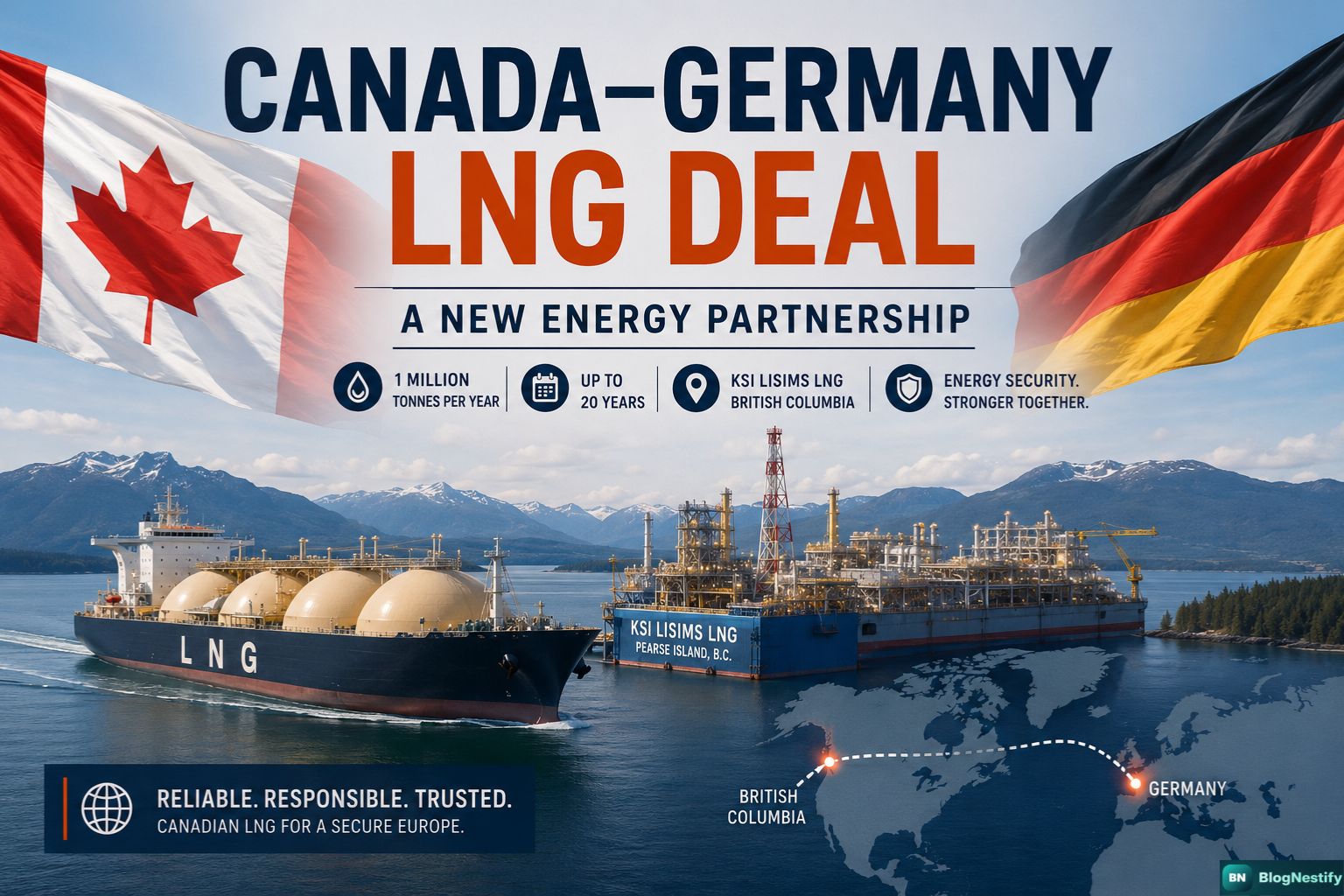
For years, the idea of Canada selling LNG to Europe was treated almost like a punchline. In 2022, then-Prime Minister Justin Trudeau openly questioned the business case for it. This week, that conversation is over.
On May 27, 2026, Natural Resources Minister Tim Hodgson announced in Vancouver that Germany's state-owned energy company SEFE has signed a deal to purchase one million tonnes of Canadian liquefied natural gas per year for up to 20 years — starting in the early 2030s. The gas will come from the Ksi Lisims LNG terminal, a $10-billion floating facility planned for the northern coast of British Columbia, built partly on land owned by the Nisga'a Nation.
It is the first long-term LNG supply agreement Canada has ever signed with a European buyer. That's the headline. But to understand what it actually means — for Canada, Germany, and the broader shift happening in global energy markets — you need to look at the full picture.
Deal at a Glance
- Buyer: SEFE (Securing Energy for Europe) — owned by the German federal government
- Seller: Ksi Lisims LNG — Nisga'a Nation, Western LNG, Rockies LNG Partners
- Volume: 1 million metric tonnes per year
- Duration: Up to 20 years
- Deliveries start: Early 2030s
- Terminal location: Pearse Island, ~80 km north of Prince Rupert, B.C.
- Project cost: $10 billion USD
- Total terminal capacity: 12 million tonnes/year
Who Are the Players?
SEFE — Germany's Energy Backstop
SEFE was not always a government company. Before 2022, it was Gazprom Germania — the European arm of Russia's state gas giant. Then Russia invaded Ukraine, European countries backed Kyiv, and Moscow turned off the gas taps. Germany nationalized Gazprom Germania for 6.3 billion euros and rebranded it as SEFE, short for Securing Energy for Europe.
Today, SEFE is one of Europe's largest gas suppliers to industrial clients, distributing over 200 terawatt hours of gas and power per year to more than 50,000 customers. It doesn't just buy energy — it warehouses it, trades it, and routes it globally. The flexibility clause in the Canada deal reflects exactly that: SEFE has the right to schedule LNG shipments worldwide, meaning the gas might not always land on a German regasification terminal. It could go to Asia, to other European ports, or wherever prices are highest.
Ksi Lisims LNG — The Project Behind the Deal
Ksi Lisims (pronounced Giss Lee-seems) is named after the Nisga'a language. The project sits on Pearse Island in Nisga'a Nation territory, about 80 kilometres north of Prince Rupert — not far from the Alaska border. The Nisga'a Nation is a full equity partner in the venture alongside Houston-based Western LNG, which will be the lead developer and future operator, and Rockies LNG Partners, a consortium of major Canadian natural gas producers.
The facility is designed as a floating liquefaction platform — meaning the production units are built in South Korea, towed to site, and moored offshore. This approach cuts construction time and on-land footprint, though it comes with its own engineering complexity. Two floating production platforms are planned.
At 12 million tonnes per year, Ksi Lisims would be Canada's second-largest LNG export terminal after LNG Canada in Kitimat. It has received both federal and British Columbia environmental assessment certificates. What it hasn't done yet is reach a final investment decision — the formal commitment from developers to actually build it. That decision is expected sometime in 2026.
Canada's Federal Government — An Unusual Broker
The deal was announced by Minister Hodgson at a Vancouver press conference attended by B.C. Energy Minister Adrian Dix, Nisga'a Lisims Government President Eva Clayton, and Germany's Deputy Consul General Dirk Jakobi. That lineup tells you something: this wasn't just a commercial transaction. Ottawa was clearly involved in making it happen, and the Carney government has positioned Ksi Lisims as a Major Project — referring it to the Major Projects Office in November 2025.
"In a moment that feels uncertain and volatile, the world trusts Canada." — Tim Hodgson, Minister of Energy and Natural Resources, May 27, 2026
Why Germany Needs This
Before the war in Ukraine, Germany was one of Europe's most dependent importers of Russian natural gas. Cheap Russian pipeline gas had been the backbone of German industrial competitiveness for decades — it powered chemical plants, steel mills, and ceramics factories across the country. When that supply vanished in 2022, Germany scrambled to build floating LNG import terminals practically overnight.
In 2025 alone, Germany imported 106 terawatt hours of gas through LNG terminals. The one million tonnes per year SEFE agreed to buy from Ksi Lisims represents roughly one-eighth of that figure in energy terms. It won't replace everything Germany lost from Russia. But it's a stable, long-term supply from a country Germany trusts — and that reliability has a price premium built into it.
Europe is also watching the Middle East carefully. Supply disruptions from conflicts in the region have made European governments more nervous about LNG routes that pass through chokepoints. Canadian gas, shipped across the Pacific, sidesteps those concerns entirely.
Why Canada Needs This Too
The timing of this deal is not accidental. Canada is actively trying to reduce its economic dependence on the United States after years of trade friction. The Carney government has made diversifying non-U.S. exports a stated policy goal, with an ambition to double them within a decade.
Historically, Canada had never sold LNG to Europe — not because it lacked the gas, but because it lacked the infrastructure, the political will, and frankly the sense of urgency to build it. All three things changed at once after 2022.
The deal also signals that Canada can be a credible alternative to both U.S. LNG (which European buyers have sometimes found politically complicated) and Middle Eastern or Australian supplies (which face geographic and logistical constraints). Natural Resources Minister Hodgson put it plainly: reliable, low-carbon Canadian energy is what the world is asking for right now.
Who Else Is Buying LNG from Ksi Lisims?
SEFE is the third major buyer to sign with Ksi Lisims. The project now has commitments for about five million of its planned 12 million tonnes per year of capacity. Analysts estimate roughly 10 million tonnes in committed purchases would likely be needed before the project board makes a final investment decision.
| Buyer | Country | Volume (MTPA) | Duration | Deal Status |
|---|---|---|---|---|
| Shell | United Kingdom | 2 million | 20 years | Signed |
| TotalEnergies | France | 2 million | 20 years | Signed (+ 5% stake in Western LNG) |
| SEFE | Germany | 1 million | Up to 20 years | Signed May 2026 |
| Remaining capacity | — | 7 million | — | Seeking buyers |
TotalEnergies went a step further than just buying LNG — the French energy major also acquired a 5% equity stake in Western LNG as part of its deal. Shell's agreement was signed earlier without an equity component.
What Still Has to Happen Before a Single Tonne Ships
The deal is real, but Ksi Lisims is still years from production. Several things need to fall into place.
Final Investment Decision
The project's backers have not yet committed to building. The SEFE deal pushes them closer — Western LNG CEO David Thames said as much at the announcement — but five million tonnes of committed buyers likely isn't enough. Analysts put the threshold closer to ten million tonnes before the board pulls the trigger. That means more sales contracts are needed.
The North Coast Transmission Line
Ksi Lisims is designed to run on BC Hydro electricity — specifically hydropower — which is what lets it claim the title of one of the world's lowest carbon intensity LNG facilities. But the transmission line that would carry that power to the project hasn't been built. The B.C. government fast-tracked it in October 2025, and construction is expected to begin in summer 2026, with a target to be in service before LNG operations start.
Legal Challenges
Two First Nations are taking the federal government to court over their approval of the natural gas line facility that would feed Ksi Lisims, arguing their concerns were not adequately considered. The Prince Rupert Gas Transmission pipeline that would connect the terminal to the gas fields also faces its own legal proceedings. These aren't fatal — major Canadian energy projects routinely navigate legal challenges — but they add timeline uncertainty.
The Floating Platform Build
The two floating production platforms are to be constructed in South Korea. That's a multiyear build even once the final investment decision is made. Current timelines point to early 2030s for first exports, which aligns with what the SEFE contract specifies.
The Bigger Picture: What This Deal Signals
Four years ago, Trudeau questioned out loud whether building LNG export infrastructure to Europe made economic sense. The argument at the time was that Europe's own climate commitments would erode demand for fossil fuels before any Canadian facility could recoup its investment.
What happened instead: Russia weaponized its gas exports, Europe scrambled for alternatives, LNG spot prices hit record highs, and Canada watched from the sidelines without a single export terminal operational on the East Coast and only one on the West Coast, not yet fully running.
The SEFE deal doesn't erase that lost decade. But it's a clear signal that Canada is trying to get ahead of the next wave rather than reacting to it. Ksi Lisims won't be Canada's only entry into this market — Woodfibre LNG near Squamish is slated to finish construction by late 2027, and the Haisla Nation-led Cedar LNG in Kitimat is targeting late 2028. A cluster of West Coast LNG capacity is coming together.
There's also a national unity angle worth noting. The Nisga'a Nation's co-ownership of Ksi Lisims is not a token arrangement. They own the land the terminal sits on. Eva Clayton, president of the Nisga'a Lisims Government, appeared at the announcement alongside federal and provincial ministers. In a country that is still navigating the complexities of resource development on Indigenous lands, that model of genuine partnership matters — and it matters to international buyers who are increasingly scrutinizing the social license behind the energy they purchase.
Key Takeaways
- →Canada has signed its first-ever long-term LNG deal with a European buyer.
- →Germany's SEFE will purchase 1 million tonnes per year for up to 20 years from the Ksi Lisims terminal in B.C.
- →Deliveries are expected to begin in the early 2030s, pending a final investment decision the team hopes to reach in 2026.
- →Ksi Lisims has now secured about 5 of the roughly 10 million tonnes analysts say is needed to commit to construction.
- →The project faces legal challenges from two First Nations and depends on a power transmission line not yet built.
- →The deal is part of a wider Canadian push to diversify energy exports away from the United States.
- →One million tonnes is roughly 2% of Germany's total annual gas needs — significant politically, modest in volume.
Frequently Asked Questions
What is the Canada-Germany LNG deal?
Canada's federal government announced a landmark agreement for Germany's state-owned energy company SEFE (Securing Energy for Europe) to purchase one million tonnes of liquefied natural gas per year from the Ksi Lisims LNG terminal in British Columbia for up to 20 years, with deliveries starting in the early 2030s.
What is Ksi Lisims LNG?
Ksi Lisims LNG is a proposed $10-billion floating LNG export terminal located on Pearse Island, about 80 kilometres north of Prince Rupert in northwestern British Columbia. It is developed by Western LNG, the Nisga'a Nation, and Rockies LNG Partners. At 12 million tonnes per year capacity, it would be Canada's second-largest LNG export facility.
Who is SEFE?
SEFE, short for Securing Energy for Europe, is a major German energy company fully owned by the German federal government. Berlin nationalized it for 6.3 billion euros in 2022 after its former parent, Gazprom, exited during Europe's energy crisis following Russia's invasion of Ukraine.
When will Canada start delivering LNG to Germany?
Deliveries are expected to begin in the early 2030s, subject to the project reaching a final investment decision and completing construction. The terminal has regulatory approvals but has not yet broken ground.
Is this Canada's first LNG deal with a European country?
Yes. The Canada-Germany SEFE deal is the first long-term LNG supply agreement Canada has ever signed with a European buyer.
What other companies have signed LNG deals with Ksi Lisims?
Shell and TotalEnergies each signed 20-year purchase agreements for two million tonnes per year before the SEFE deal. The project now has buyers committed for about five of its 12 million tonnes per year of planned capacity.
Stay Ahead on Energy & Global Markets
Blognestify covers the stories behind the headlines — energy security, trade policy, and the decisions shaping the global economy. Follow us for in-depth analysis you won't get in a two-paragraph wire report.
0 Comments
Leave a Comment