CMR Green Technologies Share Price: Stock Lists at 40% Premium on NSE — Here's How Much Investors Made
CMR Green Technologies IPO Listing: How the Debut Played Out
The market had been waiting for this one. CMR Green Technologies — India's largest non-ferrous metal recycler — made its stock exchange debut on Wednesday, June 10, 2026, and did not disappoint. The company's shares listed significantly above the IPO price on both exchanges, well ahead of what grey market traders had anticipated.
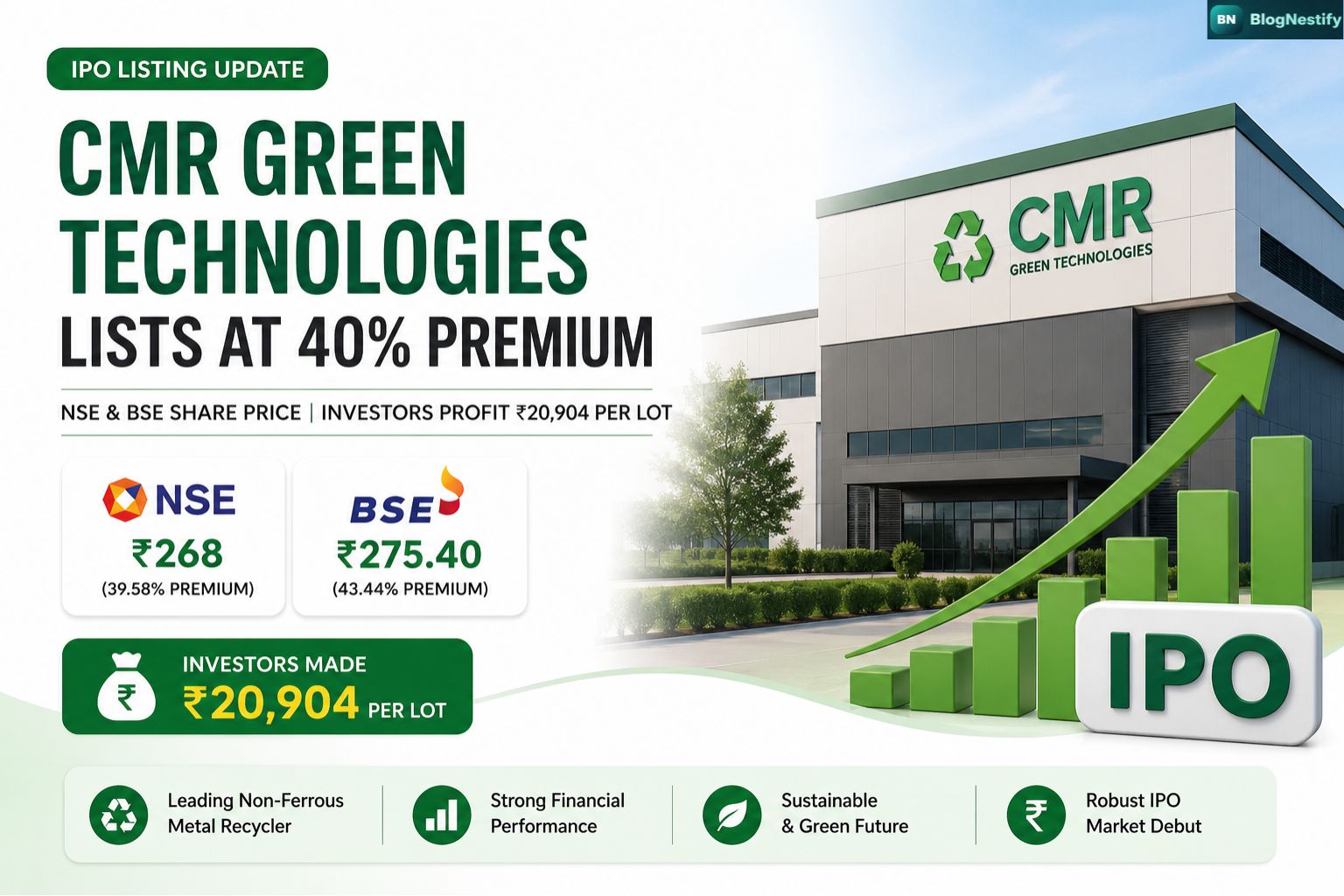
On the National Stock Exchange (NSE), the stock opened at ₹268 per share, a gain of ₹76 or 39.58% over the IPO issue price of ₹192. On the Bombay Stock Exchange (BSE), the debut was even stronger — listing at ₹275.40 per share, up ₹83.40 or 43.44%.
NSE vs BSE Listing Price: A Comparison
| Exchange | Listing Price | IPO Issue Price | Gain (₹) | Premium (%) |
|---|---|---|---|---|
| NSE | ₹268.00 | ₹192.00 | ₹76.00 | +39.58% |
| BSE | ₹275.40 | ₹192.00 | ₹83.40 | +43.44% |
| Grey Market (pre-listing) | ~₹256.50 | ₹192.00 | ~₹64.50 | ~33.59% |
How Much Did Investors Make Per Lot?
The minimum lot size for the CMR Green Technologies IPO was 78 shares, requiring a minimum retail investment of ₹14,976 at the upper price band. At the NSE listing price of ₹268, each lot was worth ₹20,904 more than the allotment cost.
Here's how listing gains worked out across investor categories:
| Investor Category | Lot Size (Shares) | Investment at ₹192 | Value at NSE Listing (₹268) | Gain (₹) |
|---|---|---|---|---|
| Retail (1 lot) | 78 | ₹14,976 | ₹20,904 | ₹5,928 |
| sNII (14 lots) | 1,092 | ₹2,09,664 | ₹2,92,656 | ₹82,992 |
| bNII (67 lots) | 5,226 | ₹10,03,392 | ₹14,00,568 | ₹3,97,176 |
*Gains calculated at NSE listing price of ₹268. Actual realised gains depend on the price at which shares were sold. These are not post-tax figures.
What Does CMR Green Technologies Actually Do?
Faridabad-based CMR Green Technologies is not your typical IPO story — it's a company that has quietly built something substantial. Founded in 2006, CMR has grown into India's largest non-ferrous metal recycling company, with installed processing capacity of approximately 6,15,150 MTPA across 13 manufacturing facilities spread across Haryana, Gujarat, Maharashtra, Tamil Nadu, Rajasthan, Uttarakhand, Odisha, and Andhra Pradesh.
The company's installed capacity is roughly four times larger than its nearest domestic competitor in the recycled aluminium space. That's not a small gap — it's a structural moat.
What CMR Makes
- Recycled aluminium alloys (ingot and liquid form)
- Zinc alloy ingots
- Furnace-ready segregated scrap of stainless steel, copper, brass, lead, and magnesium
- Aluminium billets for automotive and non-automotive sectors
Who CMR Sells To
CMR's customer list reads like an automotive industry roll call: Maruti Suzuki, Honda Cars India, Bajaj Auto, Hero MotoCorp, Royal Enfield, Endurance Technologies, and Jindal Stainless. These relationships aren't new. The top five customers have been working with CMR for 16 to 19 years.
Repeat customers account for 97% of total revenue in FY25 — a number that speaks for itself. When customers account for nearly all revenue year after year, you know the product is deeply embedded in their supply chains.
🏭 Strategic Joint Ventures
CMR has formed equity and technical joint ventures with three major Japanese companies: Toyota Tsusho Corporation, Nikkei MC Aluminium, and Nippon Light Metal. These partnerships give CMR access to advanced casting technologies and a direct relationship with Japanese automakers operating in India. Very few domestic recyclers can claim this kind of international industrial backing.
IPO Subscription: 127 Times Oversubscribed
The CMR Green Technologies IPO opened for bidding from June 3 to June 5, 2026, and investor demand was overwhelming. The issue received bids for approximately 292.75 crore shares against just 2.30 crore shares on offer, resulting in an overall subscription of 127.04 times.
| Investor Category | Subscription |
|---|---|
| Qualified Institutional Buyers (QIB) | 270.46× |
| Non-Institutional Investors (NII) | 172.35× |
| Retail Investors | 27.03× |
| Overall | 127.04× |
The QIB portion at 270× was particularly noteworthy. Institutional investors — who tend to do the deepest due diligence — piled in at a level that signalled strong confidence in CMR's business model and long-term prospects. Anchor investors who came in before the IPO opened included HDFC Mutual Fund, SBI Mutual Fund, Nippon India Mutual Fund, Kotak Mutual Fund, ICICI Prudential Mutual Fund, Goldman Sachs, BNP Paribas, and Susquehanna Pacific, among others.
IPO Structure: All OFS, No Fresh Capital
One important detail investors should note: the CMR Green Technologies IPO was entirely an Offer for Sale (OFS) of approximately 3.29 crore equity shares totalling ₹630.88 crore. The shares being sold came from promoter group entities — Mohan Agarwal, Gauri Shankar Agarwala HUF, and Mohan Agarwal HUF.
Since it was a pure OFS, CMR Green Technologies itself received none of the IPO proceeds. The money went to the selling shareholders. This is worth keeping in mind: the funds raised won't expand operations directly. Future capacity growth will depend on the company's own cash generation and borrowings.
CMR Green Technologies Financial Performance: Growth With Some Complexity
The company's revenue trajectory is solid. Total income climbed from ₹5,889 crore in FY23 to ₹6,696.66 crore in FY25. In just the first nine months of FY26 (April–December 2025), revenue had already crossed ₹6,291 crore — suggesting FY26 full-year revenues could comfortably top ₹8,000 crore.
Profitability returned convincingly after a difficult FY24. The ₹838.56 crore loss that year was driven by a one-time goodwill write-off of ₹1,240 crore related to an earlier merger — not a reflection of operational collapse. Core operations remained cash-positive. By FY25, net profit had recovered to ₹155.04 crore, and the first nine months of FY26 showed continued momentum.
| Metric | FY23 | FY24 | FY25 | 9M FY26 |
|---|---|---|---|---|
| Total Revenue (₹ Cr) | 5,889 | ~6,100 | 6,697 | 6,291 |
| PAT (₹ Cr) | — | −838.56 | 155.04 | ~162 |
| EBITDA Margin | 3.53% | — | 4.91% | 5.03% |
| EBITDA per MT (₹) | — | 6,908 | — | 10,552 |
EBITDA margins have been rising steadily, from 3.53% in FY23 to 5.03% in the first three quarters of FY26. EBITDA per MT jumped from ₹6,908 in FY24 to ₹10,552 in 9MFY26 — an improvement of over 50% in per-unit profitability. That signals better pricing power and operational efficiency.
India's Aluminium Recycling Market: Why This Sector Matters Now
CMR's timing of going public aligns with a macro tailwind that's hard to ignore. India's recycled aluminium market was worth approximately $5 billion in FY25, and analysts project it could reach $9 billion by FY30. The push for sustainability, stricter Scope 3 emissions targets at OEMs, and rising demand for electric vehicle components are all funnelling more demand toward recycled metals.
Producing recycled aluminium requires roughly 95% less energy than making primary aluminium from bauxite. For automotive manufacturers trying to hit emissions and ESG targets, switching to recycled aluminium isn't just an option — it's increasingly mandatory.
CMR already commands a 42–45% market share in the automotive cast alloy segment by volume (as of FY25), and holds an estimated 10–12% share of the overall recycled aluminium industry. With liquid aluminium supply requiring facilities to be located within roughly 25 km of the customer's plant, CMR's strategically placed network of 13 facilities acts as a hard-to-replicate barrier for new entrants.
⚠️ Key Risk Factors to Watch
- Pure OFS IPO: No fresh capital inflows means no direct reinvestment into operations from this raise.
- Rising Debt: Total borrowings rose from ₹894 crore at end-FY25 to ₹1,303 crore by December 2025, partly due to capacity expansion and extended credit cycles from customers.
- Cash Flow Pressure: Operating cash flow turned negative in FY25 (about −₹92 crore), worsening to near −₹388 crore by December 2025. Customers shifting to 90-day credit cycles while inventory grows has squeezed working capital.
- Automotive Dependence: Heavy reliance on auto OEMs and Tier-1 suppliers makes revenue sensitive to auto sector downturns.
- Short-Term Purchase Orders: Most procurement runs on short-term purchase orders with no long-term volume guarantees from customers.
- Raw Material Imports: CMR sources scrap from 198 suppliers across 73 countries. The US alone accounts for ~47.5% of imports, creating exposure to trade disruptions, currency volatility, and geopolitical friction.
📌 Key Takeaways for Investors
- CMR Green Technologies listed at ₹268 on NSE and ₹275.40 on BSE — both well above the IPO price of ₹192.
- Allotted retail investors pocketed ₹5,928 per lot at NSE listing prices. Media reports pegged per-lot gains at ₹20,904 based on total lot value vs. cost.
- At 127× overall subscription, demand was exceptional — QIBs subscribed their portion 270 times.
- The company is the dominant domestic aluminium recycler, supplying India's biggest automakers with a 97% customer retention rate.
- The OFS structure means the company raised no fresh capital — investors should monitor how CMR funds future growth.
- Rising debt and negative operating cash flows are near-term concerns that longer-term investors will want to track closely.
0 Comments
Leave a Comment