Cockroach Janata Party: The Viral Gen Z Movement That Has Everyone Asking — Is This Real?
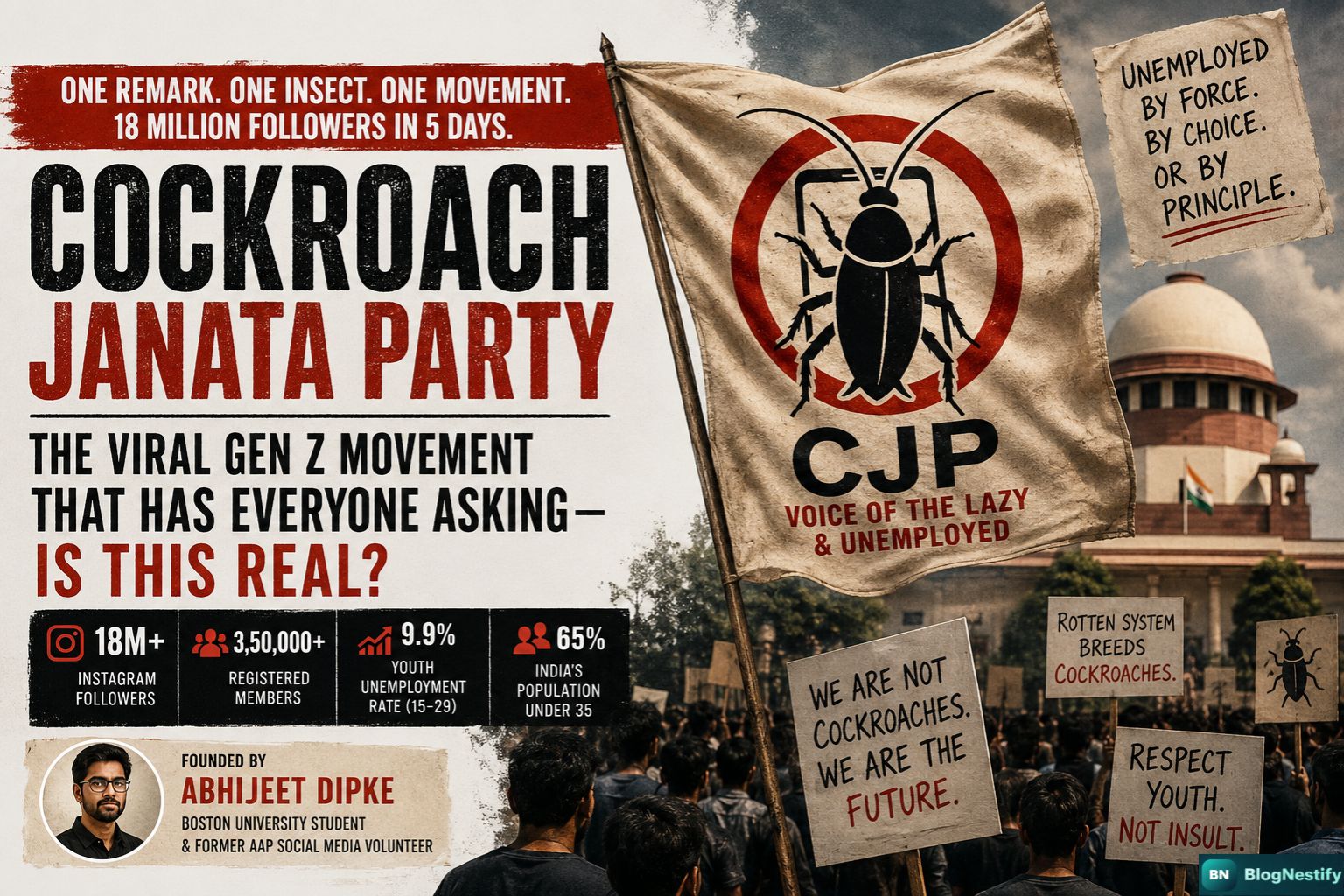
One throwaway remark by India's Chief Justice. One satirical party named after an insect. And within five days — more Instagram followers than the BJP. Here's what's actually going on.
India's internet doesn't always pick its battles wisely. But every once in a while, something lands so perfectly — the right target, the right moment, the right amount of absurdity — that it breaks through the noise and becomes something bigger than itself. The Cockroach Janata Party is one of those things.
It started on May 15, 2026. Chief Justice of India Surya Kant, while presiding over a Supreme Court hearing involving individuals who had allegedly entered the legal profession using fake credentials, made a remark that he probably didn't think would outlive the hearing room. He said there were youngsters "like cockroaches" who couldn't find employment and ended up becoming RTI activists and social media critics. The clarification came later — he was talking about people with fraudulent degrees, not the youth in general. But by then, the internet had already picked it up, run with it, and turned it into a national conversation.
The next day, Abhijeet Dipke — a 30-year-old PR student at Boston University and former AAP social media volunteer — announced on X that he was launching "a platform for all the cockroaches out there." The eligibility criteria were: unemployed, lazy, chronically online, and capable of ranting professionally. The Cockroach Janata Party was born.
How It Unfolded: A Timeline of 72 Hours That Changed the Conversation
The Remark That Started It All
Context matters here, and the Chief Justice's situation is genuinely complicated. He was dealing with a case about people who had entered the legal profession under false pretenses. His "cockroach" analogy was, by his own account, aimed at this specific category of people — not the young population at large.
But language doesn't exist in a vacuum. India in 2026 has a graduate unemployment rate of 29.1% — nine times higher than the rate for people who never attended school. The country produces over 8 million graduates annually, and the formal economy simply hasn't generated enough jobs to absorb them. The NEET paper leak controversy had erupted just weeks earlier, further fraying trust between young people and institutions. In that environment, comparing any group of unemployed youth to insects was always going to land badly, regardless of intent.
Those in power think citizens are cockroaches and parasites. They should know that cockroaches breed in rotten places. That's what India is today.
— Abhijeet Dipke, founder of the Cockroach Janata Party, speaking to Al JazeeraThe Chief Justice clarified. He called the youth "pillars of a developed India." He said sections of the media had misquoted him. None of that stopped CJP from growing. That's partly what makes this story interesting — it was never really about Chief Justice Kant personally. It was about the word he used landing on an existing wound.
What CJP Actually Is — and What It Isn't
The name is a direct play on the BJP — Bharatiya Janata Party. The logo is an outline of a cockroach on a mobile phone. The self-described mission is to be the "Voice of the Lazy and Unemployed." Dipke released a five-point manifesto, though its tone remains satirical. There is a party anthem. There is a merchandise push on the horizon.
Dipke himself has been careful to say CJP is not trying to be the next Bangladesh or Nepal moment — a reference to the Gen Z-led protests in those countries that brought down governments in 2024 and 2025 respectively. He's described it as a political communication experiment, a way to shift the conversation toward youth issues. Whether it stays satirical or pivots toward something more organised is an open question.
The Bot Controversy: Real Rage or Manufactured Momentum?
Here is where things get genuinely murky. The follower growth on CJP's Instagram is, by any normal measure, extraordinary. Going from roughly 1 million to 18 million in a single day — a reported 1,400% increase — is not something that typically happens to organic grassroots movements, satirical or otherwise.
A section of Indian social media users and commentators began raising questions quickly. The allegations: bot-driven follower inflation, possible overseas digital amplification, and coordinated inauthentic behavior designed to manufacture the appearance of mass consensus. No official investigation has confirmed these claims. The CJP and its founder have not publicly addressed the specific bot allegations in detail.
What makes this hard to dismiss entirely is the pattern. The 1,400% overnight jump is unusual even by viral standards. Social platforms typically slow organic growth curves down as they scale — a page going from 100k to 18 million in days without any paid promotion or algorithmic feature placement deserves scrutiny regardless of how genuine the underlying sentiment is.
| Platform Account | Followers (approx.) | Time to Build | Status |
|---|---|---|---|
| Cockroach Janta Party (Instagram) | 18+ million | ~5 days | Under scrutiny |
| BJP (Instagram) | ~8.8 million | Years | Surpassed by CJP |
| INC (Instagram) | ~7 million | Years | Surpassed by CJP |
| CJP (X / Twitter) | 200,000+ | ~5 days | Account withheld in India |
There's also a more cynical reading worth considering. The bot question could itself be deployed strategically — by those who'd prefer the movement discredited — to muddy the waters around what is clearly a real phenomenon. Millions of people are signed up. Hundreds of thousands registered through a Google Form with their actual details. Delhi protesters put on antennae and held placards. That's not bots.
The honest answer is: probably both things are true. The genuine sentiment is there. Whether that sentiment was artificially amplified, and by whom, remains unverified.
Why Youth Unemployment Is the Actual Story Here
Strip away the memes and the cockroach logo, and what you're left with is a very old problem that India hasn't figured out how to talk about honestly. The numbers are stark.
Overall unemployment (15+): 3.1% nationally — but this number masks the real picture by including agricultural and informal labour.
Youth unemployment (15–29): 9.9% overall. Urban youth: 13.6%. Rural youth: 8.3%.
Graduate unemployment: 29.1% — nine times the rate for those without formal education.
Annual graduates entering the market: 8+ million, significantly outpacing job creation in formal sectors.
AI disruption concern: Many entry-level roles in India's back-office and IT services industry — historically the first rung on the career ladder — are under pressure from automation.
Deloitte survey finding: 54% of Indian Gen Zs have delayed major life decisions like home purchases due to economic anxiety.
The NEET paper leak that erupted just weeks before CJP's launch was another piece of this puzzle. Here's an exam that determines medical college admissions for millions of students — and there are credible allegations that question papers were leaked, that some students essentially bought their way into the system. For young people who followed the rules, studied for years, and still couldn't break through, CJP's satirical membership criteria — "unemployed by force, by choice, or by principle" — isn't funny. It's accurate.
Will CJP Last? What Could Happen Next
Satirical political movements in India have a mixed track record. Some, like Jasmine Shah's voter awareness campaigns, evolve into sustained pressure groups. Others peak in a news cycle and dissolve. The determining factor usually isn't the quality of the memes — it's whether there's any organisational infrastructure behind the energy.
CJP has started making some structural moves. Reports indicate that the movement is seriously considering fielding a candidate in Bihar's upcoming Bankipur Assembly constituency by-election. If that happens, it becomes a very different kind of story. A satirical party contesting an actual election — even a small one — sends a signal that this isn't purely performative.
Political heavyweights signing up as members (Mahua Moitra, Kirti Azad) is a double-edged development. On one hand, it gives CJP mainstream validation. On the other, it risks the movement being absorbed into the very political machinery it's mocking. That tension is going to define the next few months.
The X account being withheld in India in response to a legal demand is also worth watching. CJP's Instagram continues to function. But the fact that a legal demand was filed and actioned in under a week tells you something about how seriously at least some corners of power are taking this — or how quickly the bureaucratic reflex to contain online dissent kicks in.
What Makes This Different From Previous Online Movements in India
India has seen online petitions gather millions of signatures. It's seen hashtags trend for days. It's seen Twitter storms that forced apologies and even legislation. What CJP has done that's slightly different is combine the form of political party — with a name, a logo, a manifesto, a website, a membership process — with the energy of viral satire. That formal structure, even if it's entirely tongue-in-cheek, gives people something to join rather than just react to.
That small design choice — a Google Form registration rather than a like or a share — creates a different psychological relationship between the movement and its participants. You're not just an audience member. You're a "member." You've done something. That's a meaningful shift in how online political expression works.
Whether it's enough to translate digital numbers into real-world change is a different question entirely. But at minimum, it's captured something that the formal opposition has struggled to do for years: a pan-Indian, cross-caste, cross-party identity for young Indians who feel the system has written them off. For now, they've decided to call themselves cockroaches and see how that goes.
0 Comments
Leave a Comment