Digital Fraud in India 2025: RBI Fights Back After a $2.5 Billion Crisis
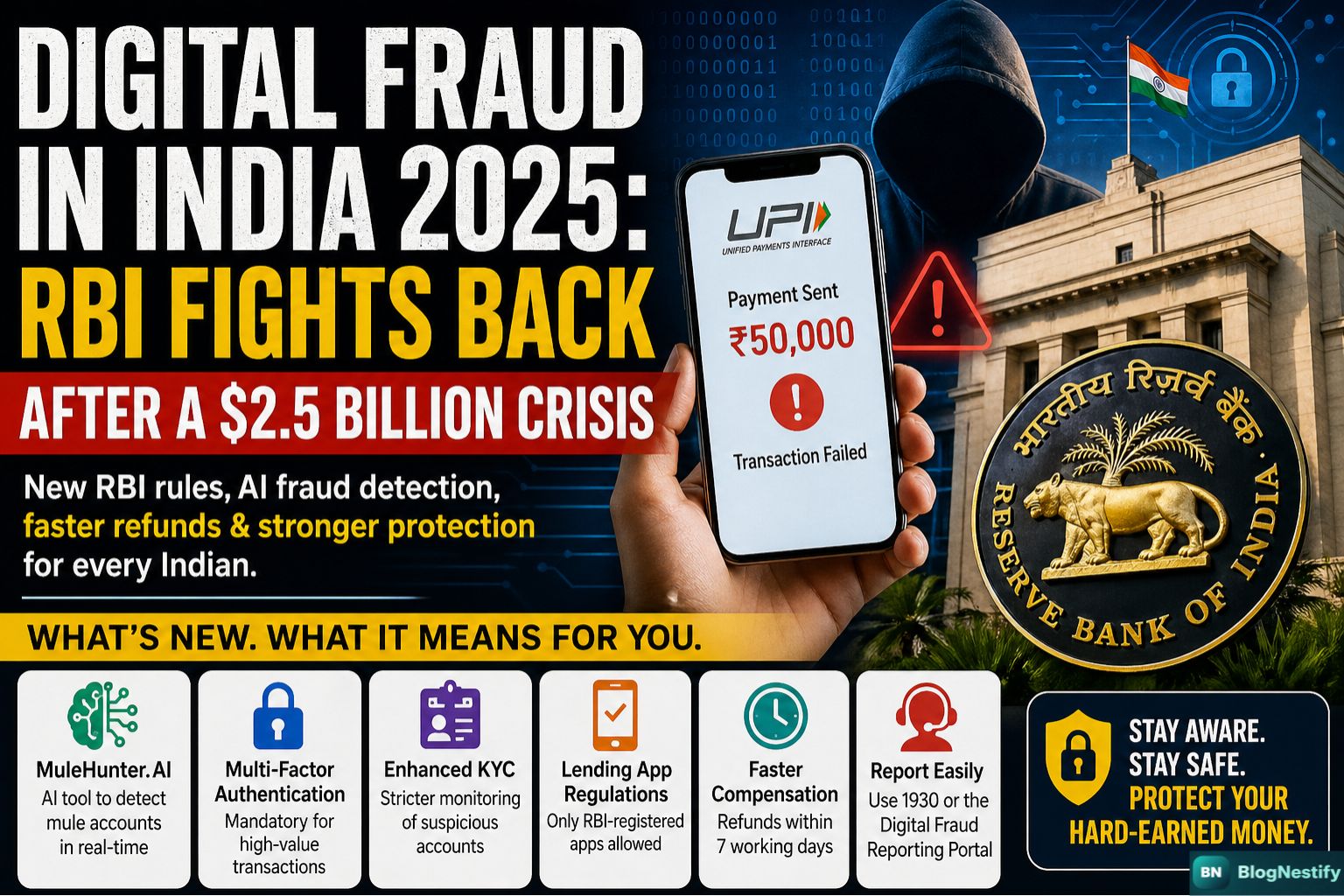
Indians lost a staggering $2.5 billion to digital fraud in a single year. The Reserve Bank of India is now pushing back with measures that could change how every Indian interacts with their money online — here's exactly what's happening and what it means for you.
The Number That Shocked the RBI
₹20,000 crore. That's the rough rupee equivalent of what Indians lost to digital fraud in 2025, and it's a figure that stopped the Reserve Bank of India in its tracks.
To put it in human terms: that's not institutional money siphoned through complex financial instruments. Most of it came out of ordinary people's accounts — salaried workers in Chennai, retirees in Lucknow, small traders in Surat — who tapped something on a screen and watched their savings disappear.
The RBI's Annual Report flagged the surge explicitly, pointing to the explosion in digital payment infrastructure as a double-edged development. India now processes over 14 billion UPI transactions a month. That volume, while genuinely transformative for financial inclusion, has also become the largest attack surface for fraud that this country has ever seen.
India ranks among the top 5 countries globally for real-time payment fraud. Every 2 minutes, someone in India reportedly loses money to a digital scam — that statistic is based on RBI complaint data from 2024–25.
The uncomfortable truth is that we built the highway before we built the guardrails. India moved faster than almost any nation on digital payments adoption, which is genuinely impressive. But fraudsters moved equally fast, and the regulatory infrastructure lagged behind.
That's what the RBI is now trying to fix.
How Digital Fraud Actually Happens in India
Before understanding the RBI's response, it helps to know what these frauds actually look like. They're not all the same, and they don't all target the same person in the same way.
The last category deserves attention. Deepfake voice fraud is still a small fraction of overall cases, but it's growing fast. Several families in metros reported transferring ₹50,000–₹2 lakh to what sounded unmistakably like a spouse or parent. There's no technical defense against this for a regular person — which is exactly why the RBI's systemic interventions matter more than any single "awareness tip."
RBI's New Measures: What Actually Changed
The RBI has published a set of directives and circulars since late 2024 that collectively represent the most aggressive anti-fraud push the central bank has made in the digital era. Here's what's substantively different:
1. MuleHunter.AI — Real-Time Account Flagging
The RBI's in-house AI tool, MuleHunter.AI, is now in pilot deployment across multiple public sector banks. It analyzes transaction behavior in real time to flag accounts being used as conduits for stolen funds — so-called "mule accounts." Early tests showed it could identify suspicious accounts with significantly higher accuracy than traditional rule-based systems.
This is more consequential than it sounds. The reason digital fraud money is so hard to recover isn't that the initial theft is undetectable — it's that the money moves through 5–7 mule accounts in under 48 hours before being cashed out. If the first mule account is frozen within hours, recovery becomes possible. Right now, most victims report fraud days after it happens, by which time the trail is cold.
A mule account is a regular bank account — often belonging to an ordinary person recruited through fake job ads — that fraudsters use to receive and forward stolen money. The account holder is often unaware of the full picture, which makes prosecution complicated. RBI's new rules target both fraudsters and knowingly complicit account holders.
2. Mandatory Multi-Factor Authentication for High-Value Transactions
All digital transactions above ₹2,000 (and select categories regardless of amount) now require a second authentication layer beyond OTP — typically a device-bound PIN or biometric. Banks that were offering single-factor auth for UPI transactions above this threshold have been given compliance deadlines.
3. Enhanced KYC and Account Monitoring
Banks are now required to re-verify KYC for accounts showing sudden behavioral changes — specifically, dormant accounts that suddenly see high inflow-outflow activity. This addresses the mule account problem from the supply side.
4. Tighter Lending App Regulations
The RBI published a whitelist of registered digital lending apps and mandated that app stores (Google Play, Apple App Store) delist unauthorized ones. Illegal lending apps operating as fronts for data harvesting and harassment have been a persistent fraud vector.
5. Faster Victim Compensation
Perhaps the most directly impactful change for individuals: banks are now mandated to resolve unauthorized transaction complaints within 10 working days and process refunds within 7 working days after resolution — down from what was previously an opaque and often months-long process at many banks.
6. The Digital Fraud Reporting Portal
A centralized reporting interface is now live, meant to reduce the friction of filing fraud complaints. The old system — where you'd call your bank, then call 1930, then file on cybercrime.gov.in, and then potentially visit a police station — was a bureaucratic maze that deterred many victims from reporting at all. Unreported fraud is, practically speaking, unrecoverable fraud.
Key RBI Milestones on Digital Fraud (2024–2025)
The Mule Account Problem Nobody Talks About
India has a specific fraud infrastructure problem that doesn't get enough public attention: the mule account economy.
Here's how it works. A fraudster needs to move stolen money without it being traced back to them. They recruit account holders — usually through WhatsApp ads promising easy income — to receive and forward funds. "Just let us use your account for a few transactions, we'll pay you ₹5,000 per transfer." Many participants have no idea they're laundering money.
The RBI estimates that each major fraud syndicate operates between 500 to 5,000 active mule accounts simultaneously. Traditional bank monitoring couldn't keep up because these accounts look individually normal — a ₹40,000 inflow followed by a ₹39,000 outflow doesn't trigger alerts unless you're looking at the network pattern, not just the account in isolation.
MuleHunter.AI is specifically designed to do the network analysis. Whether it scales to the full complexity of the problem remains to be seen — but it's the right tool for the right problem.
If someone offers you money to "use" your bank account — even briefly — decline immediately. Under PMLA (Prevention of Money Laundering Act) and IT Act provisions, you can face account seizure, criminal liability, and travel restrictions even if you didn't know the money was stolen. The law doesn't require you to have known.
Who Gets Targeted the Most
Fraud doesn't target randomly. The data from NCRB filings and RBI complaint analysis points to consistent patterns:
| Demographic | Primary Fraud Vector | Why They're Targeted | Risk Level |
|---|---|---|---|
| Seniors (60+) | Vishing, "bank official" calls | Trust authority figures, less familiar with fraud patterns | Very High |
| Job Seekers (18–30) | Task fraud, fake job portals | Motivated by income, less likely to be skeptical of "offers" | High |
| Small Traders / Shopkeepers | Fake UPI QR, phishing | High transaction volume, less time to verify each one | High |
| First-Gen Digital Users | OTP sharing, screen-share scams | Recently onboarded, not yet aware of social engineering tactics | High |
| Mid-Career Professionals | Fake investment apps | Have disposable income, aspirational about returns | Moderate-High |
| Regular Salaried Workers | Phishing, SIM swap | Predictable income patterns, less vigilance | Moderate |
The uncomfortable pattern: no demographic is "safe." The sophistication of fraud has scaled to match awareness. As urban, educated populations became harder to fool with crude OTP requests, fraudsters shifted to elaborate multi-week investment scams and AI-powered impersonation. The game keeps upgrading.
7 Concrete Ways to Protect Yourself Right Now
General advice like "don't share your OTP" has been circulating since 2015. If it worked, we wouldn't have a $2.5 billion problem. Here are more specific, actionable steps that actually reduce risk:
-
1Turn on Transaction Limits in Your UPI AppEvery major UPI app (BHIM, PhonePe, GPay, Paytm) lets you set a per-transaction and daily limit. Set them to realistic amounts for your actual usage. A fraudster who gets access to your PIN can only take what you've allowed per day, not everything.
-
2Register Your Sim for Number Lock (SIM Swap Protection)Call your telecom operator (Jio: 198, Airtel: 121, Vi: 199) and ask to enable SIM swap protection or port lock. This prevents someone from convincing a store agent to port your number to a new SIM without your explicit, in-person verification.
-
3Use a Separate "Payment Phone Number"Keep your primary phone number private and use a secondary number linked to your UPI and banking apps. Your main number — the one on your business card, LinkedIn, and WhatsApp — is harvested constantly. A separate number for banking drastically cuts your phishing exposure.
-
4Verify Investment Platforms on SEBI's SCORES WebsiteBefore putting money into any investment app, check sebi.gov.in/registration. If the app isn't registered there, it isn't regulated — which means there is no legal recourse if the money vanishes. Registered apps still carry risk, but at least there's an accountability framework.
-
5Freeze Your Credit/Unused AccountsMost Indian banks allow you to freeze accounts or set them to "receive-only" mode through net banking. Dormant accounts are prime targets for mule-account recruiters and SIM-swap fraud. If you haven't used a savings account in 6 months, freeze it.
-
6Set a Verbal Safe Word With Your FamilyGiven the rise of AI deepfake voice calls, this sounds old-fashioned but it works. Agree on a word that any family member must say when calling for emergency money. If the caller doesn't know the word — regardless of how they sound — hang up and call back directly.
-
7Screenshot Every Unusual InteractionThe moment something feels suspicious — a message, an app screen, a call log — take a screenshot with a timestamp. Fraud investigations at banks and police stations are dramatically more successful when victims have contemporaneous evidence rather than memory-reconstructions filed days later.
What to Do If You've Already Been Scammed
Speed is everything here. The RBI's compensation framework and the National Cybercrime helpline are only useful if you act fast. Most stolen money is moved and cashed out within 24–48 hours.
Step 1: Call 1930 (National Cybercrime Helpline) immediately — available 24/7. They can flag the transaction in real time. Step 2: Call your bank's fraud helpline (not the general customer care number — ask specifically for the fraud team). Request a "transaction hold" on the recipient account. Step 3: File a complaint at cybercrime.gov.in within 24 hours. Step 4: File an FIR at your nearest police station — many banks require an FIR number for compensation claims above ₹50,000.
Under RBI's liability framework: if you report an unauthorized transaction within 3 working days, your liability is zero if the breach was on the bank's side. Your liability caps at ₹5,000 if you report between 4–7 days. After 7 days, the bank determines liability on a case-by-case basis — which is why the 3-day window is critical.
One thing that trips people up: banks sometimes push back on compensation claims by suggesting the customer "must have shared credentials." That's a deflection tactic, not a legal defense. If you never shared your OTP or PIN, document that clearly in writing to the bank. Escalate to the Banking Ombudsman at bankingombudsman.rbi.org.in if the bank doesn't respond within 30 days.
Frequently Asked Questions
How much money did Indians lose to digital fraud in 2025?
According to reports reviewed by the Reserve Bank of India, Indians collectively lost approximately $2.5 billion — roughly ₹20,000 crore — to digital fraud in 2025. This covers UPI scams, phishing attacks, fake investment platforms, and unauthorized banking transactions. The figure represents a sharp increase from the previous year and directly triggered RBI's policy response.
What new measures is RBI implementing to fight digital fraud in 2025?
RBI's 2025 anti-fraud push includes: (1) MuleHunter.AI for real-time mule account detection across banks; (2) mandatory Multi-Factor Authentication for high-value transactions; (3) enhanced behavioral KYC monitoring; (4) a registered whitelist of digital lending apps with delistment requests to app stores; (5) a 10-working-day mandatory compensation timeline for unauthorized transactions; and (6) a centralized Digital Fraud Reporting Portal to streamline victim complaints.
What is a mule account and why does RBI keep mentioning it?
A mule account is an ordinary bank account used to receive and quickly transfer stolen money on behalf of fraud syndicates. The account holder is often recruited through fake job ads and may not fully understand they're facilitating crime. RBI's focus on mule accounts is strategic: cutting off these transit points can freeze stolen money before it's cashed out. MuleHunter.AI is specifically built to detect these accounts using network-level behavioral patterns, not just individual transaction rules.
What should I do immediately if I've been digitally defrauded in India?
Act within hours, not days. Call 1930 (the National Cybercrime Helpline, available 24/7) immediately — they can flag transactions in real time. Simultaneously, call your bank's dedicated fraud team and request a hold on the beneficiary account. File a complaint at cybercrime.gov.in within 24 hours and visit your nearest police station to file an FIR. Reporting within 3 working days maximizes your legal protection under RBI's liability framework — delays significantly reduce your chances of compensation.
Which type of digital fraud is most common in India right now?
UPI-based scams account for nearly 40% of all digital fraud cases — including fake QR codes, fraudulent payment requests, and OTP-based social engineering. Investment scams posing as high-return apps are the fastest-growing category in 2025, with cases rising over 200% year-on-year. AI deepfake voice fraud is an emerging category that, while still a small percentage, is growing rapidly and presents unique challenges because it's nearly impossible for individuals to detect without pre-agreed verification systems.
Will my bank compensate me if my account is hacked without my involvement?
Yes, under RBI's existing customer liability circular. If the unauthorized transaction happened due to a breach on the bank's side — their system, their security gap — you're entitled to full compensation regardless of the amount, provided you report it promptly. If you report within 3 working days, your maximum liability is zero (for bank-side breaches) or ₹5,000 (for third-party breaches where neither you nor the bank is negligent). Report within 4–7 days and the cap rises. After 7 days, it's at the bank's discretion. If your bank stalls, escalate to the RBI Banking Ombudsman at bankingombudsman.rbi.org.in.
0 Comments
Leave a Comment