Global Markets Rally as U.S.-Iran Peace Deal Enters Final Stages — Oil Plunges Over 5%
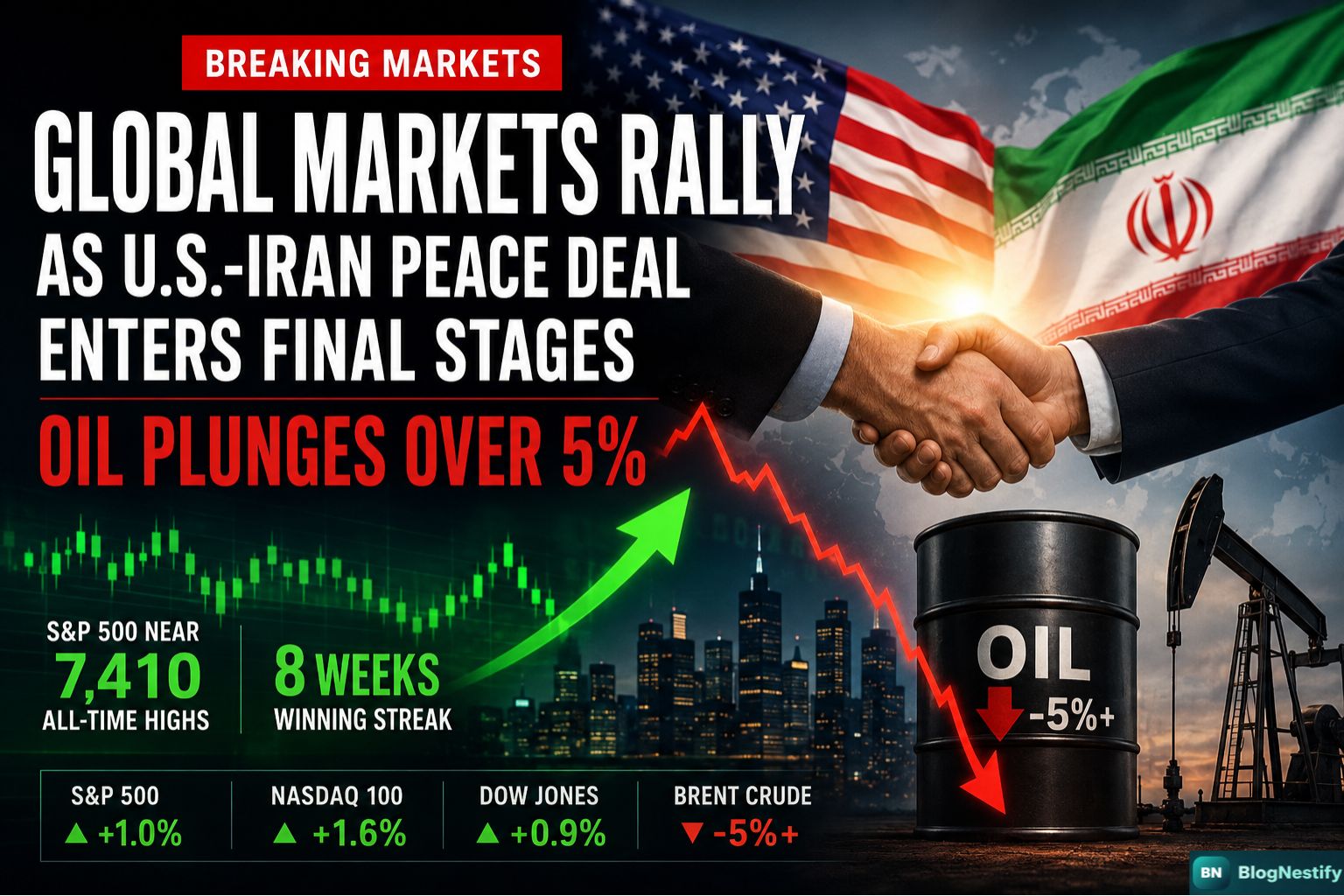
President Trump confirms negotiations are nearing conclusion. Crude oil sheds its war premium, global equities surge, and investors pivot hard into risk assets for the first time since February's Operation Epic Fury.
Something changed over the weekend. After months of ceasefire fragility, naval blockades, and on-again-off-again diplomacy, President Donald Trump told reporters on Sunday that U.S.-Iran peace negotiations are now in their "final stages." Markets didn't wait for official confirmation. They moved — fast and decisively.
By Monday morning, crude oil futures had dropped more than 5%. The S&P 500 extended what is already an eight-week winning streak. European indices surged at the open. Bond yields eased. The dollar softened. Every major risk indicator flipped green. This is what traders call a "risk-on" session — and it's one of the more convincing ones of 2026.
The question now isn't whether markets are responding rationally. They clearly are. The better question is whether the deal will hold, what it means for inflation heading into summer, and which sectors stand to gain the most from a sustained drop in energy prices.
Key Takeaways
- Trump confirmed U.S.-Iran peace deal talks are in their "final stages," triggering a global risk-on rally.
- Brent crude and WTI futures both dropped more than 5%, stripping out a large portion of the war risk premium that has inflated prices since late February.
- The S&P 500 is now on track for its eighth consecutive weekly gain, with the index trading near all-time highs around 7,410.
- Inflation expectations are easing — a sustained oil price decline would offer relief to central banks that have been watching energy-driven CPI spikes since March.
- Key risks remain: Iran's uranium stockpile question and Strait of Hormuz transit arrangements are still unresolved sticking points.
What Sparked Monday's Rally
The rally traces directly to a weekend statement from the White House. Trump signaled that both sides have made meaningful progress toward a permanent resolution of the conflict — the same conflict that began in earnest when U.S. and Israeli forces launched Operation Epic Fury against Iranian military sites on February 28, 2026. Since then, markets have been lurching between hope and dread every time a diplomat issues a statement.
This time, traders interpreted the signal as something more concrete. A Pakistani diplomatic delegation had met Iranian officials just days prior to arrange a new round of U.S.-Iran talks before the existing ceasefire's expiration. Back-channel communications have reportedly been running hot, and the 14-point Iranian proposal that Trump previously called a "workable basis for negotiations" appears to be moving toward a finalized framework.
Since the start of 2026, oil prices had climbed more than 65% as the Strait of Hormuz disruption removed roughly 14 million barrels per day from the global market — about 14% of total world supply. Monday's 5% drop is meaningful, but Brent crude is still trading above $100 per barrel. A full normalization of Hormuz flows isn't expected before early 2027 at the earliest, according to ADNOC's head.
A Quick Look at the Markets Today
| Asset / Index | Direction | Move | Driver |
|---|---|---|---|
| Brent Crude Oil | ▼ | −5%+ | War premium unwind |
| WTI Crude Oil | ▼ | −5%+ | Iran deal signals |
| S&P 500 | ▲ | +1%+ | Risk-on rotation |
| Nasdaq 100 | ▲ | Strong | Tech & growth rebound |
| European Indices | ▲ | Broad gains | Energy cost relief |
| U.S. Dollar (DXY) | ▼ | Softening | Haven demand drops |
| U.S. 10-Year Yield | ▼ | Slight ease | Inflation expectations fall |
| Gold | ▼ | Modest drop | Safe-haven selling |
Why Oil Prices Are the Real Story Here
The oil market has been carrying a massive war premium since late February. Before Operation Epic Fury, analysts were pricing Brent somewhere in the $70–$80 range on soft demand-supply fundamentals. The conflict pushed that to over $100, and at various points in April and May, prices briefly touched $110+. Every dollar above that baseline represents an inflation tax on the entire global economy.
Monday's 5% drop strips out part of that premium — but not all of it. The real inflection point comes when a permanent deal is signed, Strait of Hormuz passage is unconditionally restored, and supply from Iran, Saudi Arabia, Iraq, the UAE, and Kuwait flows freely again. That scenario would push oil meaningfully lower, probably into the $75–$85 range on Brent, according to BMI's pre-conflict baseline forecasts.
Until then, this is a "hope rally," not a "deal rally." The market is pricing in the probability that a deal gets done — and right now, that probability is rising fast.
Before the conflict, roughly 20% of all globally traded oil and gas passed through the Strait of Hormuz. Tehran's effective closure of this waterway since late February disrupted supplies from six major OPEC+ producers simultaneously. Even if a deal is signed today, ADNOC's chief has estimated that full oil flows through the Strait won't be restored until Q1 or Q2 of 2027.
What This Means for Inflation and the Fed
The Federal Reserve is stuck. March CPI came in at 3.3% year-on-year, up sharply from 2.4% in February, driven almost entirely by a 21.2% monthly surge in gasoline prices. The latest Fed minutes — released this past week — showed policymakers are not ruling out rate hikes if inflation doesn't cool. That's not what equity markets want to hear.
A sustained drop in oil prices changes that calculus. Lower energy prices flow through to gasoline, airline tickets, shipping costs, and food production within weeks. If Brent stays below $95 through June and July, the Fed gets breathing room. If a permanent deal brings prices back to the $80s, the rate-hike conversation effectively dies.
Markets are already pricing that scenario in. Bond yields eased today. The probability of a June rate hike has dropped. Traders are now betting on a late-2026 rate cut. That's a dramatic shift in narrative — one that justifies the breadth of today's equity rally beyond just energy stocks.
The Path to a Deal — And What Could Still Break It
Progress has been stop-start since the first ceasefire was agreed in early April. Here's the condensed version of how we got here:
2026
2026
2026
2026
2026
The two sticking points that have slowed finalization are Iran's enriched uranium stockpile and the question of permanent transit arrangements through the Strait of Hormuz — specifically, whether Tehran retains authority to impose "coordination protocols" on shipping. Neither issue is trivial, and both have derailed previous rounds of talks.
Markets have been here before. In May, one analyst quoted by CNBC noted: "This is not the first time a deal seemed close, only for negotiations to break down." Any official announcement delaying talks past May 31 would likely trigger an immediate reversal in oil and equities as traders reprice extended uncertainty.
Which Sectors Win — and Which Are Still Cautious
The rotation in equities today is telling. Technology and consumer discretionary stocks are leading gains — two sectors that benefit most from cheaper energy (lower logistics costs, better consumer spending power) and from a more accommodative Fed outlook. Airlines, shipping companies, and logistics firms are all sharply higher. Lower jet fuel and diesel costs have an almost immediate impact on operating margins for these businesses.
Retail and e-commerce names are catching bids too, for the same reason — Amazon and Walmart both stand to benefit from reduced transportation expenses that had been inflated by emergency fuel surcharges over the past three months.
Energy stocks are the obvious loser in this scenario. If oil prices genuinely normalize, the exceptional earnings that upstream producers and integrated majors have been posting since February begin to reverse. That's a real trade-off: good for the economy broadly, complicated for energy-heavy portfolios.
The Bigger Picture: What a Peace Deal Would Mean for 2026 Markets
Going into 2026, JPMorgan's Global Research team identified two key scenarios that could meaningfully boost equities beyond their base case. One was faster-than-expected disinflation — which a sustained oil price drop would deliver. The other was a geopolitical resolution that allowed global trade and energy flows to normalize.
Both scenarios are now on the table simultaneously. That's why today's rally feels different from the several "false starts" we saw in March and April. The macro backdrop has shifted. The S&P 500 has already built in a meaningful assumption that this conflict resolves relatively quickly — and each new signal from Washington and Tehran reinforces that bet.
The MSCI All Country World Index gained 10.2% in April alone, its strongest monthly gain in years. Emerging markets gained nearly 15%. Those numbers reflect the genuine global scope of what an energy price normalization would mean — not just for U.S. equities, but for commodity-importing economies across Asia, Europe, and South Asia.
Bottom Line
Today's rally is the market's clearest signal yet that it believes a U.S.-Iran peace deal is coming. Oil is pricing it in. Equities are pricing it in. Bond markets are pricing it in. The risk is that the deal falls through on uranium or Hormuz transit terms — and then we're back to square one. But right now, the direction of travel is clear, and the economic tailwinds from an oil price normalization would be substantial, touching everything from consumer spending to central bank policy to corporate margins.
Frequently Asked Questions
Why are global markets rallying today, May 25, 2026?
Global markets are rallying because U.S. President Donald Trump signaled that peace deal negotiations with Iran are in their "final stages." This triggered a sharp unwind of the geopolitical risk premium that has been embedded in oil prices and equities since February, sending crude down over 5% and boosting risk-on appetite across global stocks.
How much have oil prices dropped on U.S.-Iran peace deal news?
Oil prices have dropped more than 5% on Monday's latest peace signals. Brent crude had been trading above $103 in recent days. If a permanent deal is reached and the Strait of Hormuz is fully reopened, analysts expect Brent could fall further toward the $80–$90 range, though full supply normalization is not expected before 2027.
What are the main sticking points in the U.S.-Iran peace deal?
Two issues have repeatedly delayed finalization: Iran's enriched uranium stockpile (and what happens to it under a permanent deal) and transit arrangements through the Strait of Hormuz. Tehran has insisted on retaining coordination authority over shipping through the Strait, which the U.S. and its allies have pushed back against.
How does a U.S.-Iran peace deal affect inflation?
Lower oil prices are one of the most direct ways to ease inflation. Energy costs feed through to gasoline, transportation, food production, and manufacturing within weeks. If Brent crude falls back to the $80s, analysts expect meaningful relief on CPI readings — particularly on the gasoline component that has been the primary driver of elevated inflation since March.
Which stock market sectors benefit most from a U.S.-Iran peace deal?
Airlines, logistics, shipping, retail, and consumer discretionary sectors all benefit directly from lower energy costs. Technology stocks benefit from improved consumer spending power and a more dovish Fed outlook. Energy stocks are the primary negative — lower oil prices compress the profits that upstream producers and integrated majors have been enjoying since February.
Is the U.S.-Iran peace deal signed yet?
As of May 25, 2026, a permanent peace deal has not been signed. The U.S. and Iran remain in final-stage negotiations, with a framework reportedly close to finalization. A Pakistani diplomatic delegation brokered a meeting between Iranian officials and U.S. negotiators in the days before the existing ceasefire's expiration. Markets are pricing in a high probability of a deal, but nothing is confirmed yet.
0 Comments
Leave a Comment