India Bans Telegram Over NEET Paper Leak Fears: Everything That Happened, and Why
A nationwide block on Telegram, an edit-feature shutdown, and an app store delisting order, all timed to one Sunday exam. Here's what's actually going on.
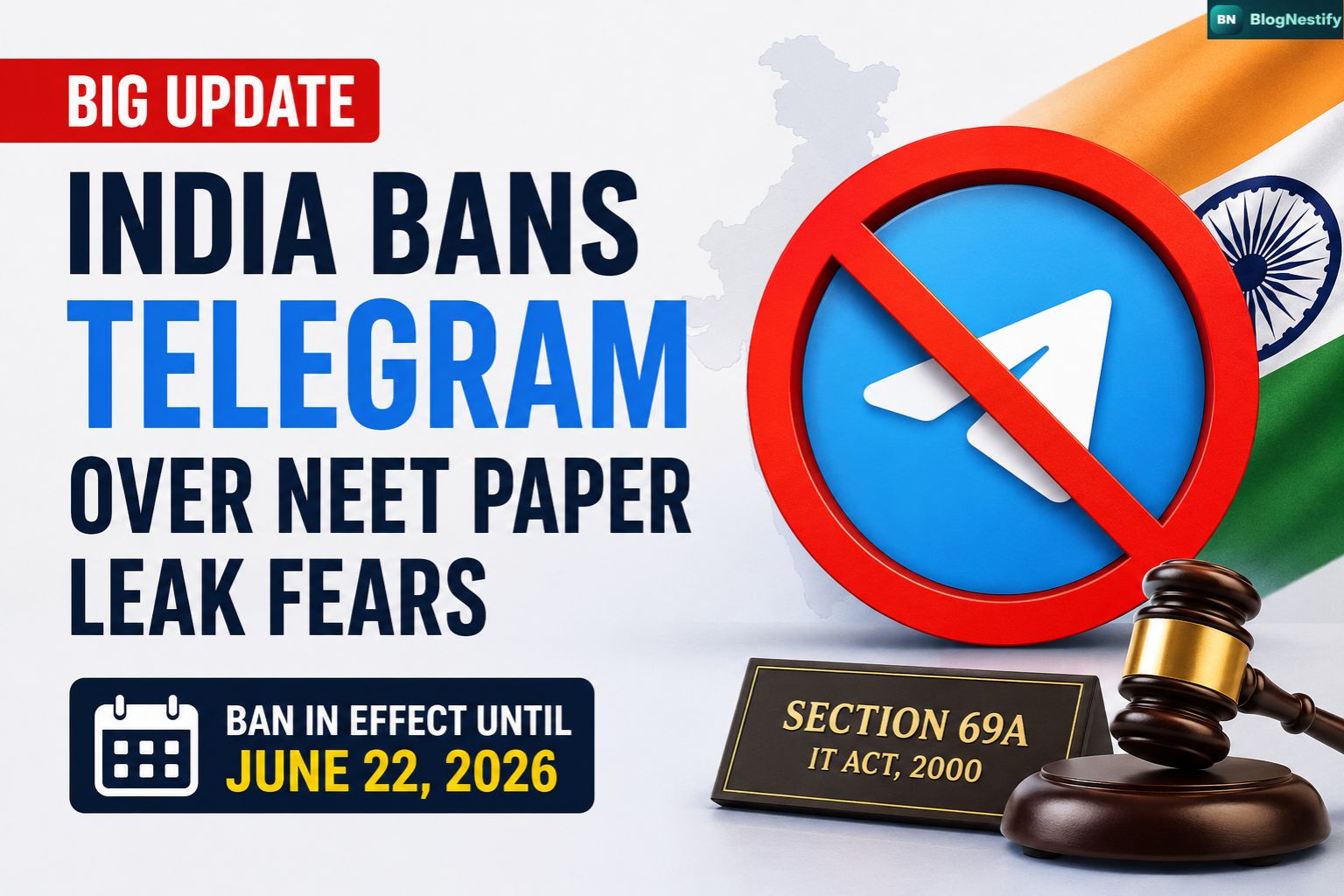
If you tried opening Telegram in India this week and got nothing but a spinning wheel, you're not imagining it. The Indian government has temporarily blocked the messaging app nationwide until June 22, 2026, invoking Section 69A of the Information Technology Act, 2000, ahead of the NEET-UG 2026 re-exam scheduled for June 21. The trigger wasn't a software bug or a corporate dispute. It was exam fraud, and a lot of scared, broke families.
I've followed enough NEET cycles on this site to know the pattern by now: a leak rumor surfaces, panic spreads faster than verification, and somewhere in a Telegram group, someone is charging a desperate parent real money for a PDF that doesn't exist. This time, the government decided to cut off the channel entirely instead of playing whack-a-mole with individual links.
What exactly happened
The Ministry of Electronics and Information Technology, acting on a recommendation from the National Testing Agency, issued a direction restricting access to Telegram across India for a limited window ending June 22. Google and Apple have confirmed they received an accompanying order to delist Telegram from the Play Store and App Store in India, and a source at Apple told Reuters the company intends to comply.
There's a second, narrower order riding alongside the ban. Telegram has also been told to disable its message-editing feature in India until June 30, 2026. That one is easy to miss but it tells you exactly how these scams operate: a channel posts something, exam day passes, and if the claim turns out to be wrong, the post quietly gets edited into something else, or into "proof" that they knew all along. Switching off editing closes that loophole. Whatever gets posted on a flagged channel between now and June 30 stays as it was written, screenshots and all.
Why NEET, and why now
More than 22 lakh students sat for NEET-UG 2026 on May 3, the entrance test required for admission to MBBS, BUMS, BHMS, BAMS, and several other medical and paramedical programs. That exam was cancelled and a re-test scheduled after allegations of a question paper leak. The re-exam affects more than 23 lakh students and is set for Sunday, June 21, from 2:00 PM to 5:15 PM.
That's the backdrop. NEET isn't a niche exam you can quietly patch and move on from. It decides who gets a medical seat in a country where the ratio of applicants to seats is brutal, and a single leak rumor can spiral into nationwide panic, court cases, and re-tests that cost the system months. The government's read here seems to be that the cost of a few days without Telegram is smaller than the cost of another contested, litigated exam cycle.
The scam channels behind the panic
According to the NTA, channels operating under names like "Paper Leaked NEET," "Re-NEET 2026," and "Private Mafia" had been demanding payments ranging from a few thousand rupees to several lakh for supposed advance access to the exam paper. A channel calling itself "REE NEET MAFIAA" turns up in NTA's list too.
None of it was real, according to the agency that runs the exam. The NTA has reiterated that no examination paper has been leaked, and that any claim offering advance access to the question paper is fraudulent. The agency has gone further, stating plainly that no NEET paper exists outside the secured examination chain, and that anyone claiming otherwise is committing fraud.
If someone messages you claiming to sell the NEET paper, it's a scam. There is no version of "early access" to a secured national exam that's legitimate. Report and block, don't pay.
This isn't Telegram's first brush with exam leaks in India
Anyone who followed the 2024 UGC-NET mess will recognize the shape of this story. In that case, the CBI questioned a suspect in Uttar Pradesh's Kushinagar district who allegedly posted a portion of the exam paper on Telegram. The university grants commission had received intelligence from the Indian Cyber Crime Coordination Centre that the paper was reportedly circulating on messaging platforms for several lakh rupees before the agency moved to cancel that exam too.
Why does Telegram keep coming up? Legal experts point to a basic structural problem: Telegram has no registered office in India, which makes it slow or unresponsive to law enforcement requests in a way that Indian-regulated platforms aren't. Large file sharing, semi-anonymous channel ownership, and a platform that's historically been lighter on content moderation than its competitors make it a convenient venue for exactly this kind of fraud, alongside piracy and other illegal file distribution that has nothing to do with exams.
What students and parents should actually do this week
Practically speaking, the ban changes very little about your exam prep, but it changes a lot about where your anxiety might come from. A few things worth keeping in mind heading into June 21:
- Treat every "leaked paper" claim as false by default. The NTA has said it directly, and the pattern from past exam cycles backs that up.
- Use the NTA's official website for your admit card and any last-minute updates rather than forwarded messages from group chats.
- If you haven't changed your exam city, your centre stays the same as it was for the original May NEET-UG attempt, but you'll need your updated re-exam admit card to be let in.
- Don't transfer money to anyone over a messaging app claiming exam access, no matter how convincing the screenshots look.
- If you spot a suspicious channel or forwarded message, report it rather than sharing it further. Forwarding panic is how these scams scale.
What Section 69A actually allows the government to do
Section 69A of the IT Act gives the central government the power to direct any intermediary to block public access to specific information, or in this case an entire platform, when it's deemed necessary in the interest of the sovereignty, integrity, defence, or security of the state, friendly relations with foreign states, or public order. It's the same legal provision that's been used in the past to restrict access to other apps and websites in India. What's notable here is the scope: this isn't a takedown of a few flagged channels, it's a blanket restriction on the whole platform, even if it's framed as temporary and tied to a specific exam window.
Frequently asked questions
Why has India banned Telegram?
The government blocked access to Telegram nationwide after the National Testing Agency flagged channels using the app to spread fake NEET paper leak claims and extract money from candidates and families ahead of the June 21 re-exam.
How long will the ban last?
The access restriction runs until midnight on June 22, 2026. The separate order disabling Telegram's message-edit feature in India stays in effect until June 30, 2026.
Has the NEET paper actually leaked this time?
No. The NTA says no paper has left the secured examination chain and that every channel claiming otherwise is running a scam.
What law is being used here?
Section 69A of the Information Technology Act, 2000, which lets the government order intermediaries to block access to content or platforms on public order and security grounds.
The bigger picture
Blocking an entire app to protect one exam is a heavy-handed tool, and it's fair to ask whether it sets an uncomfortable precedent. At the same time, it's hard to argue with the underlying problem: a platform with no India office, near-anonymous channel creation, and a multi-year track record of exam leak scams is not an easy thing to police one link at a time. Whether this approach actually reduces fraud around the June 21 re-exam, or simply pushes the scammers onto WhatsApp and Instagram for a few days, is something we'll only know after results are out.
For now, the most useful thing any NEET candidate or parent can do is treat the silence from official channels as the actual signal. If the NTA hasn't confirmed it, it didn't happen.
Khushal Charaniya is the Founder and Editor of Blognestify, covering technology, AI, cybersecurity, business, and global affairs. He focuses on accurate, reader-first reporting that helps audiences understand fast-moving policy and tech stories as they unfold.
Sources: National Testing Agency statements, Deccan Herald, Gulf News, Business Today, ummid.com, Careers360. This article will be updated if government or NTA guidance changes before June 21.
0 Comments
Leave a Comment