India Slashes Excise Duty on Ethanol-Blended Petrol: E22 to E30 Now Tax-Free
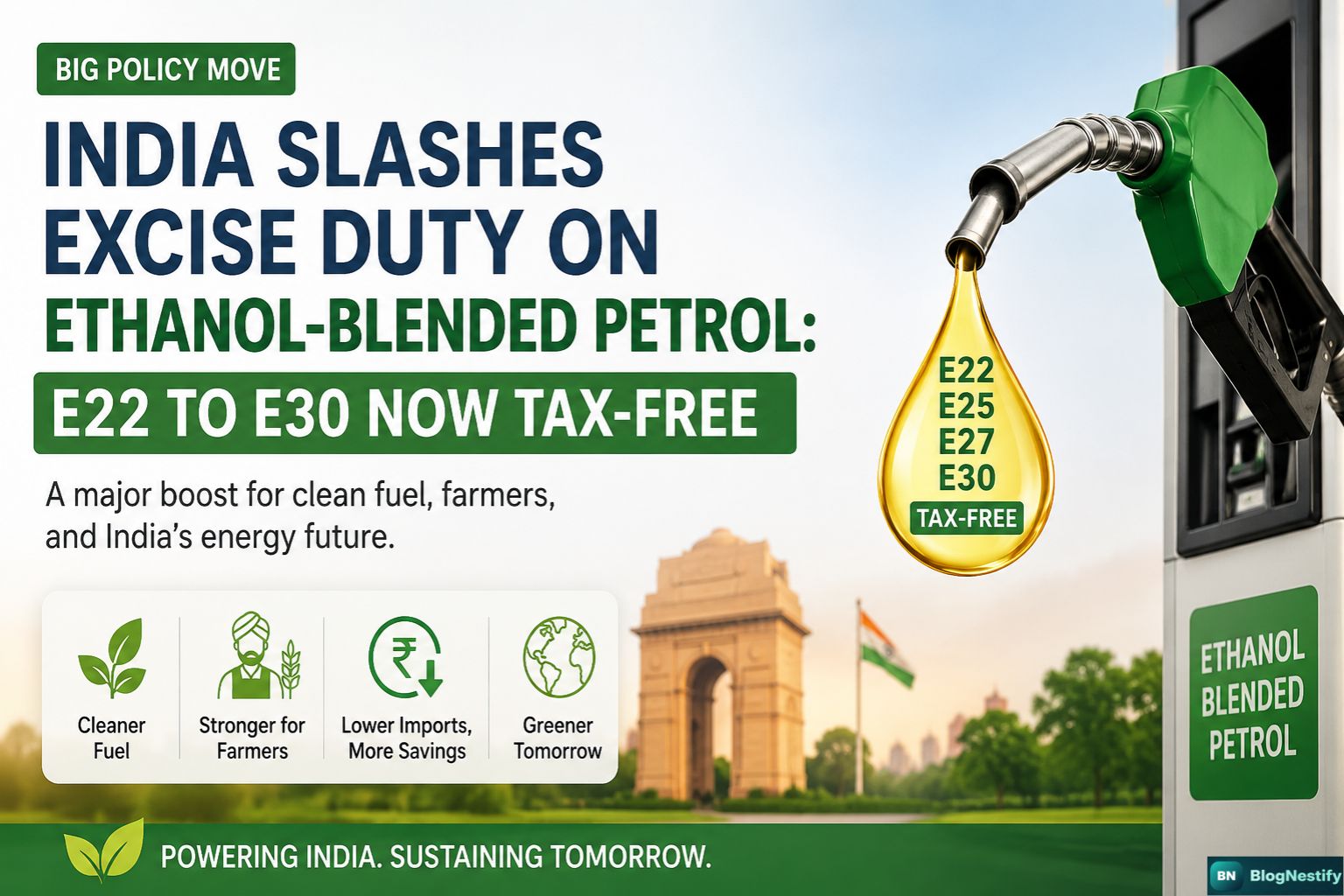
India's Ministry of Finance issued notifications on June 10, 2026, setting the central excise duty to nil on petrol blended with 22% to 30% ethanol. E22, E25, E27, and E30 fuel variants are now fully exempt from excise duty, Road and Infrastructure Cess, and related levies — but pump prices haven't changed yet, and these blends require specially certified vehicles.
India just sent a clear signal about where its fuel future is headed. The central government quietly issued a set of notifications on June 10, 2026 — removing excise duty on petrol blended with 22%, 25%, 27%, and 30% ethanol. It's a technical-sounding move, but the intent is ambitious: push fuel suppliers to go beyond the 20% ethanol blending India already achieved ahead of schedule, and keep the country's momentum toward cleaner, domestically produced fuel going.
Here's what happened, why it matters, and what it means if you're a motorist, a farmer, or anyone watching India's energy story unfold.
What the Government Actually Did
The Department of Revenue, under the Ministry of Finance, issued a series of gazette notifications on June 10, 2026. These notifications amended existing central excise rules to bring four new fuel categories under a zero-duty framework:
The exemption was granted under Section 5A of the Central Excise Act, 1944. The government also extended nil rates to the Special Additional Excise Duty and the Road and Infrastructure Cess on these blends. The Agriculture Infrastructure and Development Cess framework was similarly amended to give them concessional treatment.
One important technical note: the exemption applies only to fuel blends that meet Bureau of Indian Standards specification IS 19850. And the taxes on the individual components — ethanol and duty-paid petrol — remain unchanged. The nil duty is on the final blended product.
Why Now? The Context Behind the Move
India hit its 20% ethanol blending target (E20) in 2025 — five full years ahead of the original 2030 deadline. That's not a small thing. Going from 1.5% blending in 2013-14 to 20% in roughly a decade took sustained policy commitment, distillery capacity expansion, feedstock diversification, and supply chain overhaul across oil marketing companies.
But the government isn't stopping at E20. Nitin Gadkari, Union Minister for Road Transport and Highways, has spoken publicly about India targeting E27 by 2030. Petroleum Minister Hardeep Singh Puri launched E85 fuel on World Environment Day (June 5, 2026), making it available at 48 fuel stations run by public-sector oil marketing companies. E100 is in the feasibility study phase.
The excise exemption on E22 to E30 fills a tax gap that existed in the previous framework — those blend categories simply weren't defined under excise rules. Now they are, and they're tax-free at the production level. That removes a cost barrier for refiners and fuel suppliers who might otherwise hesitate to invest in the infrastructure for higher-blend fuels.
The Bureau of Indian Standards notified technical specifications for E22, E25, E27, and E30 fuel just weeks before this notification. The excise notification follows as the next logical policy step — define the fuel, set the standard, then create the tax incentive for producers to actually make it.
Will Petrol Prices Drop at the Pump?
This is where expectations need a reality check. Retail petrol prices at major cities did not change on June 11, 2026. The tax relief isn't a consumer subsidy. It's aimed at the supply chain: refiners, blenders, and oil marketing companies who produce the fuel.
There's also a vehicle compatibility issue. E22, E25, E27, and E30 petrol cannot be used in just any car. Under Automotive Industry Standard AIS 171, only vehicles that have been specifically designed, tested, and certified for fuel containing more than 20% ethanol can use these blends. Currently, that covers certain passenger cars, utility vehicles, three-wheelers, and select commercial vehicles where manufacturers have made the necessary changes to fuel systems, seals, and engine calibration.
In short, if your current car runs on regular E20 petrol, this notification doesn't immediately change anything for you. But it sets up the regulatory and tax foundation so that when E25 or E30 fuel does become widely available, the economics for producers are already settled.
How Far India Has Come: The Ethanol Blending Programme in Numbers
India's Ethanol Blending Programme (EBP) started in 2003, and for its first decade moved slowly. Things changed dramatically after 2014, when policy targets were repeatedly advanced and procurement prices were rationalized to make ethanol production financially viable for distilleries. The results have been substantial.
The blending trajectory tells the story clearly: 1.5% in ESY 2013-14, 10% by June 2022, 14.6% in ESY 2023-24, 17.98% by February 2025, and then full 20% in 2025. India's ethanol production capacity has grown from under 2 billion litres in 2014 to nearly 20 billion litres — far exceeding what E20 alone requires. That surplus capacity is exactly why the government can now credibly target E25 and beyond.
What This Means for Farmers and Sugar Mills
India's ethanol programme isn't just an energy story — it's an agricultural policy too. The primary feedstocks for ethanol production are sugarcane molasses, damaged grains, and increasingly maize and other crops. The National Policy on Biofuels has progressively expanded the list of permitted feedstocks to prevent any single commodity from being strained.
When refiners can sell higher-blend petrol without a central excise burden on the blended product, the commercial case for procuring more ethanol strengthens. That feeds back to sugar mills, grain-based distilleries, and the farmers who supply them. By creating a favorable tax environment for E22 to E30 production, the government is essentially creating additional ethanol demand — which translates into procurement contracts and income for the agricultural supply chain.
Uttar Pradesh, Maharashtra, and Karnataka are currently the top ethanol-producing states, accounting for the bulk of sugar-based ethanol supply. Grain-based production — using broken rice, maize, and wheat — provides the diversification that prevents over-reliance on cane.
India's Bigger Green Fuel Ambitions
The excise notification is one piece in a larger policy picture. On June 5, 2026 — World Environment Day — Minister Hardeep Singh Puri launched E85 fuel at 48 outlets across public-sector oil marketing companies. E85 contains 85% ethanol and is designed for flex-fuel vehicles capable of operating on a wide range of ethanol-petrol mixtures. The government has said it expects to expand the E85 retail network significantly over the next two years.
India is also studying E100 feasibility — a pure ethanol fuel suitable for specially designed engines, already used in Brazil. This is still in the research and planning phase for India, but the trajectory is unmistakable.
The National Policy on Biofuels, as amended in 2022, formally targets 27% blending by 2030. The vehicle compatibility framework — AIS 171 — is being updated to keep pace with the fuel standards being set by BIS. Automakers selling in India are already designing for E20 compatibility across all new vehicles from April 2023, with BS-VI vehicles required to fully meet E20 emission standards from April 2025.
Moving from E20 to E30 is expected to further reduce vehicular carbon monoxide, hydrocarbon, and particulate matter emissions. Sugarcane-based ethanol cuts lifecycle greenhouse gas emissions by roughly 65% compared to petrol. Second-generation ethanol from agricultural waste — which India is developing through 2G bio-refineries — cuts them by over 50%.
Quick Glossary: Understanding Ethanol Fuel Terms
If terms like E22 or ESY are new to you, here's a plain-language breakdown:
- E20: Petrol blended with 20% ethanol and 80% petroleum — now the standard for all petrol sold in India.
- E22/E25/E27/E30: Higher ethanol blends, now tax-exempt under the June 10, 2026 notification. Require certified compatible vehicles.
- E85: 85% ethanol blend, designed for flex-fuel vehicles. Available at 48 stations as of June 2026.
- ESY (Ethanol Supply Year): India's ethanol blending calendar runs October to September, so ESY 2025-26 means October 2025 to September 2026.
- BIS IS 19850: Bureau of Indian Standards fuel specification that E22–E30 blends must meet to qualify for the excise exemption.
- AIS 171: Automotive Industry Standard defining which vehicles are certified to use petrol with more than 20% ethanol.
- National Policy on Biofuels: India's overarching biofuel framework, amended in 2022 to expand feedstocks and advance blending targets.
Frequently Asked Questions
The Bottom Line
India's excise duty waiver on E22 to E30 petrol isn't a headline-grabbing pump-price cut for consumers. It's a quieter, structural move — the kind that removes a tax obstacle from the supply chain so that producers can invest in higher-blend fuel without a cost penalty. Combined with the BIS fuel specifications issued just weeks earlier, and the E85 launch on World Environment Day, this is the government building the regulatory stack for a post-E20 fuel market.
The Ethanol Blending Programme has already delivered results that looked ambitious just a few years ago: ₹1.44 lakh crore in forex savings, 736 lakh metric tonnes of CO₂ avoided, and meaningful income routed to farmers. Whether India can sustain that momentum into E25 and E27 territory will depend on how fast vehicle compatibility standards are adopted, how quickly distillery capacity scales, and whether the infrastructure catches up. The tax policy is now set. The rest is execution.
0 Comments
Leave a Comment