Just 1–2% Traders Drive 70% of India’s F&O Volumes: Nithin Kamath Flags Market Imbalance
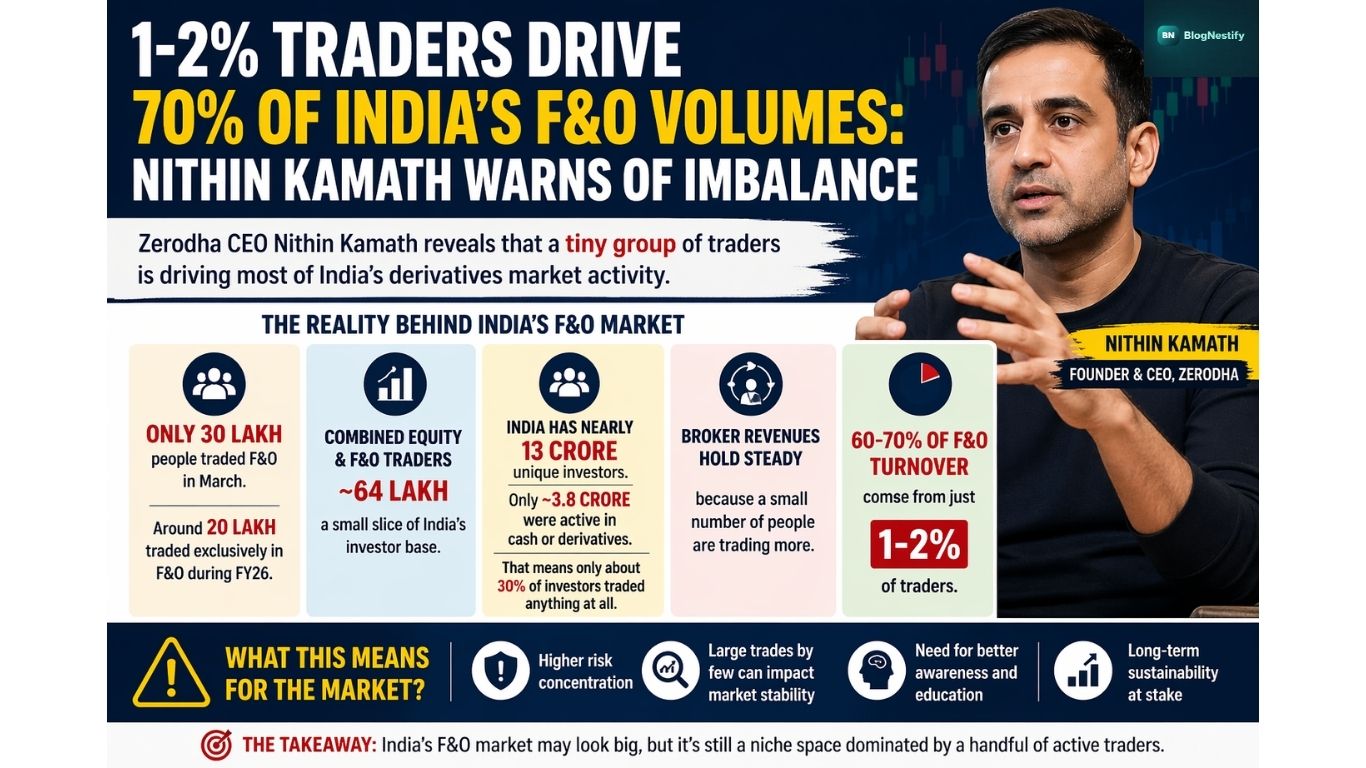
India’s booming derivatives market often appears massive and fast-growing from the outside. But beneath the surface, the reality is far more concentrated. According to Zerodha founder and CEO Nithin Kamath, a very small group of traders is responsible for most of the activity.
This insight raises important questions about how balanced and sustainable the market really is.
A Surprisingly Small Market
Despite the growing buzz around futures and options (F&O), actual participation remains limited. Kamath highlighted that compared to India’s overall investor base, F&O trading is still a niche segment.
“Despite what people think about F&O trading in India, it is still a very small market compared to almost anything else.”
In March alone, around 30 lakh traders participated in F&O contracts. Across the full financial year FY26, about 20 lakh individuals traded exclusively in F&O.
Even after combining equity and derivatives traders, the total stands at roughly 64 lakh — a small fraction of India’s rapidly growing investor base.
Most Investors Are Not Actively Trading
India now has nearly 13 crore unique investors. However, only about 3.8 crore were active in either equity or derivatives trading.
This means nearly 70% of investors are not actively trading. Many hold demat accounts but do not regularly participate in the market.
Interestingly, broker revenues remain stable — not because more people are trading, but because a small group is trading more frequently.
A Highly Uneven Market Structure
The imbalance becomes even more evident in the derivatives segment.
Around 60–70% of total F&O trading volumes come from just 1–2% of traders.
In simple terms, a handful of highly active traders dominate the market, while the majority remains on the sidelines.
What This Means for Investors
This concentration highlights several key concerns:
- Risk Concentration: Heavy reliance on a small group increases systemic risk.
- Market Volatility: Large trades from few players can impact price movements.
- Investor Awareness: Many investors may lack understanding of derivatives trading.
- Long-term Sustainability: A market driven by a few may face stability challenges.
Final Thoughts
The Indian F&O market may look large and dynamic, but in reality, it remains a niche space dominated by a handful of active traders.
As participation grows, the focus should shift toward better awareness, balanced involvement, and responsible trading practices to ensure long-term market stability.
0 Comments
Leave a Comment