India's ₹3 Fuel Shock, The Beijing Summit, and The Adani Reversal
Three stories landed on the same day — and none of them travel in a straight line. Here's what actually happened, and why it matters.
At a Glance
India Finally Blinks on Fuel Prices
India held the line for four years. No matter what crude did on the global market, the government kept retail petrol and diesel prices frozen — an unspoken political contract with voters that everyone understood but nobody said out loud.
That contract ended on Friday, May 15.
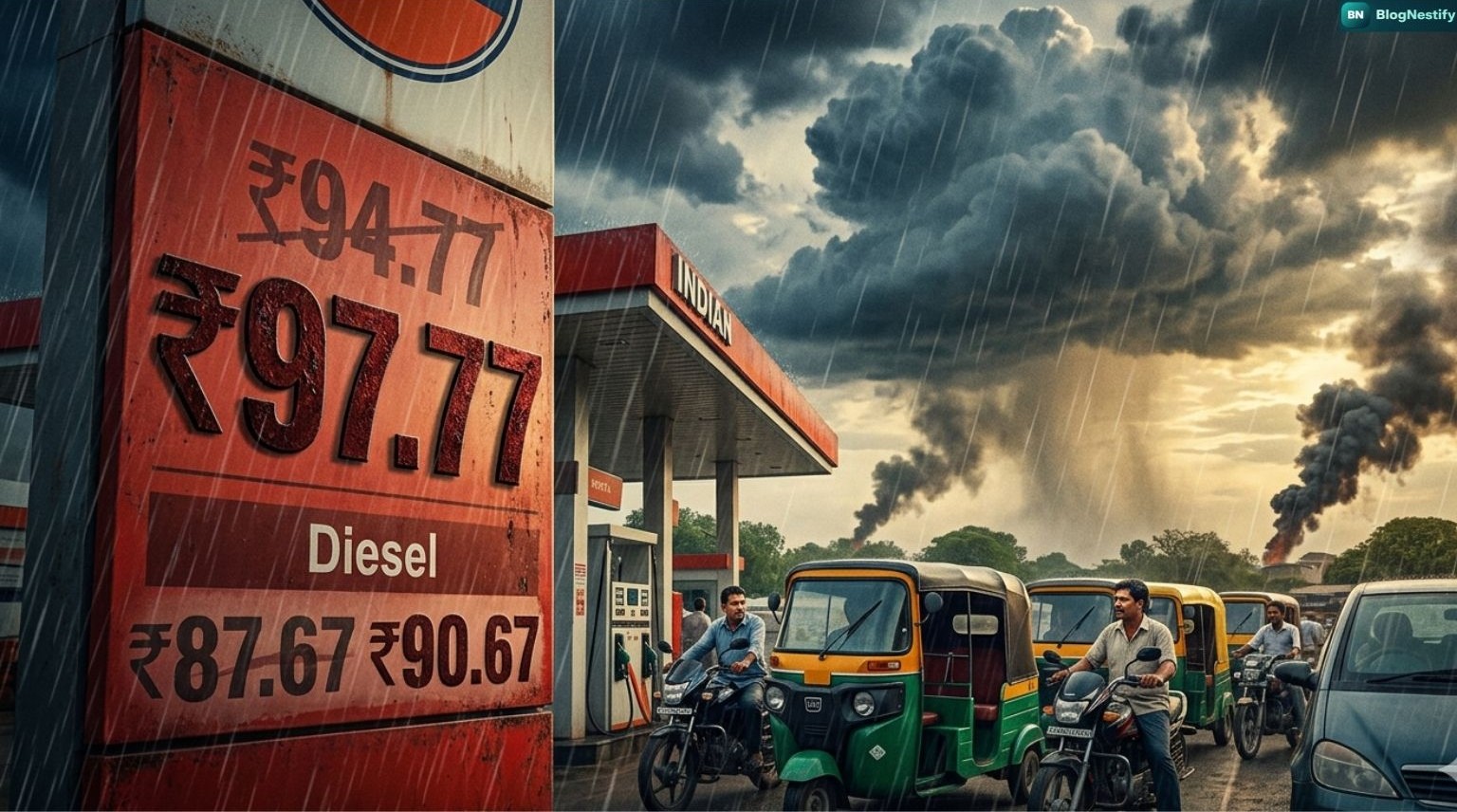
Oil marketing companies revised petrol and diesel prices upward by ₹3 per litre across the country, citing sustained losses caused by the surge in global crude costs triggered by the Middle East conflict. In Delhi alone, petrol jumped from ₹94.77 to ₹97.77 per litre. Diesel followed a similar path, moving from ₹87.67 to ₹90.67.
What's Driving This
The Strait of Hormuz — roughly a 33-kilometre-wide waterway between Oman and Iran — accounts for about 20% of the world's seaborne oil trade. The ongoing West Asia conflict has disrupted shipping through this route, and the knock-on effect on crude prices has been brutal. Brent crude went from around $76 per barrel in early March to $105.76 by May 13. That's a 38% jump in under three months.
India imports over 85% of its crude oil and is deeply exposed to any disruption in Middle East supply lines. RBI Governor Sanjay Malhotra said at a conference in Switzerland that it was essentially "a matter of time" before the government passed on some of the cost to consumers.
Even before the official announcement, long queues formed at petrol stations across Delhi-NCR, Uttar Pradesh, Gujarat, and Bihar. Consumers feared further hikes — with some expecting prices to rise by ₹5 to ₹20 per litre in the coming weeks.
New Prices Across Major Cities
| City | Petrol (₹/L) | Diesel (₹/L) | Change |
|---|---|---|---|
| Delhi | 97.77 | 90.67 | +₹3.00 |
| Mumbai | 106.68 | 93.14 | +₹3.12 |
| Kolkata | 108.74 | 95.13 | +₹2.97 |
| Chennai | 103.67 | 95.25 | +₹2.86 |
The rupee has also taken a hit — touching a record intraday low of ₹95.34 against the US dollar — which compounds the cost of oil imports denominated in dollars. None of this helps inflation, which was already edging up.
This revision may not be the last. Speculation is circulating that rates could climb further before things stabilise.
— India Today ground report, May 15, 2026
There's a reasonable case that Friday's ₹3 hike is a calculated partial pass-through — enough to stop the bleeding for oil marketing companies, but not enough to absorb everything if crude stays above $100. If the Strait of Hormuz situation doesn't improve, this conversation will come back around by summer.
Trump and Xi in Beijing: Stability Without Trust
The same day India raised fuel prices, US President Donald Trump wrapped up a three-day state visit to Beijing — only the second time he's been received by Xi Jinping in China, and the first since his second presidency began.
The two leaders met at the Great Hall of the People on May 13 and continued talks through May 15. If you were hoping for a decisive breakthrough, you won't find one here. What you get instead is something arguably more durable: a managed-stability framework that both sides seem willing to work within.
What They Agreed
According to Beijing's official readout, Xi and Trump agreed to develop a "constructive China-US relationship of strategic stability" — cooperation as the dominant note, "measured competition" managing the rest, and guardrails to prevent things from spiralling. Xi said this framework would guide policy for at least the next three years.
Both leaders explicitly agreed that the Strait of Hormuz must remain open to restore global energy flows — a rare point of alignment given how differently Washington and Beijing are positioned on the Iran conflict.
On trade, the talks covered expanding US market access in China and Chinese investment in American industries. Trump also pushed hard on fentanyl — asking Beijing to step up controls on precursor chemicals flowing into the US. Agricultural purchases from America were on the table too.
The Taiwan question loomed large. Chinese readouts in recent months have centred increasingly on Taiwan, while American readouts have focused on economics. Before the trip, Trump broke with long-standing US protocol by announcing he intended to discuss arms sales to Taiwan with Xi directly — a move that alarmed Taipei and put the administration's Taiwan policy under scrutiny.
The Bigger Picture
The context matters here. China entered these talks from a position of relative confidence. In 2025, Xi successfully used rare earth restrictions to push back against Trump's tariff escalation, and Beijing's energy stockpiles have largely insulated it from the early effects of the Strait of Hormuz disruption.
The US, on the other hand, is managing stretched military supply chains after significant weapons expenditure in the Middle East and Ukraine — which makes access to Chinese rare earths and permanent magnets more strategically sensitive than ever.
It signals a period of 'managed stability' that will hold for some time. There will be a guardrail, and things won't spiral out of the two sides' control as they nearly did in 2025.
— Tianchen Xu, Senior Economist, Economist Intelligence Unit
The summit produced no joint statement — which is normal for US-China meetings — and the symbolic wins were mostly symbolic. But an EIU economist described the outcome as a genuine guardrail moment: meaningful enough to contain volatility, limited enough to leave the underlying tensions in place.
The Adani Case: A Legal Reversal Nobody Saw Coming
For more than 18 months, a bribery indictment from a New York federal court sat over the Adani Group like a loaded question. The US Securities and Exchange Commission and the Department of Justice had alleged that Gautam Adani, his nephew Sagar Adani, and others had orchestrated a $250 million-plus bribery scheme between 2020 and 2024 to secure solar energy contracts in India.
Now, according to reports from Bloomberg and The New York Times citing people familiar with the matter, the DOJ is planning to drop those criminal charges entirely.
How the Case Unravelled
Adani's legal team got a new lead counsel: Robert J. Giuffra Jr. of Sullivan & Cromwell LLP — who is also one of President Trump's personal lawyers. Last month, Giuffra's team held a meeting at DOJ headquarters in Washington and walked prosecutors through roughly 100 slides arguing they lacked both sufficient evidence and jurisdiction to proceed. The core argument was that the alleged conduct involved Indian defendants, an Indian issuer, securities not registered with the SEC, and underlying conduct that took place exclusively in India.
As part of that meeting, Giuffra's team reportedly suggested that if charges were dropped, Adani would invest $10 billion in the American economy and create 15,000 jobs. Prosecutors told the counsel this would not affect the case — though NYT reported the offer drew a "favourable response" from at least one Justice Department official.
The civil case is moving toward a separate resolution. Bloomberg reported that Adani is in talks for a $15–20 million SEC settlement, with Gautam personally expected to pay a portion of that. The conglomerate is also reportedly close to a $275 million settlement with the Office of Foreign Assets Control on a parallel probe.
What This Means
The legal reversal is significant for several reasons. Adani Group shares had taken a severe beating after the original indictment in November 2024, and the group was frozen out of certain international capital markets. A clean exit from the criminal case — particularly in the current US political climate, where the Trump administration has shown selective prosecutorial priorities — could reopen those doors quickly.
It also says something about how legal strategy works at this level. The hire of Giuffra — a lawyer with direct access to the current US president — was not accidental. And the offer to invest $10 billion in America, timed to a legal presentation to federal prosecutors, sits in genuinely murky territory.
None of this means Adani is entirely in the clear. The SEC civil settlement and OFAC probe are still live. But the criminal charges — the part with the most reputational and operational weight — appear to be heading for the exit.
Connecting the Dots
These three stories feel separate on the surface — domestic fuel policy, superpower diplomacy, and a corporate legal drama. But they're all moving along the same underlying current.
The Middle East conflict is the thread running through everything. It's what drove Brent crude to $105 and forced India's hand on fuel prices. It's what made the Strait of Hormuz the single most urgent agenda item when Trump sat down with Xi. And it's indirectly what has made the geopolitical environment one in which the Trump administration is recalibrating which fights to pick — whether that's with Beijing over trade or with the DOJ over which foreign business cases to pursue.
The global picture right now is one of managed instability — where major actors are trying to contain costs and reduce friction without resolving the underlying problems. India is absorbing a price hike it couldn't delay anymore. Washington and Beijing are putting guardrails around a rivalry neither can afford to let escalate. And one of the world's wealthiest men is doing what the wealthy tend to do when faced with legal exposure: hire the best lawyers, frame the problem differently, and find an exit.
Frequently Asked Questions
India raised petrol and diesel prices by ₹3 per litre on May 15, 2026, because the ongoing Middle East conflict caused a blockade of the Strait of Hormuz — through which about 20% of the world's oil supply passes. Crude oil climbed roughly 38% between March and mid-May 2026, forcing oil marketing companies to pass those costs on to consumers after a four-year freeze on retail fuel rates.
After the ₹3 per litre hike on May 15, 2026: Delhi — petrol ₹97.77, diesel ₹90.67. Mumbai — petrol ₹106.68, diesel ₹93.14. Kolkata — petrol ₹108.74, diesel ₹95.13. Chennai — petrol ₹103.67, diesel ₹95.25.
Trump and Xi agreed on a "constructive China-US relationship of strategic stability" framework, covering cooperation and measured competition for at least the next three years. Key outcomes included discussions on US market access in China, Chinese investment in American industries, fentanyl controls, and agricultural purchases. Both leaders also agreed the Strait of Hormuz must remain open to stabilise global energy flows.
As of May 2026, the US Department of Justice is planning to drop criminal bribery charges against Gautam Adani after his new legal team — led by Robert Giuffra Jr., one of President Trump's personal lawyers — argued that prosecutors lacked evidence and jurisdiction. The SEC civil fraud case is heading toward a $15–20 million settlement, and the conglomerate is reportedly close to a $275 million OFAC settlement.
India imports over 85% of its crude oil and is highly exposed to Middle East supply disruptions. The Strait of Hormuz blockade pushed crude prices up roughly 38% between March and May 2026, weakened the rupee to a record low of ₹95.34 against the dollar, stoked inflation, and forced the first fuel price hike in four years.
Disclaimer: This article is based on publicly available reports and news sources as of May 15, 2026. Fuel prices vary by state and may have changed. Legal proceedings mentioned are subject to ongoing developments. Nothing in this article constitutes financial or legal advice.
0 Comments
Leave a Comment