India Just Approved Two More Semiconductor Plants in Gujarat — and the Details Are Worth Knowing
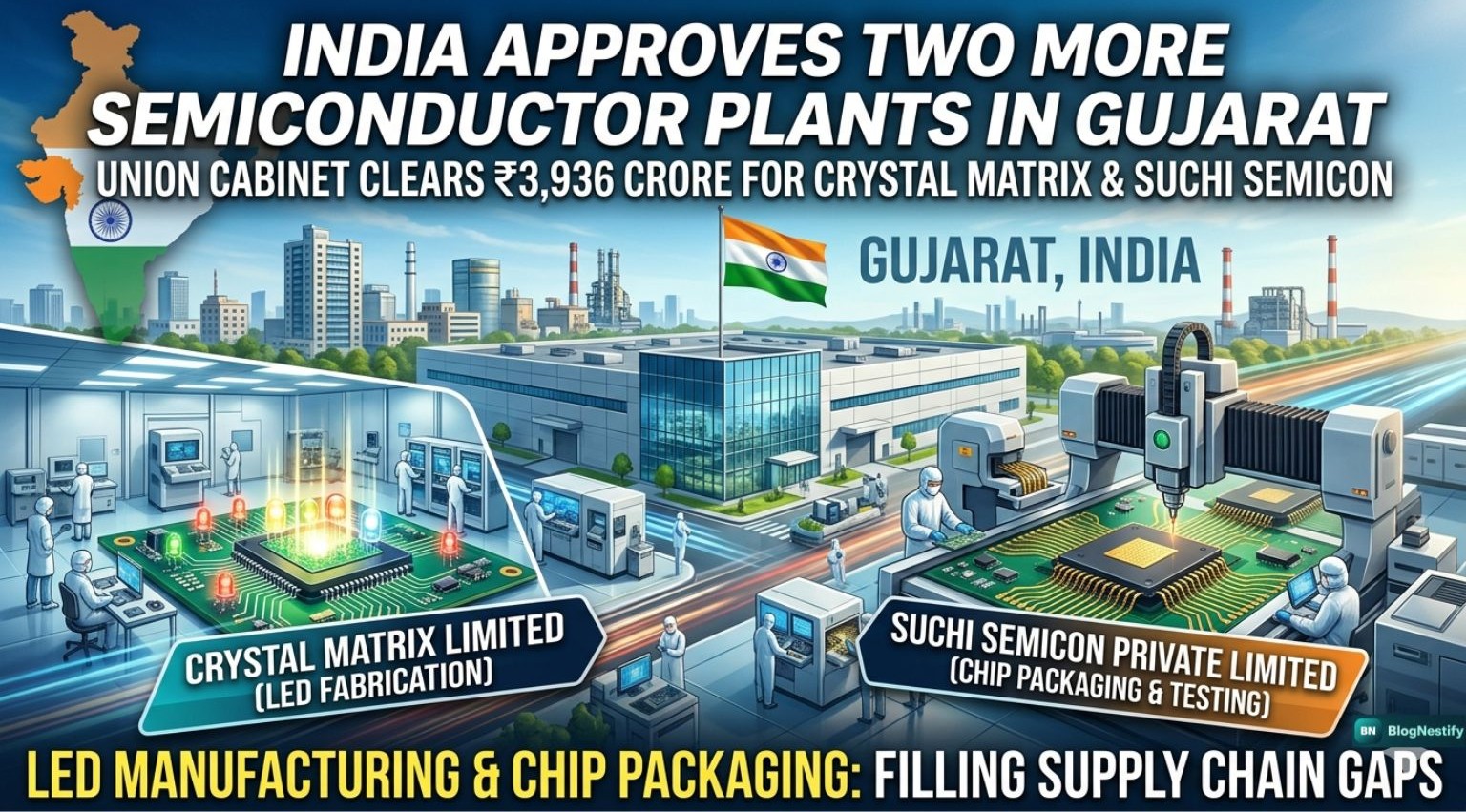
The Union Cabinet cleared ₹3,936 crore for Crystal Matrix Limited and Suchi Semicon Private Limited. One does LEDs, the other does chip packaging. Together, they fill two specific gaps in India's supply chain.
India keeps adding chips to the board. Two more semiconductor projects just got Union Cabinet clearance — both in Gujarat, both under the India Semiconductor Mission (ISM), and both targeting areas where India has quietly depended on imports for decades.
The approvals are for Crystal Matrix Limited and Suchi Semicon Private Limited, with a combined outlay of ₹3,936 crore. One company is betting on mini and micro-LED displays. The other is building chip packaging infrastructure. Neither is as flashy as a full silicon fabrication plant, but both address real bottlenecks in how India uses — or outsources — semiconductor manufacturing today.
What the Cabinet Actually Approved
Both facilities go under the ISM's Production Linked Incentive framework, which offers fiscal support for companies that set up and operate semiconductor-related manufacturing in India. The government doesn't hand over money upfront — companies get support as they hit production milestones.
Crystal Matrix Limited is going into mini/micro-LED display manufacturing. This is compound semiconductor territory — not the silicon chips that power your phone's processor, but the gallium nitride and gallium arsenide-based LEDs that make screens glow. India imports nearly all of this today, mostly from Taiwan and China. A domestic supply could serve TV manufacturers, automotive display makers, and the growing market for wearables and industrial panels.
Suchi Semicon Private Limited is focused on semiconductor packaging. This is the back-end of chip manufacturing — after a chip is fabricated on a wafer, it gets cut, assembled into a package, and connected to the outside world. India currently exports most of its fabricated dies overseas for this step. Domestic packaging capacity means India captures more value from chips before they ship.
| Detail | Crystal Matrix Limited | Suchi Semicon Pvt. Ltd. |
|---|---|---|
| Focus | Mini/Micro-LED Display | Semiconductor Packaging |
| Technology | Compound semiconductor (GaN, GaAs) | ATMP (Assembly, Test, Mark, Pack) |
| Location | Gujarat | Gujarat |
| End markets | TVs, wearables, automotive displays | Consumer electronics, industrial chips |
| Import substitution | LEDs from Taiwan/China | Packaging done abroad |
Why Gujarat Again?
Gujarat is becoming India's semiconductor cluster the same way Tamil Nadu became its auto hub — by accumulating the first few big bets until the infrastructure and talent ecosystem grows around them.
Micron Technology is already building its ATMP plant in Sanand. Tata Electronics' massive fab (in partnership with Taiwan's PSMC) is coming up in Dholera. When you stack those alongside the two new approvals, Gujarat is starting to look like a real industrial zone for chips rather than a collection of one-off announcements.
There are practical reasons for this. Reliable power, proximity to Mundra and Kandla ports, established industrial land banks, and the GIFT City financial infrastructure all factor in. Semiconductor plants are power-hungry and export-oriented — both of which Gujarat handles better than most states.
Where This Fits in India's Semiconductor Story
The India Semiconductor Mission was formalized in 2021 with a ₹76,000 crore PLI allocation. It took a couple of years to get the first real approvals, and the pace has picked up considerably since 2023.
Mini-LED vs. Micro-LED — What Crystal Matrix Is Actually Building
Mini-LED uses thousands of tiny LED chips as a backlight for a conventional LCD panel. The LEDs are grouped into dimming zones — some parts of the screen can be brighter, others darker, in the same frame. Apple's ProDisplay XDR and several high-end QLED TVs use this approach. It's better than older backlighting, but it's still a backlight — the LCD layer sits on top and does the color work.
Micro-LED goes further. Each pixel is its own individual LED emitter. There's no LCD layer, no backlight at all. You get true blacks, extremely high brightness, and fast response times. Manufacturing it at consumer scale is genuinely hard — you have to precisely transfer millions of microscopic LEDs onto a panel without defects.
Crystal Matrix is positioned to make the underlying LED components for both types. India currently imports essentially all of these. If this plant produces at scale, it feeds a domestic display supply chain that TV and smartphone manufacturers have wanted for years.
Why Chip Packaging Matters More Than It Sounds
After a wafer is fabricated, it's cut into individual chips (dies). Those bare dies can't do anything on their own — they need to be placed in a package that protects them, connects them to other components, and allows heat to escape. The quality and design of the package affects the chip's speed, power consumption, and reliability.
Advanced packaging — chiplets, 2.5D and 3D stacking — is where a lot of the performance improvement in modern chips actually comes from. Intel, AMD, and TSMC all invest heavily in it. India building domestic packaging capacity puts it in a position to participate in that part of the value chain.
Suchi Semicon's plant addresses the simpler, higher-volume end of packaging first. That's sensible — it's where the most immediate import substitution happens, and where process learning accumulates before attempting the more complex stuff.
What to Actually Take Away From This
- Two new semiconductor plants approved for Gujarat — one for mini/micro-LED components, one for chip packaging.
- Combined investment is ₹3,936 crore under India Semiconductor Mission PLI support.
- Crystal Matrix targets display LED components that India imports entirely from East Asia today.
- Suchi Semicon targets ATMP chip packaging — a step India has historically outsourced abroad.
- Gujarat is building a semiconductor cluster — Micron, Tata/PSMC, and now these two all in the same state.
- Neither project is a full silicon fab, but both fill specific, real gaps in the supply chain.
- ISM is pacing approvals across technology segments — display, packaging, fab — rather than betting on one.
What to Watch Going Forward
Approvals are the easy part. The harder questions come over the next 18–36 months as these facilities move from blueprints to production lines.
For Crystal Matrix, the key metric is yield — what percentage of LED chips come out functional. Micro-LED manufacturing in particular has brutal yield challenges. If the facility can hit commercial yield rates, it becomes genuinely competitive.
For Suchi Semicon, the question is customer traction. Packaging plants need anchor customers — chip designers or OEMs who will commit to using domestic packaging instead of sending their dies overseas. The ISM's network of approved projects could help here if companies like Tata's upcoming fab send work to domestic packaging partners.
The broader story is about whether India can turn a collection of individual approvals into a functioning ecosystem where chips flow between design houses, fabs, packaging plants, and end manufacturers — all within the country. That's what Taiwan built over 30 years. India is trying to do a version of it faster, with a different mix of foreign partners and domestic players.
Reasonable people can disagree about whether the timeline is realistic. What's hard to dispute is that the approvals are accumulating, the investments are real, and Gujarat is now a place where semiconductor manufacturing actually happens rather than just gets announced.
Frequently Asked Questions
India Semiconductor Mission is a government program launched in 2021 under the ₹76,000 crore Production Linked Incentive scheme. Its goal is to build a domestic semiconductor manufacturing ecosystem — design, fabrication, packaging, and display — so India is not dependent on imports for critical chips.
Crystal Matrix Limited will set up a mini/micro-LED display manufacturing facility in Gujarat. The plant will produce compound semiconductor-based LED display components used in premium screens, wearables, and specialized displays. India currently imports all of these, primarily from Taiwan and China.
Suchi Semicon Private Limited will build a semiconductor packaging and assembly unit. Packaging encases the chip die in a protective shell and connects it to a circuit board. India has historically exported bare dies for packaging abroad, so this plant keeps that value addition domestic.
The Union Cabinet approved a combined investment of ₹3,936 crore for both projects — Crystal Matrix Limited and Suchi Semicon Private Limited — under the India Semiconductor Mission.
Gujarat offers established industrial infrastructure, reliable power supply, proximity to ports like Mundra and Kandla for export logistics, and government-level support. It already hosts Micron's ATMP plant in Sanand and Tata's upcoming fab in Dholera, making it a natural semiconductor cluster.
ATMP stands for Assembly, Testing, Marking, and Packaging. It is the back-end stage of chip production where fabricated silicon dies are assembled, electrically tested, marked with identifiers, and packaged for final use. India's semiconductor push includes building this capacity domestically.
Mini-LED uses thousands of small LEDs as a backlight behind an LCD panel, improving contrast and local dimming. Micro-LED goes further — each pixel is its own individual LED emitter, eliminating the LCD layer entirely. Micro-LED offers better color accuracy and lower power consumption, but is significantly harder to manufacture at scale.
Earlier ISM approvals include Tata Electronics' ₹91,000 crore fab in Dholera, Micron's ₹22,516 crore ATMP plant in Sanand, and CG Power's unit with Renesas. The two new approvals (₹3,936 crore combined) are smaller but add LED display components and packaging diversity to India's semiconductor supply chain.
0 Comments
Leave a Comment