The Rupee Just Hit ₹95.20 Per Dollar — Here's What That Actually Means
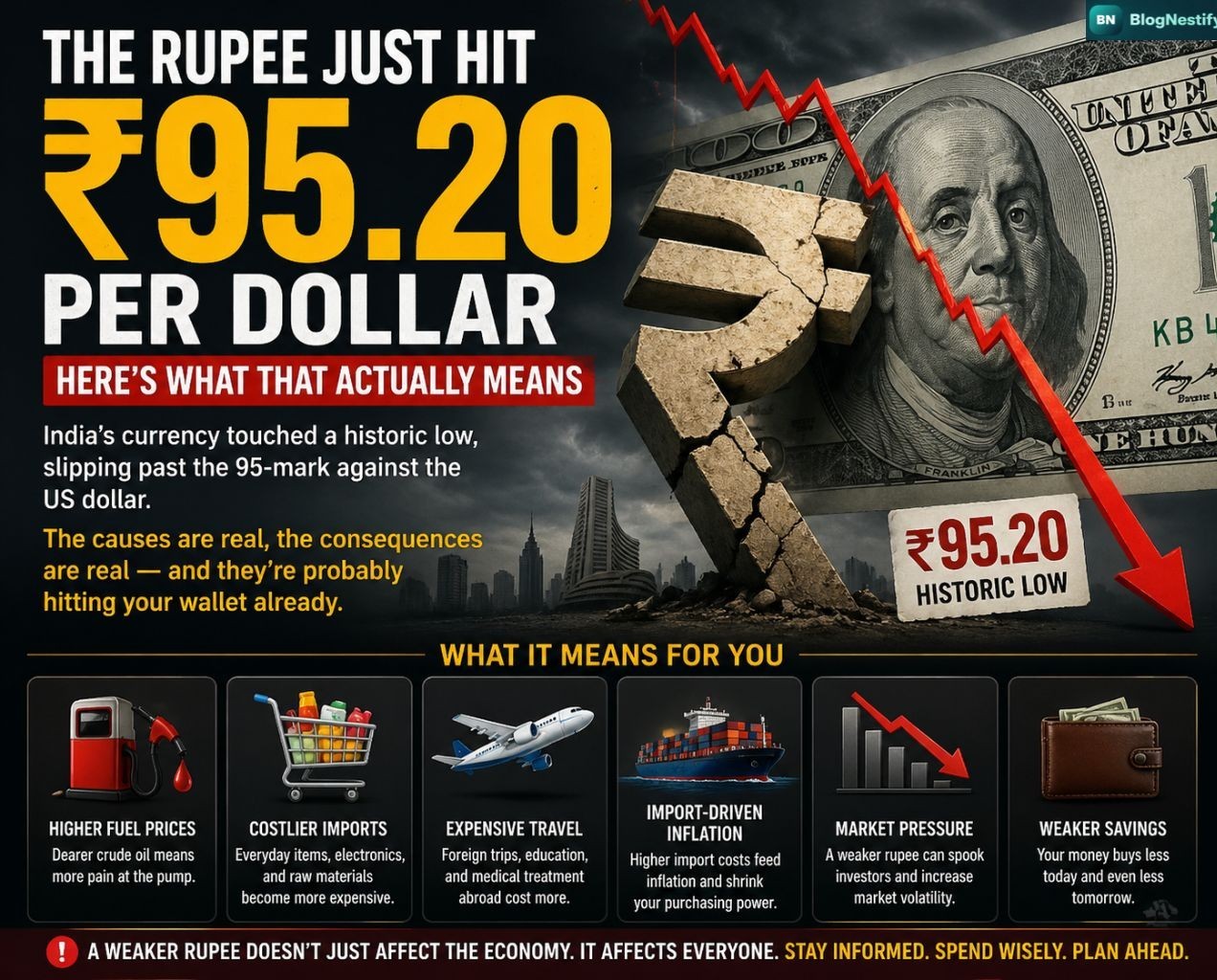
India's currency touched a historic low, slipping past the 95-mark against the US dollar. The causes are real, the consequences are real — and they're probably hitting your wallet already.
Sometime this week, the Indian rupee did something it has never done before — it crossed ₹95 per US dollar. For context, the rupee was at around ₹83 just eighteen months ago. That's not a gradual drift. That's a slide that's accelerated faster than most economists had predicted, and faster than the Reserve Bank of India publicly wanted.
If you're wondering why your fuel prices are creeping up again, or why that imported gadget suddenly costs more, or why the news is full of RBI intervention talk — this is the story behind all of it.
The 4-Layer Picture: What's Actually Going On
Why the Rupee Fell — The Actual Causes
There's rarely a single trigger for a currency move this significant. It's usually a few things combining badly at the same time. Right now, we have three of them firing simultaneously.
1. The Dollar Got Stronger — Not Just Against the Rupee
The US Federal Reserve has kept interest rates elevated for longer than markets expected. Higher American rates pull global capital toward dollar-denominated assets. When money moves to dollars, every other currency — the yen, the euro, and yes, the rupee — weakens against it. The rupee's fall is partly a global phenomenon disguised as an India-specific one.
2. Crude Oil Is Expensive Again
India imports roughly 85% of its crude oil. Every time oil prices rise — and they've been stubbornly elevated through much of 2025 — India needs more dollars to pay for it. More dollar demand means more rupee supply in the forex market, which pulls the currency down. It's a structural vulnerability that India has struggled with for decades.
3. Foreign Investors Are Pulling Money Out
Foreign Institutional Investors (FIIs) have been net sellers in Indian equity markets for several months. When they sell Indian stocks and bonds, they repatriate the proceeds as dollars — again adding pressure on the rupee. This cycle can be self-reinforcing: a falling rupee makes Indian assets look riskier to foreign investors, who sell more, which makes the rupee fall further.
The Impact — Who Gets Hit, Who Gets Lucky
Here's where it gets personal. A falling rupee isn't equally bad for everyone. Some sectors and individuals actually benefit when the rupee weakens.
What the Numbers Have Been Doing
To understand how significant this is, it helps to see where we've been over the last few years.
| Period | INR per USD | Movement |
|---|---|---|
| Jan 2020 | ~71 | ↑ Stronger |
| Jan 2022 | ~74 | ↓ Weakening |
| Oct 2022 | ~83 | ↓ Sharp fall |
| Jan 2024 | ~83–84 | → Sideways |
| Dec 2024 | ~85–87 | ↓ New lows |
| Apr 2025 | 95.20+ | ↓ Historic low |
That table tells you something important. The rupee lost roughly 5 rupees to the dollar over two years from 2020 to 2022. It's now lost another 12+ rupees in under three years since then. The pace has quickened.
What Is the RBI Doing About It?
The Reserve Bank of India has two main tools when the rupee falls sharply.
The first is direct market intervention — the RBI sells US dollars from its foreign exchange reserves. By increasing the supply of dollars in the market, it helps stabilize the rupee's exchange rate. India's forex reserves, while lower than their peak, are still substantial enough to allow this kind of defence.
The second is interest rate policy. Higher rupee interest rates attract foreign capital, which brings dollars in and supports the currency. But rate hikes also slow the economy, so the RBI uses them cautiously.
The tricky part? The RBI doesn't want to defend a specific number. It wants to prevent excessive volatility, not stop the rupee from ever moving. There's a difference, and currency traders know it.
Is This a Crisis? Or Just a New Normal?
That's the genuinely difficult question. Some economists argue that India's fundamentals — GDP growth, forex reserves, trade competitiveness — are strong enough that the rupee should stabilize once global dollar strength eases. Others point to structural issues: India's oil import dependency, its current account deficit, and the pace of FII outflows, and argue this could go deeper before it stabilizes.
What's probably true is somewhere less dramatic than either camp suggests. Currency markets overshoot. The rupee at 95+ might be reflecting some genuine pressures, some global dollar dynamics that will ease, and some panic that will correct itself. But the people paying for imported goods right now are paying in the meantime.
What Should You Do Personally?
This isn't investment advice — but there are sensible things people are doing in this environment. Those with foreign currency loans or expenses are hedging where possible. Some investors are looking at export-heavy stocks as a natural hedge within their portfolio. People sending money abroad are getting it done now rather than waiting, assuming the rupee could slide further.
And those receiving money from abroad? They're probably not complaining.
2 Comments
Nice 👍🏻
Nice 👍🏻
Leave a Comment