Indian Stock Market Falls:
Nifty 50 Toward 23,600, Sensex Plunges 500+ Points
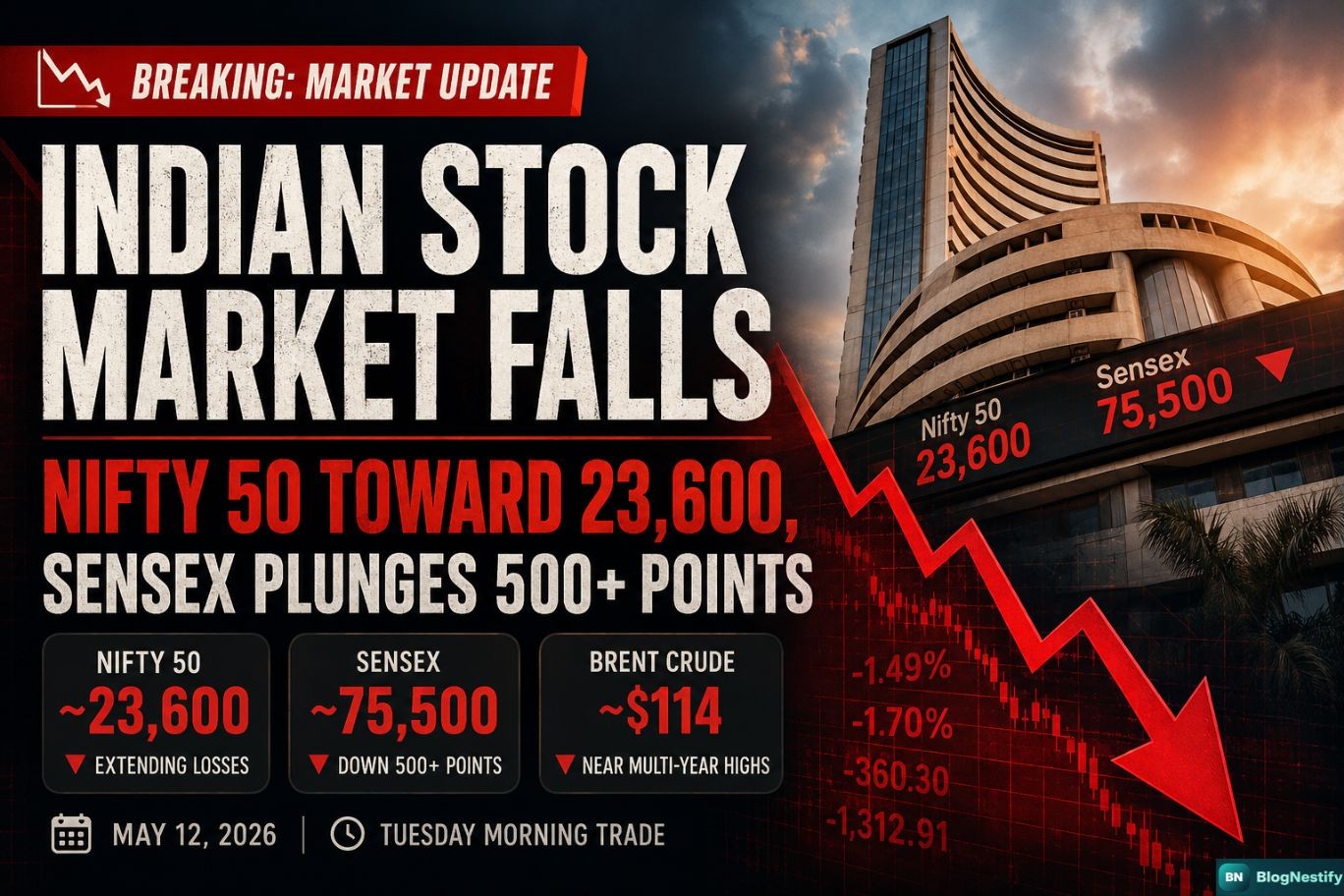
The NSE Nifty 50 extended its losses toward 23,600 and the BSE Sensex plunged over 500 points in Tuesday morning trade — the third consecutive losing session. Here is what is actually going on, and what it means for your portfolio.
Indian markets opened in the red — again
Tuesday's opening bell brought no relief. The Nifty 50 slipped toward 23,600 as selling pressure persisted across banking, jewellery, and energy counters. The Sensex dropped more than 500 points within the first hour of trade. For context: the previous session had already closed 1,312 points lower. Investors woke up to their third difficult morning in a row.
Why the Indian Stock Market Is Falling — 5 Real Reasons
Markets don't crash for one reason. They crash when multiple pressures land at the same time, and right now, India's equity markets are dealing with at least five of them simultaneously.
Brent Crude Near $114 — The Single Biggest Headache
The US-Iran conflict has choked roughly 20% of global oil supply that flows through the Strait of Hormuz. Brent crude was hovering close to $114 per barrel as of early May 2026 — a dramatic spike that directly hits India's import bill. For every $10 rise in oil per barrel, India's CPI inflation tends to rise around 35 basis points when second-round effects through transport and logistics are factored in. That's not theoretical — it's already showing up in freight costs and airline margins.
FIIs Have Pulled ₹2.28 Trillion Out of India in 2026
Foreign Institutional Investors have been relentless sellers. Their ownership of NSE-listed companies dropped to a 14-year low of 16.13% as of March 31, 2026. The combination of a weakening rupee, higher US yields, and geopolitical uncertainty has made Indian equities less attractive for dollar-denominated investors. Each day of selling adds another layer of pressure on index heavyweights.
The Rupee Is Sliding and That Feeds the Doom Loop
A weaker rupee makes Indian assets less valuable in dollar terms, which discourages foreign buying — which in turn puts more pressure on the rupee. Analysts at Shinhan Bank noted USD/INR could test 96.20–96.50 if external pressures persist. A currency at those levels makes the macro picture for India meaningfully harder to defend.
PM Modi's Austerity Call Hammered Consumer Stocks
Prime Minister Modi's public appeal to cut fuel consumption, reduce unnecessary foreign travel, and avoid non-essential imports like gold sent shockwaves through consumer-linked stocks. Titan Company plunged nearly 7%. Kalyan Jewellers fell 9.7%. IndiGo slipped 4.7% on higher jet fuel costs. These aren't small corrections — they're sector-level selloffs driven by a single political signal.
SBI's Profit Miss Added to Financial Sector Pressure
State Bank of India dropped 4.5% after missing profit estimates — a bruising result for PSU banking stocks broadly. HDFC Bank, Bajaj Finance, and Bajaj Finserv each declined between 1.2% and 2.1%. Financial stocks make up a large share of both indices, so weakness there doesn't just trim a few points — it pulls the headline numbers down hard.
"A sustained $10/barrel rise in crude oil price typically adds ~35 basis points to India's CPI inflation — and second-round effects through transport and logistics amplify the impact further."
— Kunal Sodhani, Head of Treasury, Shinhan BankTop Nifty 50 Losers — May 11 Close (Previous Session)
This gives context for where the pressure is coming from. Tuesday's trade extended these trends.
| Stock | Sector | Change (%) | Why It Fell |
|---|---|---|---|
| Titan Company | Jewellery / Consumer | –7.0% | PM Modi urged citizens to cut gold purchases |
| Kalyan Jewellers | Jewellery | –9.7% | Same austerity signal; sharper sell-off |
| State Bank of India | PSU Banking | –4.5% | Missed Q4FY26 profit estimates |
| IndiGo (InterGlobe) | Aviation | –4.7% | Higher jet fuel costs from crude spike |
| HDFC Bank | Private Banking | –2.1% | Broad financial sector pressure |
| Bajaj Finance | NBFC | –2.0% | Risk-off sentiment in financial sector |
| Sun Pharma | Healthcare | +1.4% | Defensive buying; one of few gainers |
| HUL | FMCG | +0.9% | Defensive buying; staples held up |
| Tata Consumer Products | FMCG | +6.3% | Beat Q4 estimates; double-digit growth guidance |
Key Nifty 50 Levels to Watch
Traders are watching a narrow but important range. Where the index closes this week will likely set the tone for the next few sessions.
Sumeet Bagadia, Executive Director at Choice Broking, described market sentiment as "cautious to positive" within the 24,450–24,900 range. A bearish candlestick pattern with a lower high and lower low has now formed for the third straight session — which is the kind of chart structure that historically keeps sellers in control until either the support holds or volume steps in on the buy side.
Which Sectors Are Holding Up — and Which Aren't
Not every corner of the market is getting punished equally. Consumer Durables, Realty, PSU Banks, and Oil & Gas corrected the hardest, each falling between 2% and 4% in the May 11 session. The Nifty Auto index was down 2.17%. Every sectoral index closed in the red.
The exceptions were Healthcare and Pharma. Defensive stocks tend to catch bids when investors get nervous about the macro — and that's exactly what happened here. Sun Pharma and HUL were among the rare green spots in an otherwise broad sell-off. Tata Consumer Products surged over 6% after posting strong quarterly results and guiding for double-digit revenue growth in FY27, a reminder that earnings still matter even in a difficult market.
Midcap and Smallcap indices actually held up better than the benchmarks on May 11. The BSE Midcap ended just 0.17% lower and the Smallcap index rose 0.99% — which suggests the selling is concentrated in large-cap, globally exposed names rather than a total market collapse.
What Should Investors Actually Do Right Now?
This is where most market commentary gets evasive. So here's a more honest take: this correction has multiple drivers, and some of them — crude oil, geopolitical risk, FII flows — are entirely outside India's control. That matters for how you think about the next move.
Defensive Sectors First
Healthcare, FMCG, and domestic consumer staples have outperformed in this sell-off. If you're adding exposure, these are the counters that historically hold better during oil-driven corrections.
Watch the 23,800 Level
A clean closing break below 23,800 on Nifty opens the door to 23,550. Don't average into positions until you see whether that floor holds or cracks on a closing basis.
Track Crude and the Rupee Daily
The two variables driving this correction most directly are Brent crude and USD/INR. If crude retreats below $100, the selling pressure will likely ease quickly. Until then, volatility stays elevated.
Long-Term: Corporate Earnings Are Still Growing
Analysts project India's corporate profits growing at a 10–15% CAGR through FY2028. The broader market is trading around 17.5x FY28 estimated earnings — not cheap, but not stretched for a growth market either.
Consider Tax Loss Harvesting
If some positions in your portfolio are sitting at a loss, this correction is an opportunity to harvest those losses for tax offset purposes — especially before FY close. This is a legitimate strategy, not capitulation.
Avoid Leverage in This Environment
India VIX has been elevated. Leveraged positions in a market with multiple macro overhangs — crude, currency, FII selling — is where portfolios can get permanently damaged. Caution here is not timidity.
This article is for informational purposes only and does not constitute financial or investment advice. Stock market investments carry inherent risks. Please consult a SEBI-registered financial advisor before making any investment decisions.
The Bigger Picture: Where India Stands in 2026
It's worth stepping back from the daily numbers for a moment. The Indian stock market has come a long way — and this kind of correction, while uncomfortable, is not unusual in the context of geopolitical shocks. Indian equities declined roughly 4% over two days when the US-Iran conflict first escalated, and crude spiked more than 15% in a short window. Markets have been digesting that shock ever since.
FII ownership of NSE-listed companies hitting a 14-year low sounds alarming, but it also means domestic retail and institutional investors have been absorbing supply — and DII inflows of ₹6,748 crore on May 8 alone show domestic money is still active. India's long-term story on demographics, digital infrastructure, and corporate profitability hasn't changed because of an Iran conflict or a month-long crude spike.
The honest answer is that nobody knows exactly when this correction ends. What we do know is that Indian GDP growth is expected to recover in Q1 FY2027, corporate earnings remain on a structural upward path, and the sectors hurt hardest — jewellery, aviation, PSU banking — are correcting on policy or macro signals, not structural earnings deterioration. That's a different kind of fall than what happened in 2020 or 2008.
Frequently Asked Questions
Quick answers to the most common questions about today's market fall.
The Indian stock market fell on May 12, 2026 due to a combination of rising Brent crude oil prices near $114 per barrel, continued FII selling worth ₹2.28 trillion in 2026, a weakening Indian rupee, and lingering US-Iran geopolitical tensions disrupting global energy supply via the Strait of Hormuz. PM Modi's austerity call also triggered heavy selling in consumer and jewellery stocks.
The NSE Nifty 50 dropped toward the 23,600 level during Tuesday morning trade on May 12, 2026. The previous session (May 11) had seen the index close at 23,815.85, down 360.30 points or 1.49% — making this the third consecutive declining session.
The BSE Sensex plunged over 500 points in Tuesday morning trade. The previous session (May 11) saw it close at 76,015.28 — down 1,312.91 points or 1.70%, one of the steeper single-day drops so far in 2026.
Consumer Durables, Realty, PSU Banks, and Oil & Gas saw the heaviest selling, each correcting between 2% and 4%. Jewellery stocks were particularly hard hit — Titan fell nearly 7% and Kalyan Jewellers 9.7% — after PM Modi urged citizens to cut gold purchases. IndiGo declined 4.7% on higher jet fuel costs.
Market analysts describe Nifty 50 as trading in a consolidation range between 23,800 and 24,400. A sustained close below 23,800 could open a further downside move toward 23,550. On the upside, immediate resistance sits at the 23,997–24,127 gap zone. Healthcare and Pharma are relatively better positioned in the near term given defensive buying interest.
Market corrections driven by temporary geopolitical events have historically been followed by recoveries for long-term investors with a clear strategy. That said, every investor's risk tolerance is different, and leveraged positions in elevated-VIX environments carry real risk. It is always advisable to consult a SEBI-registered financial advisor before making investment decisions during volatile periods.
0 Comments
Leave a Comment