 Semiconductors & Markets
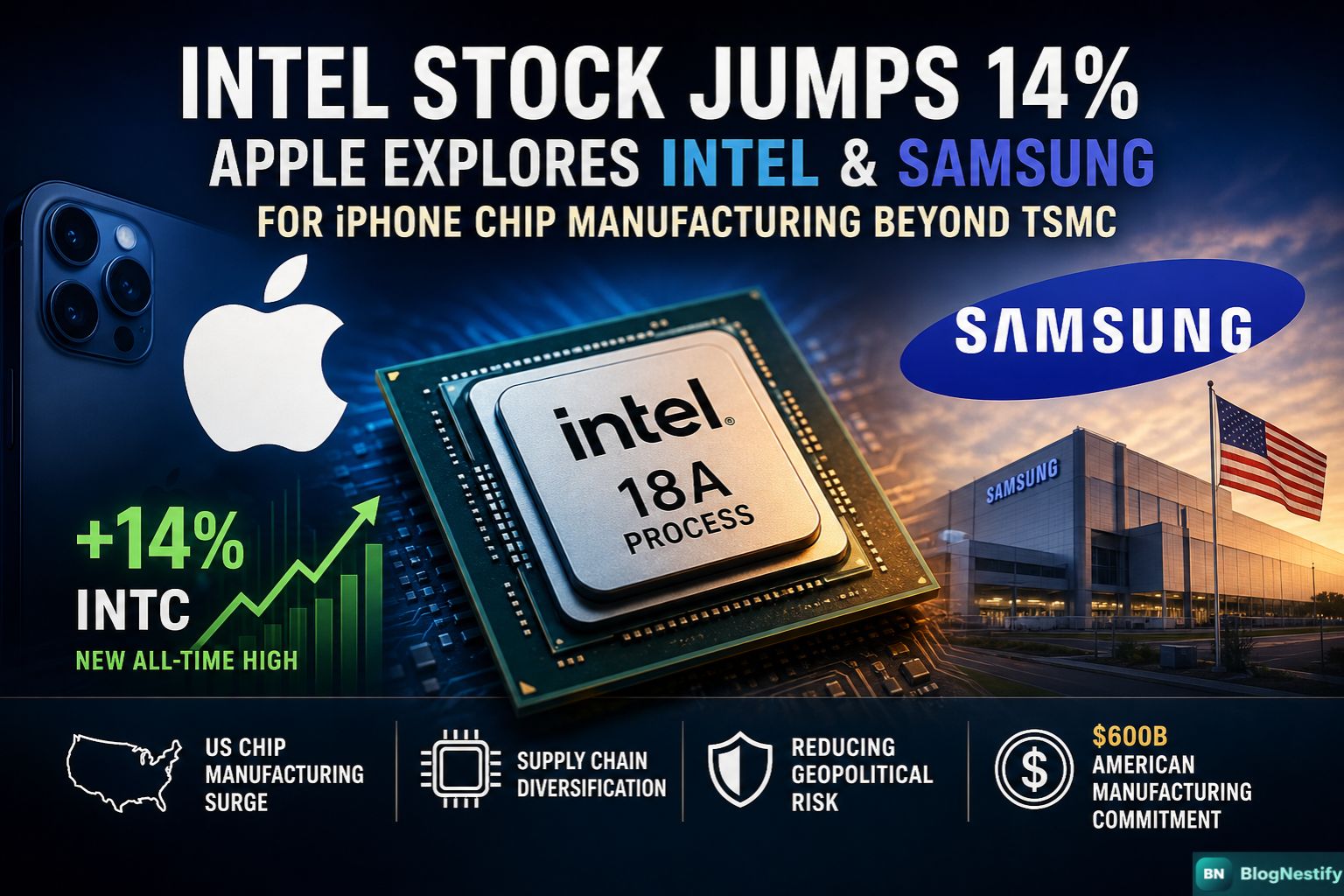
Intel Stock Jumps 14%: Apple Eyes Intel & Samsung to Manufacture iPhone Chips Beyond TSMC
A Bloomberg report on May 5, 2026 sent Intel to a new all-time high after revealing Apple is exploring chip manufacturing partnerships with both Intel and Samsung — a potential seismic shift in the global semiconductor supply chain.
Something big just moved in the semiconductor world. On Tuesday morning, Intel's stock shot up 14% and hit an all-time high — not because of an earnings beat, not because of a product launch, but because of a single Bloomberg report. Apple, the company that spent the last six years making its own chips precisely to avoid depending on anyone else's hardware, is apparently in talks with Intel about making those chips.
Let that sink in for a second. Apple — which left Intel's x86 processors behind in 2020 and built the M-series Apple Silicon that made the rest of the industry look slow — may now come back to Intel, this time as a manufacturing customer. Different relationship, sure. But still.
The Bloomberg report, written by Mark Gurman, Ian King, and Ryan Gould, says Apple has also visited a Samsung semiconductor facility currently under construction in Taylor, Texas. No deals have been signed. No orders placed. Apple reportedly hasn't even confirmed the talks. But the market didn't need a signed contract. Intel is up 14%, Samsung hit a record close in Seoul, and the conversation about who makes Apple's chips just got a lot more interesting.
Why Apple Would Even Look Elsewhere
For more than a decade, Apple and TSMC have had one of the most productive relationships in tech. Apple designs the chip, TSMC makes it, and the result has been some of the most power-efficient, high-performance silicon the consumer market has ever seen. The iPhone 17 lineup runs on 3nm chips that only TSMC can produce at scale right now. That's not a relationship you walk away from lightly.
So what changed? A few things, and they've been building pressure for a while.
The AI infrastructure boom happened. Nvidia's demand for TSMC capacity has grown so aggressively that, according to Nvidia CEO Jensen Huang himself, his company has effectively dethroned Apple as TSMC's top customer. That's not just a symbolic shift. It means Apple is competing for fab time with Nvidia's GPU orders — and Huang hinted that Apple might have to pay more going forward. Apple CEO Tim Cook confirmed in the company's most recent earnings report that iPhone sales were genuinely limited by chip supply shortages. That's a real operational problem, not a talking point.
"The CPU is reinserting itself as the indispensable foundation of the AI era."
— Intel CEO Lip-Bu Tan, Q1 2026 earnings callThere's also the geopolitical reality. Over 60% of Apple Silicon is still manufactured in Taiwan. That's a concentration risk that would make any CFO nervous, and it's a talking point that the Trump administration has pressed hard. When Apple announced its $600 billion American Manufacturing Program (AMP), it wasn't entirely voluntary goodwill — it was also a response to real political pressure. Partnering with Intel, a company in which the US government holds a 10% stake through an $8.9 billion CHIPS Act investment, would align Apple very neatly with that commitment.
Intel's Position Right Now Is Actually Interesting
A year ago, this story would have read very differently. Intel was struggling. It had canceled fab projects in Germany and Poland. Its Ohio plant was delayed until 2030. CEO Pat Gelsinger was pushed out in late 2024. The foundry business — Intel's attempt to manufacture chips for other companies — had no major customers and significant questions about whether its advanced processes could compete with TSMC and Samsung.
Things have shifted, at least on paper. Lip-Bu Tan took over as CEO and brought a new strategy. Intel's 18A process node — its most advanced manufacturing technology, produced at US-based fabs — has been showing yield rates above 60%, which industry analysts consider sufficient for production ramp. Intel signed a deal with Google. It joined Elon Musk's Terafab project in Austin, Texas, to produce chips for SpaceX, xAI, and Tesla. Musk confirmed on Tesla's Q1 earnings call that Tesla plans to use Intel's 14A process node for future chips.
US government takes a 10% stake in Intel via $8.9B CHIPS Act investment. Intel stock begins its recovery.
Nvidia announces a $5 billion investment in Intel, boosting foundry credibility.
Analyst Ming-Chi Kuo first reports Apple signed an NDA with Intel and obtained Intel's advanced-node 18AP PDK.
KeyBanc Capital Markets research confirms Apple as a client for low-end M-series chips in 2027, with Intel's 18A yields above 60%.
Intel jumps 114% in a single month — its best month in 55 years. Partnerships with Google and Terafab fuel the rally.
Intel Q1 2026 earnings beat expectations. Data center revenue climbs 22% to $5.1B. Stock surges 20% on the day.
Bloomberg reports Apple in early-stage talks with Intel and Samsung. Intel hits new all-time high, up 14% in morning trading.
Intel stock is up 175% year-to-date and over 330% since the government investment last August. That's a remarkable recovery for a company that many analysts had written off as a relic competing in a game it could no longer win.
What the Deal Would Actually Look Like
It's worth being specific here, because "Apple is talking to Intel" can sound more dramatic than the reality likely is. Nobody is suggesting Intel replaces TSMC. That's not remotely on the table.
According to analyst research from KeyBanc Capital Markets and reporting from 9to5Mac and MacDailyNews, the shape of any potential arrangement would be far more targeted:
| Chip Type | Timeline | Process Node | Status |
|---|---|---|---|
| Low-end M-series chips (Mac) | 2027 | Intel 18A | Early discussions |
| A21/A22 SoCs (non-Pro iPhone) | 2028–2029 | Intel 14A | Exploratory |
| Pro iPhone / Pro Mac chips | Ongoing | TSMC leading nodes | TSMC confirmed |
| Peripheral chips (PMICs, sensors) | Ongoing | Various | Already diversified |
| Image sensors (Samsung Austin, TX) | In progress | Samsung CMOS | Deal confirmed |
Intel would only handle manufacturing. Apple keeps full control over chip design, which stays on ARM architecture. And the initial scope, if it happens, would be lower-tier devices — base model iPhones, the budget "iPhone e" series — where the performance bar is lower and yield consistency is somewhat less critical. High-end Pro chips would stay on TSMC.
This is supply chain diversification, not a supplier replacement. The distinction matters.
Samsung's Role in All This
Samsung is the other name in the Bloomberg report, and it's worth noting separately. Apple executives visited Samsung's semiconductor facility currently under construction in Taylor, Texas. Samsung shares jumped 5.4% to close at a record KRW 232,500 in Seoul trading on Tuesday.
Samsung and Apple have a complicated history. Samsung made iPhone chips from the original device all the way through the iPhone 5S. Apple switched to TSMC in 2016 and never looked back — partly over performance, partly because Samsung competes directly with Apple in the smartphone market, which makes that supplier relationship awkward. A Samsung foundry Texas facility changes the calculus a little, at least on the "using a direct competitor's overseas factory" dimension.
Samsung also already has a foothold with Apple. The two companies signed a deal for Samsung's Austin facility to manufacture advanced CMOS image sensors for iPhones, breaking Sony's decade-long hold on that component. The relationship exists. The Texas geography helps. But closing the gap with TSMC on leading-edge logic chips is still a longer journey for Samsung than the stock reaction on Tuesday might imply.
TSMC Isn't Sitting Still Either
If there's a company that should be the most nervous about all this, it's TSMC — and yet TSMC's stock only dipped about 1% on Tuesday. The market seems to understand that any shift away from the Taiwanese manufacturer is a gradual, years-long process, not a sudden break.
TSMC is also not idle. The company has announced an intention to expand US investment to $165 billion total, including three new fabrication plants, two advanced packaging facilities, and a major R&D center in Arizona. That's the largest single foreign direct investment in US history. The Arizona fab is already in volume production. If Apple does want US-made chips at scale and at leading-edge quality, TSMC Arizona eventually becomes part of that answer too.
The Bigger Picture: Why This Moment Matters
Zoom out a bit and the real story here isn't just about two companies in talks. It's about what the semiconductor industry looks like when AI demand, geopolitical pressure, and supply chain risk all collide at once.
For years, the chip world looked relatively settled: TSMC made the best chips, Apple and Nvidia were its biggest customers, and everyone else competed for the scraps. That picture has been changing fast. Nvidia's AI GPU orders have grown so large that they've genuinely displaced Apple as TSMC's priority customer. The US government is now a stakeholder in Intel and is explicitly trying to build domestic chip manufacturing capacity. Apple is publicly committed to $600 billion in US manufacturing. Elon Musk is building a massive chip complex in Texas. Suddenly Intel — which many wrote off as a legacy company unable to catch up — is at the center of several of those converging threads.
Bank of America has predicted the CPU market could more than double by 2030, driven by agentic AI workloads that need CPUs as much as GPUs. Intel's Q1 data center revenue was up 22% year-over-year. CEO Lip-Bu Tan's quote about the CPU "reinserting itself as the indispensable foundation of the AI era" sounds like spin, but the numbers back it up to a reasonable degree.
None of which guarantees the Apple talks lead anywhere. Bloomberg's report is careful to note that Apple has real concerns about whether Intel's technology can meet its reliability and performance requirements. Apple has never been a company that ships something it isn't confident in. If Intel's yields on 18A are good but not great, Apple will wait.
📡 What to Watch in the Coming Months
- Any formal statement from Apple, Intel, or Samsung confirming or denying the Bloomberg report
- Intel's Q2 2026 guidance ($13.8B–$14.8B revenue) — whether foundry revenue shows new client activity
- Intel 14A development progress — Elon Musk said it needs to be "fairly mature" before Terafab scales
- TSMC Arizona capacity expansion and whether Apple sources more chips domestically through TSMC itself
- Apple's American Manufacturing Program milestones and whether Intel is mentioned publicly
- KeyBanc Capital Markets follow-up research — they've been ahead of this story
What This Means for Investors
Intel at $109 and up 175% year-to-date is a very different risk profile from Intel at $44 six months ago. The foundry thesis has more credibility now than it has in years, but exploratory talks are not signed contracts, and a stock that has run this far on momentum can move in both directions quickly.
The setup is real. The 18A process, the government backing, the Terafab partnership, the Apple NDA — none of that is invented. But confirmation of even a small pilot tape-out with Apple would be a meaningful catalyst. Continued silence would invite profit-taking. Intel's Q2 guidance and any further comments from Tan about unnamed "multiple customers actively evaluating 14A" will be closely watched.
For Apple shareholders, this is probably a mild positive. Any credible chip supply diversification reduces concentration risk and adds some leverage in negotiations with TSMC. Apple's stock was up 1.49% on Tuesday, which reads as measured approval rather than excitement.
For the semiconductor industry broadly, this is one more data point in the argument that the US chip ecosystem is rebuilding itself around AI-era demand in ways that weren't plausible two years ago.
0 Comments
Leave a Comment