Iran-Israel War Update: Trump Will Only Accept a Deal That Satisfies His Red Lines, White House Says
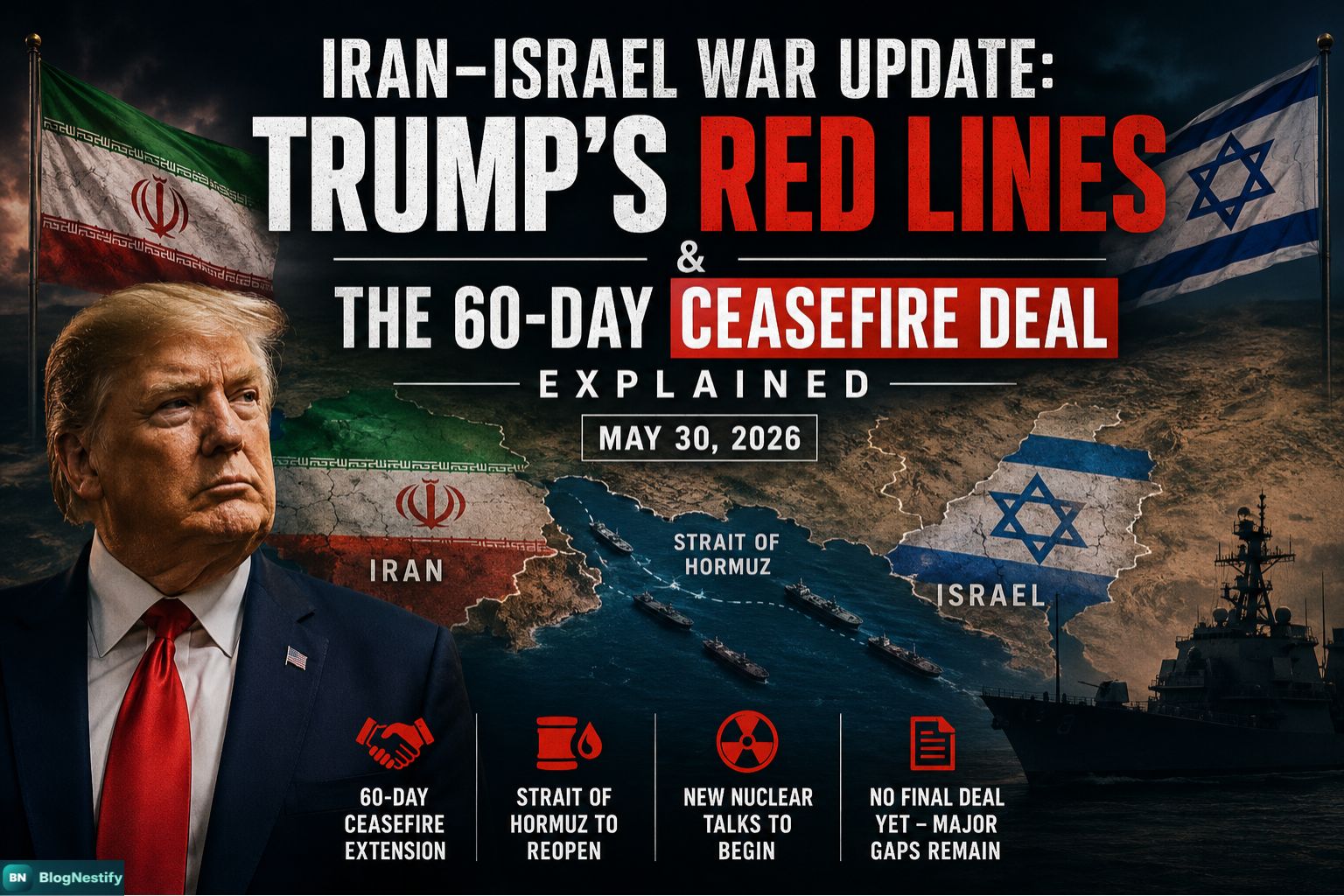
A two-hour Situation Room meeting ended without a final decision. The proposed memorandum would extend the ceasefire by 60 days and launch new nuclear talks — but major gaps remain between Washington and Tehran.
Key Facts at a Glance
- Trump met with national security aides on May 30 but reached no final decision on the Iran deal
- The proposed MOU would extend the existing ceasefire by 60 days and begin new nuclear talks
- A White House official confirmed Trump "will only make a deal that satisfies his red lines"
- Iran denies agreeing to hand over its enriched uranium stockpile — a central US demand
- The Strait of Hormuz remains contested; Iran disputes Trump's claim that reopening is "largely negotiated"
- Iran holds 440.9 kg of uranium enriched to 60% purity, just below weapons-grade level
The situation is moving fast — but not fast enough for a signed deal. President Donald Trump convened a roughly two-hour meeting in the White House Situation Room on Friday, reviewing the latest terms of a proposed agreement with Iran. When it ended, there was still no final decision.
A senior administration official told reporters that Trump would only accept a deal that "satisfies his red lines" — language that signals the president is not about to blink, even as Iran insists the deal on the table differs significantly from Washington's public description of it.
The two countries have been in a fragile ceasefire since April 8, brokered largely through Pakistan's mediation. That truce has held — mostly. There have been skirmishes, contested violations, and a deeply entrenched mutual distrust that surfaces every time a diplomat opens their mouth. Now the question is whether negotiators can turn a tentative memorandum of understanding into something both sides can actually live with.
What the Proposed Deal Actually Contains
The outlines of the MOU, first reported by Axios and since confirmed in broad strokes by multiple officials, are fairly clear even if the fine print remains contested.
Under the US version of the agreement, the Strait of Hormuz would reopen immediately and without fees. Iran would be required to remove all sea mines it deployed in the strait within 30 days. The US naval blockade on Iranian ports would be lifted proportionally as commercial shipping is restored. Iran would be permitted to sell oil freely, providing some relief to its battered economy. And both sides would enter a 60-day negotiating period focused on Iran's nuclear programme — specifically, what happens to Tehran's stockpile of highly enriched uranium.
What the deal does not include — and this is where things get complicated — is any up-front commitment from Iran to surrender that uranium or dismantle its enrichment capacity. Those issues are supposed to be sorted out during the 60-day window. Iran, for its part, wants a permanent end to the war before it even considers nuclear concessions.
"President Trump will only make a deal that is good for America and satisfies his red lines. Iran can never possess a nuclear weapon."
— White House official, speaking to AFP, May 30, 2026Trump's Red Lines: What He's Demanding
The president has been consistent on this throughout the war and the months of negotiations that followed. His demands are not subtle.
- 🔴 Iran must never develop or possess a nuclear weapon or bomb
- 🔴 Iran's entire nuclear enrichment programme must be dismantled
- 🔴 The Strait of Hormuz must reopen with no tolls, no fees, no Iranian management
- 🔴 All sea mines placed by Iran must be destroyed
- 🔴 Iran's highly enriched uranium stockpile must be removed and destroyed
- 🔴 No money will be exchanged until terms are certified and signed
Treasury Secretary Scott Bessent, speaking at a White House briefing, put it plainly: Trump is not going to make a bad deal. Iran must hand over its enriched uranium and cannot have a nuclear programme. When pressed on whether there was actually a deal on the table, Bessent did not answer directly — only that "everything depends on what the president wants to do."
Vice President JD Vance was slightly more forthcoming, acknowledging that there are still "a couple of issues on the nuclear stuff, the highly enriched stockpile, and also the question of enrichment." He said both sides were "going back and forth on a couple of language points" but expressed cautious optimism that progress was being made. Whether the president would be in a position to endorse the agreement, he said, was "still TBD."
Iran's Position: What Tehran Actually Wants
Iran's negotiators have been careful not to appear to be surrendering. The country's main negotiator told reporters on Friday that Tehran has "no trust in guarantees or words" — only actions. Given that the US and Israel have attacked Iran twice in the past year while nuclear negotiations were underway, that distrust is not irrational.
What the US Wants
- Full dismantlement of Iran's nuclear programme
- Surrender of all enriched uranium
- Free navigation through Hormuz (no fees)
- Limits on ballistic missiles and drones
- No up-front money or sanctions relief
What Iran Wants
- Permanent end to war before nuclear talks
- Right to enrich uranium domestically
- Full lifting of US sanctions
- Unfreezing of assets in foreign banks
- Reparations for war damages
Iran's Fars news agency has disputed several key elements of Trump's public characterisation of the deal, describing his remarks as "a mixture of truth and lies." Tasnim, another Iranian state news outlet, reported that under the latest draft exchanged between the two sides, the Strait of Hormuz would remain under Iranian management — a direct contradiction of Trump's framing. Tehran also denies agreeing to surrender its enriched uranium, calling that claim inconsistent with the draft MOU's actual text.
Iran's insistence on domestic uranium enrichment is not simply a bargaining position — it's presented as a matter of national sovereignty. The right to enrich is not prohibited under the Treaty on the Non-Proliferation of Nuclear Weapons, and Tehran has made clear it is not prepared to give that up as a precondition. The Trump administration, however, is not interested in a scaled-back version of the 2015 JCPOA. It wants the programme gone entirely.
The Uranium Problem
This is the number that sits at the centre of every negotiation. According to the International Atomic Energy Agency, Iran currently holds 440.9 kilograms — roughly 972 pounds — of uranium enriched to up to 60% purity. Weapons-grade uranium requires enrichment to 90%. At 60%, Iran is a short, technically achievable step away from material that could be used in a bomb.
The first issue to be negotiated during any 60-day ceasefire extension, US officials have said, would be what happens to that stockpile. The question is not just where the uranium goes — it's who controls the process, on what timeline, and with what verification mechanisms. Iran has sought to keep nuclear discussions separate from the ceasefire framework, arguing that a permanent end to hostilities must come first. The US wants nuclear commitments baked into any deal from the start.
A Timeline of How We Got Here
-
Feb 28, 2026US and Israel launch strikes on IranSupreme leader killed. Major military and government infrastructure destroyed. Iran launches retaliatory missiles at a US air base in Qatar.
-
Mar 6, 2026Trump demands "unconditional surrender"Sets a series of deadlines — March 21, then March 23, then April 7 — threatening strikes on energy infrastructure and bridges. None are carried out.
-
Apr 8, 2026Pakistan brokers the first ceasefireA conditional two-week halt to hostilities. The Strait of Hormuz begins partial reopening. Hegseth says the ceasefire will hold. Iran's initial 10-point peace proposal is "thrown in the garbage" by Trump's team.
-
Apr 21–22, 2026Ceasefire extended; tensions flareTrump extends the truce at Pakistan's request. US gives Iran three to five days to resume negotiations. Skirmishes continue. Israel intensifies its separate campaign in Lebanon.
-
May 23, 2026Trump says deal is "largely negotiated"Calls regional leaders. Says the Strait of Hormuz will reopen. Iran immediately disputes his characterisation. Iranian state media calls the announcement "incomplete and inconsistent with reality."
-
May 28–29, 2026Tentative MOU reached by negotiatorsUS and Iranian negotiators reportedly agree on terms for a 60-day ceasefire extension and new nuclear talks. The deal still requires Trump's final approval. Iran says nothing has been finalised.
-
May 30, 2026Situation Room meeting — no decisionTwo-hour session with national security aides concludes without a signed deal. White House says Trump will only accept terms that satisfy his red lines.
The Strait of Hormuz: Why It Matters So Much
About one-fifth of the world's oil passes through the Strait of Hormuz — a narrow waterway between Iran and the Oman peninsula. When Iran deployed mines and started charging tolls at the start of the war, global energy prices jumped sharply. Tankers rerouted or sat idle. The economic pressure on importing nations was immediate.
Under the proposed deal, the strait would be fully reopened and shipping would flow without fees or Iranian management. The US naval blockade of Iranian ports would be lifted in proportion to how much commercial traffic is actually restored. This is presented by US officials as a win-win: Iran gets oil revenue, the rest of the world gets fuel, and Trump gets to point to a concrete economic outcome.
Iran sees it differently. Tehran's position has been that it retains management rights over the waterway — a claim that directly contradicts the US framing. Resolving this specific language gap is reportedly one of the final sticking points before any MOU can be signed.
Israel's Role and the Lebanon Dimension
Israeli Prime Minister Benjamin Netanyahu has stated publicly that any deal must eliminate Iran's nuclear threat entirely — meaning dismantled enrichment sites and removal of all enriched material from Iranian territory. This aligns with Trump's stated position but raises the stakes considerably: a deal that gives Iran any residual nuclear capacity would be rejected by Netanyahu's government.
Meanwhile, Israel's war in Lebanon has continued largely independently of the US-Iran ceasefire. Since the ceasefire did not formally include Lebanon, Israeli operations against Hezbollah have not stopped. More than 3,000 people have been killed in Lebanon since Israel expanded its invasion in early March. Hezbollah has continued drone launches against Israeli forces. A 60-day Iran ceasefire extension is reported to include a regional component that would also end the Lebanon fighting — but the details remain murky.
What Happens If There's No Deal
The existing ceasefire is technically open-ended, but it is fragile. Both sides have violated it. Iran's negotiators have made clear they do not trust words — only actions. US forces remain deployed in the region, ready to resume operations if ordered. The Trump administration has threatened strikes on Iranian energy infrastructure and bridges before. Those threats have not disappeared.
A deal collapse would almost certainly mean resumed hostilities. Given the damage already done to Iran's military infrastructure, the calculus on both sides is complicated. Iran has fewer options than it did before February. But it has not been reduced to unconditional surrender, and its negotiators are behaving accordingly.
Bottom Line
- No deal has been signed as of May 30, 2026
- The core gap is Iran's enrichment programme — the US wants it gone, Iran refuses up-front concessions
- The Strait of Hormuz is a secondary gap: who manages it and under what terms
- Both sides say they want a deal; neither side trusts the other's words
- A 60-day extension would buy time — but not resolve the fundamental disagreement
- The next 24–72 hours will likely determine whether negotiations advance or stall
Keyword Research: What People Are Searching
Based on current search patterns around this story, here are the primary and secondary keywords driving traffic — and what intent each serves:
- 🔍Iran Israel war update 2026 — Tier 1 head term, informational, very high volume. Target with news updates and pillar content.
- 🔍Trump Iran deal red lines — Tier 2 body term, high informational intent, moderate difficulty. Strong for featured snippet capture.
- 🔍Iran ceasefire 60 day extension — Tier 3 long-tail, informational/news intent, lower difficulty. Fast-ranking potential.
- 🔍Strait of Hormuz deal 2026 — Tier 2, mixed informational/commercial intent, moderate volume and difficulty.
- 🔍Iran nuclear programme latest news — Tier 2, high informational intent, strong PAA and AI Overview potential.
- 🔍Iran US peace deal terms — Tier 3 long-tail, low difficulty, high conversion from engaged news readers.
- 🔍Trump Iran nuclear deal May 2026 — Tier 3, news-specific, easy to rank quickly with timely content.
Frequently Asked Questions
Disclaimer: This article is based on publicly available reporting from multiple international news sources as of May 30, 2026. The Iran-Israel conflict and associated diplomatic negotiations are evolving rapidly. Information may change significantly after publication. Blognestify does not represent any government, political party, or diplomatic entity. Readers are encouraged to consult primary news sources for the latest developments.
0 Comments
Leave a Comment