Met Gala 2026 Indian Icons: How Isha Ambani, Ananya Birla & the Desi Contingent Made Fashion History
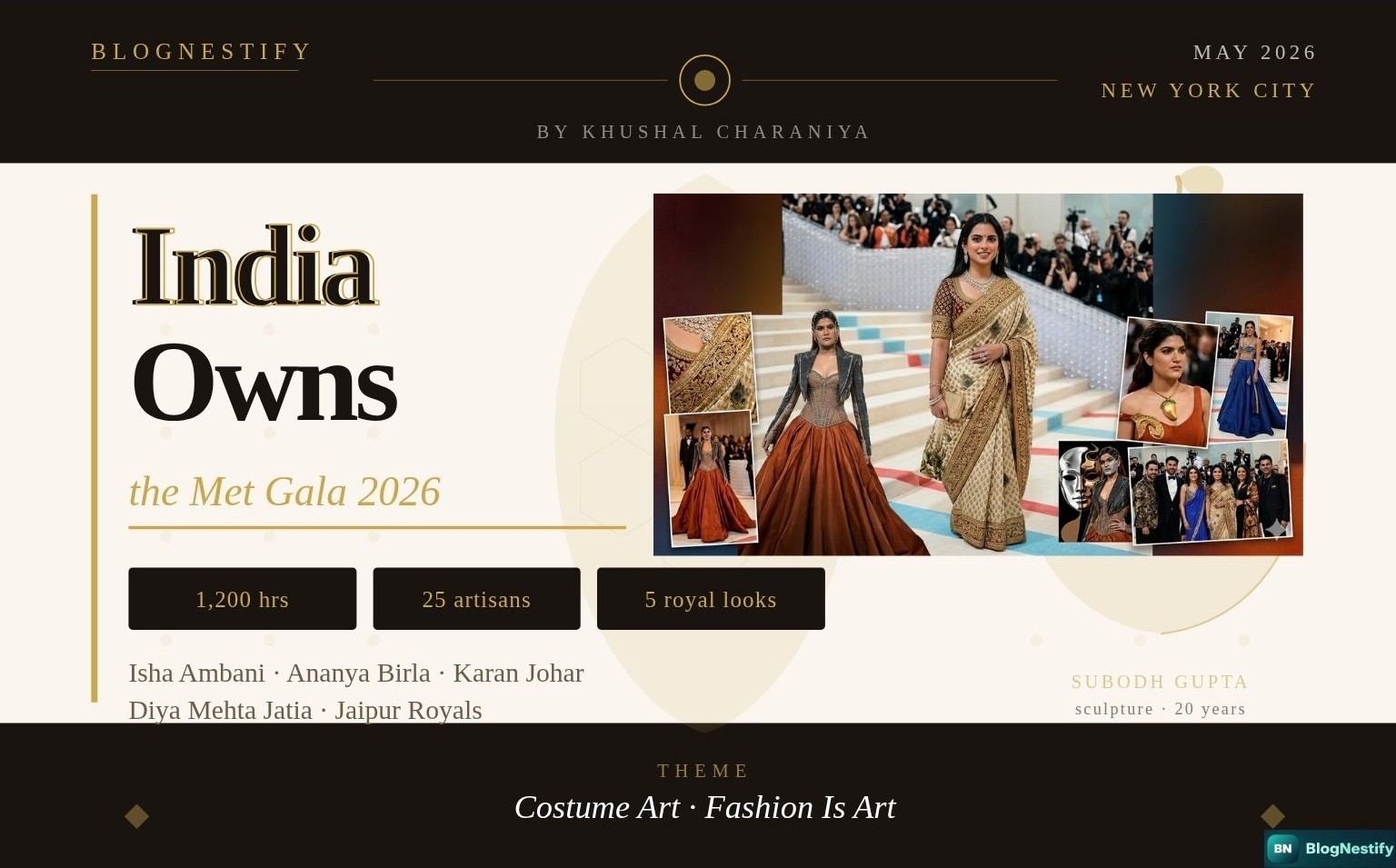
Gold threads. A 20-year-old mango. A steel face mask. India showed up to fashion's biggest night not just dressed — but carrying stories.
Monday night at the Metropolitan Museum of Art, India did not whisper. It arrived with 1,800 carats of diamonds, hand-painted Pichwai motifs woven from literal gold thread, a steel mask over a woman's face, and — most memorably — a mango in hand. Not a bag shaped like a mango. A 20-year-old sculpture of one, carried as art.
The 2026 Met Gala's "Costume Art" theme, with its "Fashion Is Art" dress code, was made for a culture that has never really separated the two. Indian textiles have always been art. Indian jewellery has always told stories. What changed this year is the number of people walking that staircase who understood that — and dressed accordingly.
Here's a full breakdown of every Indian moment on the red carpet, what it meant, and why this might be the most significant year yet for Indian fashion on the global stage.
Why "Costume Art" Was the Perfect Stage for India
The Met Gala picks its themes years in advance, but 2026's choice felt almost tailored for Indian culture. "Costume Art" asked guests to treat fashion as visual art — sculpture, painting, installation. For Western fashion houses, this required a conscious pivot. For Indian craft traditions, it was simply Tuesday.
Pichwai paintings from Rajasthan, kalamkari textile art from Andhra Pradesh, zardozi embroidery from Lucknow — these are not decorative techniques layered onto clothes. They are complete art forms that happen to live on fabric. So when the theme asked attendees to blur the line between fashion and art, Indian designers and their clients were uniquely positioned to respond with something genuine rather than theatrical.
Every Indian Look at Met Gala 2026, Decoded
Isha Ambani — The Gold Saree & the Mango That Stopped the Internet
Isha Ambani's Met Gala looks have always carried weight, but 2026 was different. The custom Gaurav Gupta saree — woven using pure gold threads by Swadesh artisans and covered in hand-painted Pichwai-inspired motifs in muted gold and earthy tones — was not just clothing. It was a sustained argument that Indian craft deserves to exist at the absolute top of global fashion, without apology.
The saree's sculptural drape was conceived as wearable artwork, the body treated as a living canvas. Underneath, her blouse was even more staggering: sourced from mother Nita Ambani's personal collection, it carried over 1,800 carats of diamonds alongside emeralds, polki, and kundan, all set by hand and requiring more than 50 artisans and 1,200 hours total to complete.
The jasmine hair sculpture — a modern take on the traditional mogra gajra, handcrafted over 150 hours from paper, copper, and brass — was extraordinary on its own. But the piece that actually broke the internet was simpler: a mango-shaped sculpture by artist Subodh Gupta, which Isha revealed had been created over 20 years ago. The "aam," as it is known in Hindi, is woven through Indian poetry, painting, ritual, and everyday life. On that red carpet, it became an elegant, slightly witty, completely Indian middle finger to any notion that heritage requires explanation.
She carried a 20-year-old mango sculpture as her accessory. That's not a statement — that's confidence.
Ananya Birla — The Steel Mask Debut Nobody Saw Coming
If Isha's look was a love letter to Indian heritage, Ananya Birla's debut was something else entirely — a confrontation. For her first Met Gala appearance, the musician and Aditya Birla Group director chose a custom Robert Wun creation: a structured black blazer bodice with a cinched waist, a dramatic peplum, and a floor-length high-shine pleated skirt that caught every camera flash. A light-blue shirt peeked from the collar and cuffs, adding an androgynous, almost boardroom-against-couture tension to the silhouette.
Then there was the mask. A stainless steel sculptural face covering designed by artist Subodh Gupta — the same artist behind Isha's mango, which is a fun coincidence or a deeply planned moment of Indian art solidarity — completely covered Ananya's face. The effect was part armor, part theatre, part erasure of identity. Rhea Kapoor styled the full look, keeping makeup and hair minimal so the structure and the mask could do the talking.
The look earned immediate praise from industry figures, including actress Bhumi Pednekar. For someone making her debut, Ananya did not ease into the room. She walked in wearing steel over her face. That tracks, honestly.
Karan Johar — "Framed in Eternity" and Finally on Those Steps
Karan Johar has been adjacent to Met Gala culture for years — styling friends, watching from afar, being the person everyone expects to eventually show up. In 2026, he finally did, in a custom Manish Malhotra jacket inspired by the paintings of Raja Ravi Varma.
The choice of inspiration matters here. Raja Ravi Varma was a 19th-century Indian painter famous for bringing mythological figures into vivid, emotionally grounded life. Johar, in his Instagram caption, wrote that "Raja Ravi Varma felt right because his work does something I've always tried to do in cinema. He painted feelings." It's a neat line and it's also genuinely true — both men spent their careers trying to make large audiences feel specific, personal things at the same time.
Manish Malhotra also walked the carpet himself, in a heavily embroidered bandhgala set with 3D sculptural elements — a reminder that Indian designers are not just dressing celebrities at this event; they are attending as artists themselves.
Diya Mehta Jatia — Kanjeevaram Meets Bengal Craft
Less talked about but no less considered: Diya Mehta Jatia, an Ambani relative attending the event for the first time, wore a Mayyur Girotra gown built on a gold and silver Kanjeevaram sari base, elevated through detailed shola work — a Bengali craft tradition using dried pith — layered across the silhouette. It was the kind of look that rewards someone actually looking closely rather than scrolling past.
Jaipur's Royal Family — Gayatri Devi's Legacy, Reimagined
Maharaja Sawai Padmanabh Singh and Princess Gauravi Kumari attended in ensembles by Nepalese-American designer Prabal Gurung. Princess Gauravi channelled Maharani Gayatri Devi's elegance — a reference that hit hard for anyone who knows Indian fashion history — while the Maharaja paid tribute to Jaipur's own royal legacy. It was a thoughtful, quietly spectacular presence.
What India's 2026 Met Gala Moment Actually Means
There is a version of this piece that would frame all of this as "India arriving on the global stage." That framing is both accurate and lazy. Indian craftsmanship has never needed to arrive anywhere. Zardozi embroidery has been collected by European royalty for centuries. Kashmiri shawls were status symbols in Napoleonic France. Kanjeevaram silk is UNESCO-recognized. The craft was always there.
What has shifted is visibility. And specifically, the kind of visibility that happens when an Indian billionaire carries a mango sculpture on the most photographed staircase in fashion and the whole world asks, "Wait, what is that?" — and then actually goes and finds out.
Every look on that carpet by Indian attendees this year shared a specific quality: they required knowledge to fully understand. Isha's Pichwai motifs mean something. Karan's Raja Ravi Varma jacket means something. Ananya's Subodh Gupta mask is not decoration, it is a reference to a specific body of contemporary Indian art. You could appreciate the looks without the context, but the context made them richer. That is, almost exactly, the definition of art.
Every Indian look on that carpet this year required knowledge to fully understand. That is, almost exactly, the definition of art.
What Indian designers and their clients seem to have figured out is that the Met Gala is not just a red carpet — it is a 24-hour cultural conversation that spreads across social platforms for days afterward. Wearing something that rewards research rewards the wearer. Isha's mango will generate articles explaining Subodh Gupta's practice to audiences who had never heard of him. Karan's jacket will send people down a Raja Ravi Varma rabbit hole. That kind of cultural reach does not happen by accident.
The Indian Design Houses Behind the Looks
A lot of the conversation around Indian representation at the Met Gala focuses on the celebrities. The designers deserve equal billing.
Gaurav Gupta has now built two consecutive Met Gala moments — Kiara Advani's 2025 breastplate gown and Isha Ambani's 2026 gold saree — that have stopped the conversation cold. His work sits at the intersection of sculpture and fashion in a way that is genuinely unusual. The saree he built for Isha is not a garment with artistic references; it is a sculpture that happens to drape over a body.
Manish Malhotra, who dressed Karan Johar and attended himself, has been at this longer than almost anyone. His presence on the red carpet as a designer-attendee rather than just a behind-the-scenes figure signals something about how seriously Indian fashion is being taken in that room.
And then there is Subodh Gupta — not a fashion designer but a contemporary artist whose work appeared on two separate bodies at the same event, in two completely different forms. That kind of crossover between fine art and fashion is exactly what the "Costume Art" theme called for, and India answered with someone who has been making that argument with steel kitchen utensils and stainless steel for 30 years.
Bottom Line
India's 2026 Met Gala night was not a moment of arrival. It was a statement of mastery. Isha Ambani built a look that took 25 people 1,200 hours to construct and then carried a 20-year-old mango as the finishing touch, because she could. Ananya Birla put on a steel mask and walked into one of the most surveilled rooms in fashion for her debut. Karan Johar showed up dressed as a feeling.
The "Fashion Is Art" dress code gave everyone an instruction. India gave it a vocabulary.
Frequently Asked Questions
Everything you wanted to know about India at Met Gala 2026.
The 2026 theme was Costume Art with a dress code of Fashion Is Art. The gala took place May 4, 2026, at the Metropolitan Museum of Art in New York City. Co-chairs were Beyoncé, Nicole Kidman, Venus Williams, and Anna Wintour, with Lauren Sánchez Bezos as honorary co-chair. Attendees were expected to interpret fashion as a visual art form — sculpture, painting, or conceptual design.
Isha Ambani wore a custom couture saree by Gaurav Gupta, crafted with pure gold threads and hand-painted Pichwai-inspired motifs. Her diamond and zardozi blouse — adorned with over 1,800 carats of diamonds plus emeralds and kundan — came from her mother Nita Ambani's personal collection. The entire ensemble took 25 artisans over 1,200 hours to create. Her accessory was a mango-shaped sculpture by artist Subodh Gupta, over 20 years old. Her jasmine hair sculpture was handcrafted over 150 hours from paper, copper, and brass.
Ananya Birla made her Met Gala debut in a custom Robert Wun couture piece — a structured black blazer-style bodice with a dramatic peplum, cinched waist, and floor-length high-shine pleated skirt, with a crisp light-blue shirt at the collar and cuffs adding an androgynous contrast. She wore a stainless steel sculptural face mask by artist Subodh Gupta. Styling was by Rhea Kapoor. Jewellery was from Mehta & Sons.
Yes — Karan Johar made his long-awaited Met Gala debut at 2026 in a custom Manish Malhotra jacket inspired by the artwork of painter Raja Ravi Varma. In his Instagram caption, Johar described the look as "Framed in Eternity" and explained that Raja Ravi Varma's work resonated because the painter "painted feelings," much like Johar's own films. Manish Malhotra also attended in a heavily embroidered bandhgala set with 3D sculptural elements.
The mango — known as aam in Hindi — is a fruit woven deeply into Indian culture, art, literature, and daily life. The sculpture Isha carried was created by renowned Indian contemporary artist Subodh Gupta and was over 20 years old. By carrying it as her accessory on the Met Gala red carpet, Isha used it as a conceptual statement connecting Indian heritage to the event's Fashion Is Art theme. It was at once playful, rooted, and effortlessly confident as a choice.
Gaurav Gupta dressed Isha Ambani in a custom gold saree. Manish Malhotra dressed Karan Johar and also walked the red carpet himself. Robert Wun (British-Hong Kong designer with an Indian-art connection via Subodh Gupta) dressed Ananya Birla. Mayyur Girotra dressed Diya Mehta Jatia in a Kanjeevaram and shola-work gown. Prabal Gurung (Nepalese-American) dressed members of Jaipur's royal family.
0 Comments
Leave a Comment