MV Hondius Hantavirus Outbreak: What Is Really Happening on the Stranded Cruise Ship
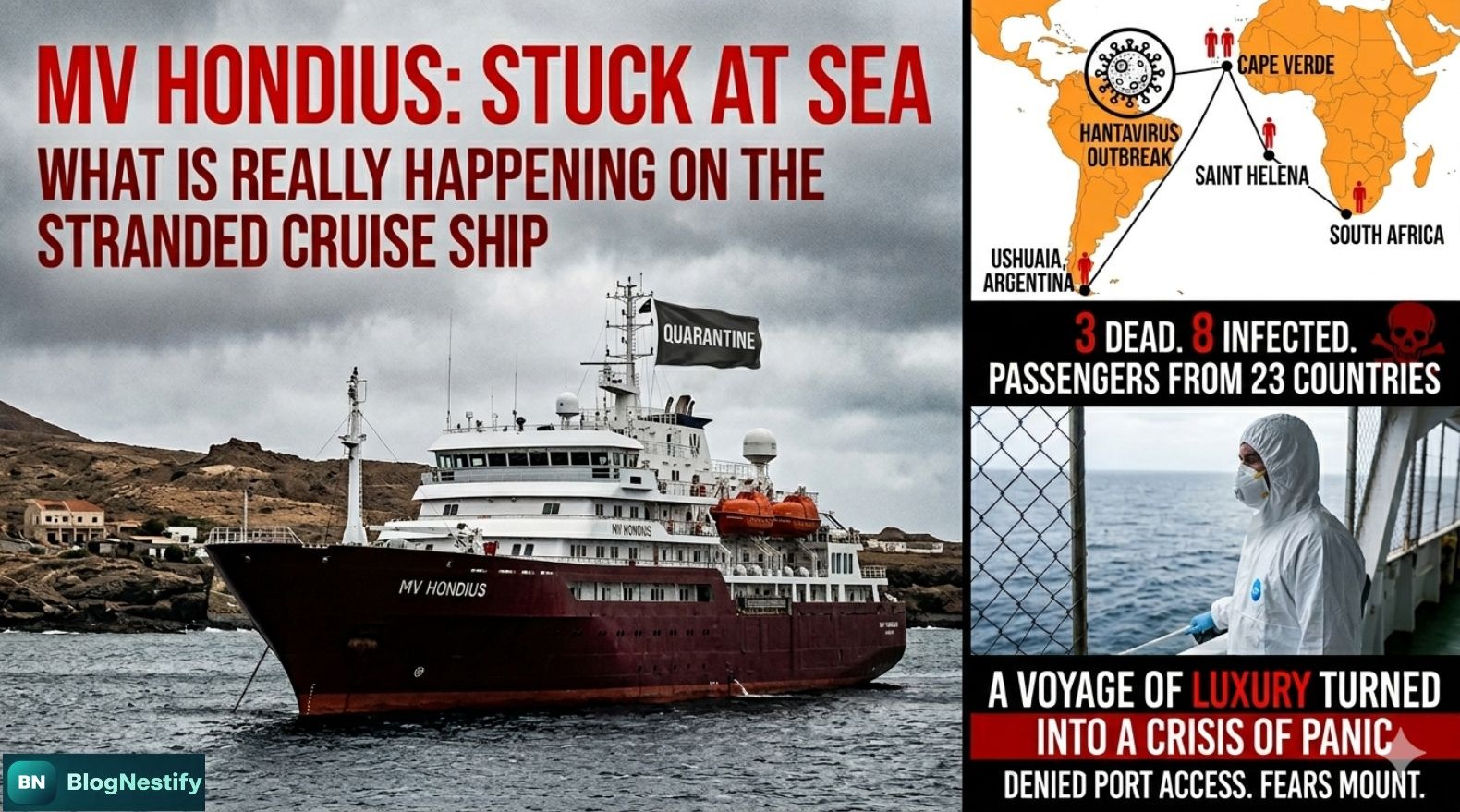
Three people are dead. Eight are infected. Around 150 passengers from 23 countries are stuck at sea. And the ship that started this crisis is now headed toward a region that does not want it.
What Actually Happened on MV Hondius
The MV Hondius left Ushuaia, Argentina — the southernmost city in the world — on April 1, 2026. It was meant to be a luxury expedition: Antarctica, remote South Atlantic islands, a voyage few people ever get to take. Instead, what unfolded over the following weeks became one of the strangest and most alarming public health stories of the year.
The ship is owned by Oceanwide Expeditions, a Dutch company. It holds up to 196 passengers and a crew of 72. On this particular trip, there were roughly 147 to 149 people on board, from 23 different countries — Spain, the UK, and the US made up the bulk of passengers, while most of the crew came from the Philippines.
Argentine authorities confirmed that no one was showing symptoms when the ship left port. Whatever happened, it started quietly.
By mid-April, someone was sick. By April 11, a passenger was dead. By the time the ship reached the island of Saint Helena on April 24, things had gotten bad enough that the deceased passenger's body and his wife — who had also developed symptoms — were airlifted off the vessel. She died in a hospital in Johannesburg on April 26. A third passenger was evacuated from Ascension Island on April 27 and flown to South Africa, where he is still being treated in an ICU.
On May 2, a German woman died on board. On May 3, the ship anchored off the coast of Praia, the capital of Cape Verde. And on May 6, Cape Verde — which lacks the medical infrastructure to manage an evacuation of this scale — denied the ship permission to properly offload passengers.
Timeline of the Outbreak
What Is Hantavirus — and Why the Andes Strain Changes Everything
Most people have never heard of hantavirus. That is not an accident — it is genuinely rare. The CDC tracked hantavirus in the US from 1993 to 2023 and found 890 total cases over 30 years. But here is the number that makes public health officials pay attention: roughly 35% of those cases were fatal.
Hantavirus typically spreads through contact with infected rodents — specifically through their urine, feces, or saliva. You can get it by breathing in dust contaminated with rodent droppings. That is how most people get it. It does not normally spread person to person.
The Andes strain is different. It is the only hantavirus strain known to transmit between humans, and that is precisely what makes the MV Hondius situation worth watching closely. Human-to-human transmission with Andes is rare — it requires prolonged, very close contact — but it has happened in previous outbreaks. On a cruise ship where people are sharing confined spaces for weeks, the conditions are not ideal.
🧫 Hantavirus Fast Facts
- Type: RNA virus in the Hantaviridae family, carried by rodents
- Normal transmission: Inhaling dust from infected rodent droppings, urine, or saliva
- Andes strain only: Can spread human-to-human in rare close-contact situations
- Incubation: 1–6 weeks before symptoms appear
- Symptoms: Fever, fatigue, gastrointestinal illness → rapid progression to pneumonia, ARDS, shock
- Fatality rate: ~35% in confirmed US cases over three decades
- Pandemic risk: WHO says "low" — does not spread like respiratory viruses
According to WHO, the passengers who fell ill showed symptoms including fever, gastrointestinal problems, rapid progression to pneumonia, acute respiratory distress syndrome, and shock. That timeline — a week or two of feeling unwell, then a crash — matches the known clinical pattern of hantavirus pulmonary syndrome.
Where Did the Virus Come From?
The Argentine health ministry published a report on May 6 that traced the movements of the index case — the couple who first showed symptoms — before the ship departed. They spent four months traveling across Chile, Uruguay, and Argentina between November 27, 2025, and April 1, 2026.
Two anonymous Argentine investigators told media outlets that the leading hypothesis involves birdwatching. The theory is that the Dutch couple visited a landfill area near Ushuaia while on a birdwatching trip, and that the contact with rodent-contaminated environments there is what infected them. Ushuaia's surrounding wilderness is known hantavirus territory.
The Argentine health ministry also reported 101 hantavirus infections nationally since June 2025 — roughly double the caseload seen over the same period the year before. Whether the ship outbreak and the broader Argentine uptick are connected is still under investigation.
Spain has a moral and legal obligation to assist these people, among whom are several Spanish citizens.
— World Health Organization statement, May 2026The Canary Islands Standoff
This is where it gets politically messy. The MV Hondius needed somewhere to dock and safely evacuate its passengers. Cape Verde lacked the capacity. The logical destination was Spain's Canary Islands — close, well-equipped, and home to 13 of the ship's passengers plus a crew member.
Canary Islands President Fernando Clavijo said no. His position: there was not enough information about the outbreak to guarantee the safety of the island's population. Islanders largely agreed with him. Their tourism-dependent economy took a brutal hit during COVID-19, and the instinct to keep outbreaks away from home ports is understandable, even if medical experts say the actual risk is low.
WHO pushed back directly, stating that Spain has "a moral and legal obligation" to assist. The Spanish central government agreed — the interior ministry said passengers would be allowed to disembark starting May 11, with non-Spanish citizens repatriated to their home countries. Clavijo's regional authority and Madrid's central government are not quite on the same page, which is creating friction as the ship closes in on the islands.
⚠ Contact Tracing Is Now Underway Internationally
- A Dutch woman who died disembarked at Saint Helena before her diagnosis. She flew from Saint Helena to Johannesburg on an Airlink flight carrying 82 passengers and 6 crew. Contact tracing for that flight has begun.
- France identified a passenger on that same flight who is now being monitored as a "contact case."
- South Africa has identified more than 60 people for monitoring through contact tracing.
- A Swiss man who was a former passenger is being treated at University Hospital Zurich.
- A British national is in a Johannesburg ICU in improving condition.
Who Is Still On Board the MV Hondius
Around 150 people remain on the ship. The passenger mix spans nationalities from across Europe, the Americas, Africa, and Asia. Here is a partial breakdown of countries with passengers on board:
| Region | Countries Represented |
|---|---|
| Western Europe | Spain (13 passengers + 1 crew), UK, Germany, France, Belgium, Ireland, Portugal, Netherlands |
| Americas | United States, Canada, Guatemala |
| Eastern Europe | Russia, Poland, Ukraine, Montenegro |
| Asia-Pacific | Japan, India, Australia, New Zealand, Philippines (crew majority) |
| Other | Greece, Turkey |
All remaining passengers are currently reported as asymptomatic. The Spanish health ministry said non-Spanish nationals will be repatriated to their home countries once the ship docks. Epidemiologists are expected to investigate the full scope of virus exposure before passengers are cleared.
Is This Going to Become a Global Health Emergency?
The short answer is: health authorities do not think so. WHO Director-General Tedros Adhanom Ghebreyesus has repeatedly said the overall public health risk remains "low." Officials have explicitly dismissed comparisons to COVID-19, pointing out that hantavirus does not have the same respiratory spread mechanism.
The Andes strain can spread person-to-person, but only in cases of very prolonged, close contact — think sharing a small living space, not passing someone in a hallway. The CDC has tracked fewer than 900 US cases in three decades. This is not a virus that spreads efficiently in the way that respiratory viruses do.
That said, the situation is being watched. Contact tracing is active across multiple countries. The ship's passengers visited some of the world's most remote wildlife-rich islands during their voyage — Antarctica, Tristan da Cunha, Saint Helena, Ascension Island. Any new cases that emerge in the weeks ahead will need to be mapped carefully.
📋 What Health Authorities Are Doing
- WHO is coordinating with IHR focal points in Cape Verde, Netherlands, South Africa, Spain, and the UK
- Argentina's health ministry and the Malbrán Institute are conducting rodent capture and testing along the index case's travel route
- South Africa has traced more than 60 contacts from the commercial flight that transported an infected passenger
- France, Switzerland, and South Africa are monitoring their own confirmed or suspected cases
- Spain's epidemiologists will investigate the ship before passengers disembark from May 11
- CDC issued a formal statement on May 7 confirming US passengers are being monitored
What This Means for Cruise Travelers
If you have a cruise booked, there is no reason to panic. The MV Hondius situation involved highly specific circumstances — a remote expedition ship, wildlife-rich stops in known hantavirus territory, and a small group of passengers with prior rodent exposure. This is not a pattern that describes a typical Caribbean or Mediterranean cruise.
That said, a few things are worth keeping in mind. Hantavirus is endemic in parts of South America, particularly Argentina and Chile. Travelers planning trips to rural or wilderness areas in those regions — especially people who enjoy birdwatching, camping, or exploring natural areas — should be aware of the rodent-avoidance basics: avoid handling rodents, do not disturb rodent nests, wear gloves when cleaning spaces that show signs of rodent activity, and avoid areas with heavy rodent populations.
There is no vaccine for hantavirus. There is no specific antiviral treatment. Early recognition and supportive hospital care — particularly mechanical ventilation in severe cases — is the primary medical response. If you develop fever, fatigue, and respiratory symptoms after traveling in known hantavirus regions, tell your doctor where you have been.
Frequently Asked Questions
Hantavirus is a rare rodent-borne virus. People normally contract it through contact with infected rodent urine, feces, or saliva — often by breathing in contaminated dust. The Andes strain in this outbreak is the only hantavirus known to spread between humans, but only through prolonged, very close contact. It is not airborne in the same way flu or COVID-19 are.
As of May 8, 2026, WHO has confirmed 8 cases linked to the MV Hondius — 3 laboratory-confirmed infections and 5 suspected cases. Three passengers have died, though only one death has been definitively attributed to hantavirus so far. The other two remain under investigation.
Canary Islands President Fernando Clavijo refused the ship on May 6, citing insufficient information about the outbreak and concerns about public safety. Island residents — still scarred by COVID-19's impact on their tourism economy — largely supported the decision. WHO responded that Spain has "a moral and legal obligation" to assist, particularly because several Spanish nationals are on board. Spain's central government has since overruled the regional position and confirmed disembarkation will begin May 11.
The leading hypothesis is that the index case — a Dutch couple who first showed symptoms — contracted the Andes strain while birdwatching near a landfill in Ushuaia, Argentina, before boarding. The Argentine health ministry tracked their four-month road trip through Chile, Uruguay, and Argentina prior to departure. Rodent capture and testing is ongoing along their travel route.
No. WHO Director-General Tedros Adhanom Ghebreyesus confirmed the global public health risk remains "low." Unlike COVID-19, hantavirus does not spread efficiently through casual contact or respiratory droplets. The Andes strain's human-to-human transmission requires prolonged, very close contact. Health officials have explicitly stated this is not expected to become a pandemic threat.
Early symptoms include fever, fatigue, and gastrointestinal issues. In severe cases, the disease progresses rapidly to pneumonia, acute respiratory distress syndrome (ARDS), and shock. The incubation period is 1–6 weeks. There is no specific antiviral treatment — supportive hospital care is the primary response. The virus has roughly a 35% fatality rate in confirmed US cases.
As of May 8, 2026, the MV Hondius is en route to Spain's Canary Islands after departing Cape Verde on May 7. Three ill passengers were evacuated before the ship left — two transported to Amsterdam and one diverted to Gran Canaria after Morocco refused refueling. Spain's interior ministry confirmed that passenger disembarkation will begin from May 11, with non-Spanish citizens repatriated to their home countries.
Sources & References
- World Health Organization — Disease Outbreak News: Hantavirus cluster linked to cruise ship travel, Multi-country. who.int
- Wikipedia — MV Hondius hantavirus outbreak. wikipedia.org
- Al Jazeera — Three people evacuated from hantavirus-hit cruise ship. aljazeera.com
- CNN — Hantavirus cruise ship heads for Spain's Canary Islands. cnn.com
- TIME — What Countries Are Linked to the Hantavirus Outbreak? time.com
- CDC Newsroom — Statement on the M/V Hondius Cruise Ship, May 7, 2026. cdc.gov
0 Comments
Leave a Comment