NEET 2026 Was Supposed to Be Leak-Proof. Here's How the System Failed Anyway
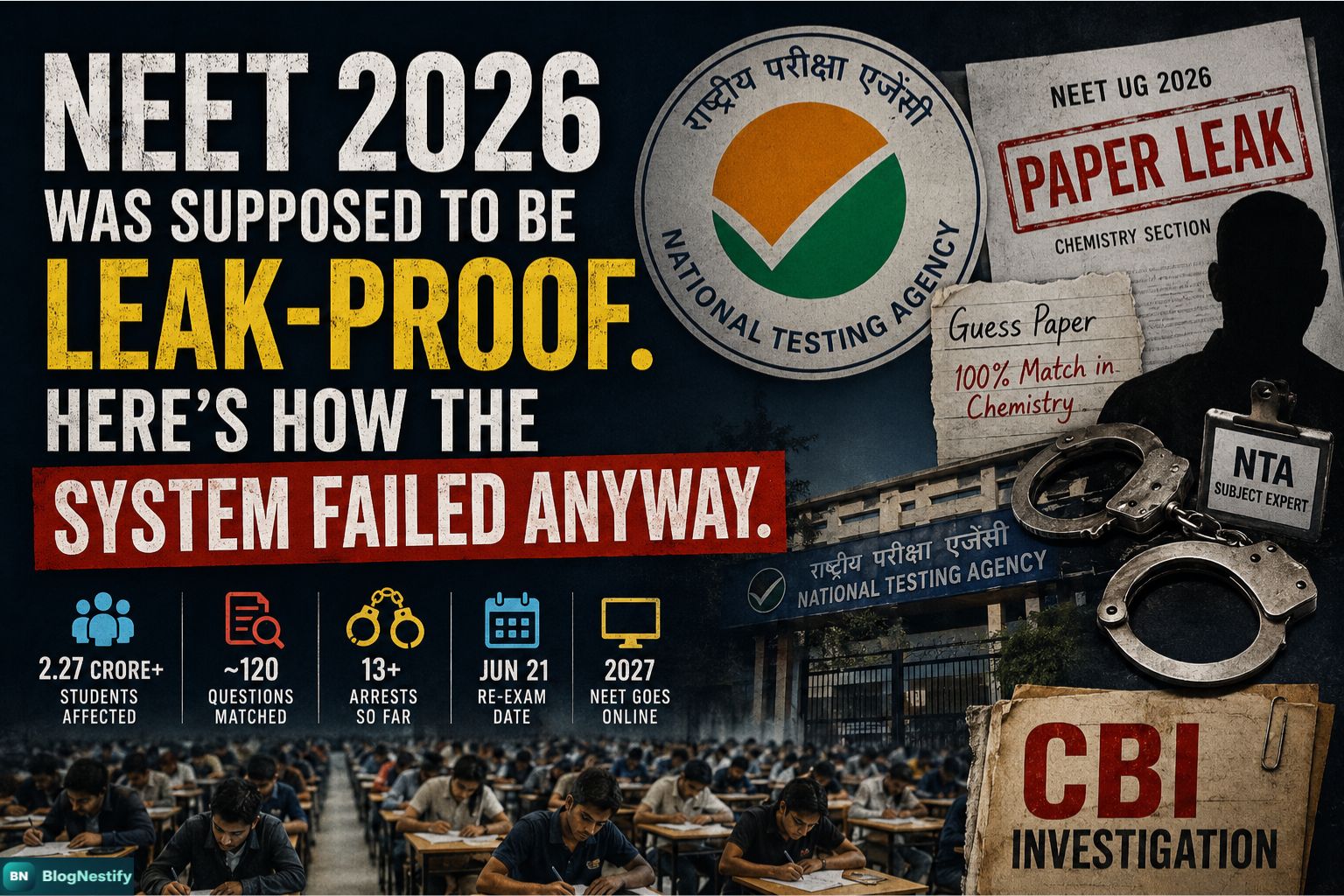
Inside the government, there is quiet acknowledgement that the 13 CBI arrests so far are only part of the story. The real failure, insiders say, runs deeper — through the very process used to set the exam itself.
On May 7, 2026 — four days after 22.7 lakh students sat for NEET UG — a chemistry teacher in Sikar, Rajasthan noticed something that nobody at NTA wanted to see: a "guess paper" circulating in coaching circles matched the actual exam almost perfectly. Every Chemistry question. Large chunks of Biology. He emailed the NTA with a PDF. Five days later, the exam was cancelled.
NEET 2026 — At a Glance
- 2.27 CrStudents who appeared
- ~120Matching questions reported
- 13+CBI arrests (as of May 2026)
- Jun 21Re-exam date
- 2027NEET shifts to CBT format
- 3Students died by suicide after leak news
This was not supposed to happen again.
After the NEET 2024 debacle — when question papers were physically stolen from a strongroom in Hazaribagh and solved in a rented room in Patna — the government had assembled a seven-member expert committee under former ISRO chairman K. Radhakrishnan. It produced a detailed reform agenda: encrypted paper delivery, AI-based surveillance, biometric authentication, background checks for paper setters, and a shift to computer-based testing. The Supreme Court closed the matter in April 2025 after the Centre promised to implement all of it.
Fourteen months later, the same exam — with many of those reforms officially in place — was cancelled again. This time, the breach did not happen at a strongroom or a transport chain. It happened much earlier, and much deeper inside.
The Leak That Came from Within
PV Kulkarni is 60-something, retired, and not exactly a household name. He spent 28 years as a Chemistry professor at Dayanand College in Latur, Maharashtra, eventually becoming its principal before hanging up his chalk around four years ago. After retirement, he freelanced at coaching institutes in Pune — not unusual for someone of his calibre. What was unusual was his second career: a contractual appointment with the NTA as a Chemistry subject expert.
CBI investigators allege that Kulkarni used his NTA access to create a PDF copy of the NEET UG 2026 Chemistry paper and circulate it through a coordinated racket spread across Maharashtra and Rajasthan. Interrogation of Kulkarni subsequently led to the arrest of a Biology professor, Manisha Gurunath Mandhare, who allegedly had similar access to the Botany and Zoology portions of the paper.
Mandhare, who worked at Pune's Modern College, allegedly ran her own operation separately but in parallel. Starting in April 2026, she conducted special coaching sessions at her residence where she dictated specific Botany and Zoology questions to select students, instructing them to note answers in notebooks and mark them in textbooks. When investigators raided her home, the handwritten notes matched the actual exam paper.
These were not street-level middlemen or desperate candidates. They were credentialed academics who had earned NTA's trust — and exploited it.
"The probe has uncovered that the leakage primarily involved Chemistry and Biology papers, with insiders from the NTA panel allegedly collaborating with middlemen who organised paid coaching sessions for select students."
— CBI statement, May 2026A third arrest, on May 18, brought in Shivaraj Motegaonkar, owner of the Renukai Chemistry Classes coaching institute in Latur. Investigators found that this same racket had also compromised NEET UG 2025 — meaning the network had been operational for at least two exam cycles before anyone caught it.
How the Chain of Custody Actually Works — and Where It Broke
The NTA operates with formal protocols around paper-setting. Experts are recruited under strict conditions: secure, internet-free rooms, no phones, no laptops. Papers are set in isolation, reviewed, translated, and encrypted before transportation. On paper, it is a controlled process with multiple checkpoints.
The problem is the human factor inside those checkpoints. The translators — who convert papers into regional languages including Marathi, Tamil, and Telugu — see the same content as paper setters. The NTA's own internal investigation, triggered by the Sikar whistleblower's email, found that all Chemistry questions were compromised. The agency then shared a list of approximately 26–27 individuals with the CBI for investigation, comprising paper setters, translators, and others involved in the Chemistry paper process. Officials suspect some of them may have been involved in previous exam cycles too.
NTA's secure paper-setting rooms do not allow devices or internet. But they cannot prevent a human expert from memorising questions and dictating them to students after leaving. This is not a technology gap — it is a vetting gap. The 2024 reforms focused heavily on physical security and encryption; background verification of paper setters and translators received comparatively less attention.
The Education Minister acknowledged this directly. At a press conference on May 15, Dharmendra Pradhan said there had been a "breach in the command chain" despite the Radhakrishnan committee's reforms being implemented. He accepted government responsibility — and pointed to the OMR system as the structural culprit. What he did not say, though it was implied: the reforms fixed the delivery chain, not the source.
A Timeline of a Scandal in Slow Motion
Oasis School principal and vice principal arrested. Paper physically accessed hours before exam. Supreme Court declines full cancellation; 155 students at two centres identified as beneficiaries.
Seven-member expert panel tasked with recommending full security overhaul including shift to CBT, biometric authentication, and encrypted delivery systems.
Centre assures implementation of all Radhakrishnan recommendations. One key recommendation — CBT format — quietly deferred. Court satisfied with compliance reports.
Over 2.27 crore students write the exam at centres across India. No immediate disruption.
Chemistry teacher in Rajasthan compares leaked "guess paper" to actual exam. Finds near-100% match in Chemistry and significant overlap in Biology. Shares PDF with NTA.
Cancellation affects all 2.27 crore students. Re-examination announced for June 21. CBI formally takes over the case from Rajasthan Police SOG.
Arrests in Pune, Latur, Delhi, Gurugram, Jaipur. CBI reveals 2025 paper was also compromised by same network. Total arrests reach 13.
Pradhan admits "breach in command chain." Announces CBT format from 2027 — the one Radhakrishnan recommendation previously left out of compliance assurances.
SC bench questions how leaks persist despite monitoring of HPC recommendations. Asks whether recommendations were flawed or implementation inadequate. Petitions seek NTA's replacement by an act of Parliament.
What the Reforms Actually Fixed — and What They Didn't
It is worth being precise here, because "reforms were implemented but failed" is doing a lot of rhetorical work that the facts don't entirely support.
The Radhakrishnan committee's recommendations were substantial. They called for biometric verification of candidates, encrypted paper delivery, AI surveillance at exam centres, stronger centre allocation systems, and a shift to CBT. The Centre accepted most of them. Physical security around transportation and exam centres was significantly upgraded. Encryption protocols were strengthened. AI-based anomaly detection systems were deployed — though officials privately acknowledged these were still "at a nascent stage."
The one recommendation the Centre explicitly declined, as Solicitor General Tushar Mehta told the Supreme Court in April 2025, was the move to CBT. Pradhan cited cost, infrastructure readiness, and concerns about digital equity in rural areas. These are not frivolous objections. But the leak in 2026 originated not in transportation or examination centres — it originated in the paper-setting process, where CBT would have had limited direct impact anyway.
The 2024 reforms were designed primarily around the failure mode of 2024 — physical theft of printed papers during transit or at exam centres. The 2026 breach happened earlier in the pipeline: at the level of paper setters with direct access to questions before printing. No amount of encrypted envelopes or biometric centre-entry can prevent an insider from memorising and dictating questions after they have helped set them.
The process also remained vulnerable due to multiple human handling points in the chain, creating opportunities for breaches. The deployment of advanced AI-based surveillance systems to detect anomalies was still nascent. And critically, background verification and third-party due diligence for paper setters and translators — a gap that the Outlook investigation flagged — had not been institutionalised with the same rigour as physical security measures.
The NTA's Structural Problem No One Wants to Name
Three students died by suicide in the weeks after the cancellation was announced. The human cost here is not abstract.
But the structural problem is also real: the NTA has been conducting one of the world's largest single-day examinations — 2.27 crore students, 5,400 centres, hundreds of cities — with an institutional design that has not kept pace with the exam's scale or the sophistication of those trying to game it.
The agency relies on contractual experts, many drawn from the same academic networks as coaching institutes. In some cases, as the 2026 investigation revealed, the same individuals who set NEET questions also maintain affiliations with coaching businesses. The conflict of interest was not incidental — it was structural.
| Year | Breach Point | Key Failure | Response |
|---|---|---|---|
| 2024 | Physical transit / Exam centre | Strongroom accessed in Hazaribagh; papers leaked in Patna | Radhakrishnan committee; partial reform implementation |
| 2025 | Paper-setting process | Same racket as 2026 — went undetected | Not publicly known at the time; CBI confirmed in 2026 |
| 2026 | Paper-setting / translation process | NTA-contracted experts dictated questions to students | Cancellation; CBI probe; NEET to go CBT from 2027 |
The Supreme Court put it plainly during the May 2026 hearings: either the Radhakrishnan recommendations were flawed, or effective monitoring had not taken place. It is probably both. A committee formed after one type of failure will naturally optimise its recommendations around that failure. The 2026 breach required a different diagnosis — one that the 2024 committee, formed before 2026's pattern was visible, could not have fully anticipated.
What Happens Next: The CBT Bet
Pradhan's announcement that NEET will go online from 2027 is significant — but it needs scrutiny, not celebration.
Computer-based tests like JEE allow for question randomisation, which makes large-scale leaks harder because each candidate can get a different set. Secure delivery, real-time monitoring, and tamper-evident systems are all more tractable in a digital format. These are real advantages.
Critics have a point too, though. If the leak originates in the paper-setting process itself — when the question bank is still being assembled — then it does not matter how secure the delivery is. A CBT system with compromised setters is not safer than a pen-and-paper exam with vetted ones.
Will help: Prevents physical theft in transit, enables question randomisation per candidate, enables real-time anomaly detection, reduces risks at the examination centre level. Won't fix: Insider access during question bank creation, human vetting failures, conflict-of-interest among contracted experts, state-level coaching-NTA nexus. CBT is necessary. It is not sufficient.
The more fundamental reform — which petitioners before the Supreme Court are pushing for — is replacing the NTA itself with a more autonomous, independently governed body created by an Act of Parliament, with its own dedicated technology, security, and vetting divisions. The UPSC comparison keeps coming up: India's civil services exam, conducted for decades, does not produce scandals at this scale. The difference is institutional credibility built over time — not just better technology.
The Re-Exam and What Students Are Facing
For the 2.27 crore students who wrote NEET on May 3, the cancellation is not a policy question. It is their lives, rescheduled. Medical aspirants in India often spend two to three years — sometimes more — preparing for a single exam. Their families plan around it. Admissions counselling timelines run tight. A two-month delay ripples into everything.
The re-examination is scheduled for June 21 at over 5,400 centres across 550 cities. Admit cards are expected by June 14. Pradhan also announced 15 additional minutes of examination time, acknowledging that the earlier OMR formalities had unnecessarily consumed student time. Fee refunds have been extended.
The Supreme Court has noted what "a bench led by Justice PS Narasimha" articulated: "It's actually very traumatic if something like this happens — not just for the students but also their families and everybody." The court has made clear it will not disappoint young aspirants again, and is monitoring the matter closely into July.
Students and opposition leaders — from Rahul Gandhi to actor-politician Vijay — have called the repeated leaks a systemic indictment. "A crime against the youth's future," Gandhi said, comparing the situation to the exam being put up for auction. The political pressure is real, even if the solutions being debated are more complicated than the rhetoric.
Key Takeaways
- NEET 2026 was leaked via NTA-contracted paper setters, not through transit theft — a different failure mode than 2024, and one the 2024 reforms were not designed to address.
- The same racket compromised both NEET 2025 and NEET 2026, operating undetected across at least two exam cycles.
- The Centre deferred CBT adoption after NEET 2024 despite it being the expert panel's primary recommendation — and has now committed to it for 2027 after the 2026 crisis.
- Background vetting of paper setters and translators — not just encryption of delivery — is the gap that enabled this breach.
- The Supreme Court is actively monitoring reform implementation; petitions seeking NTA's dissolution and replacement are pending for July hearing.
0 Comments
Leave a Comment