Nvidia's N1X Specs Leak in Full — Here's What's Next for Windows on Arm
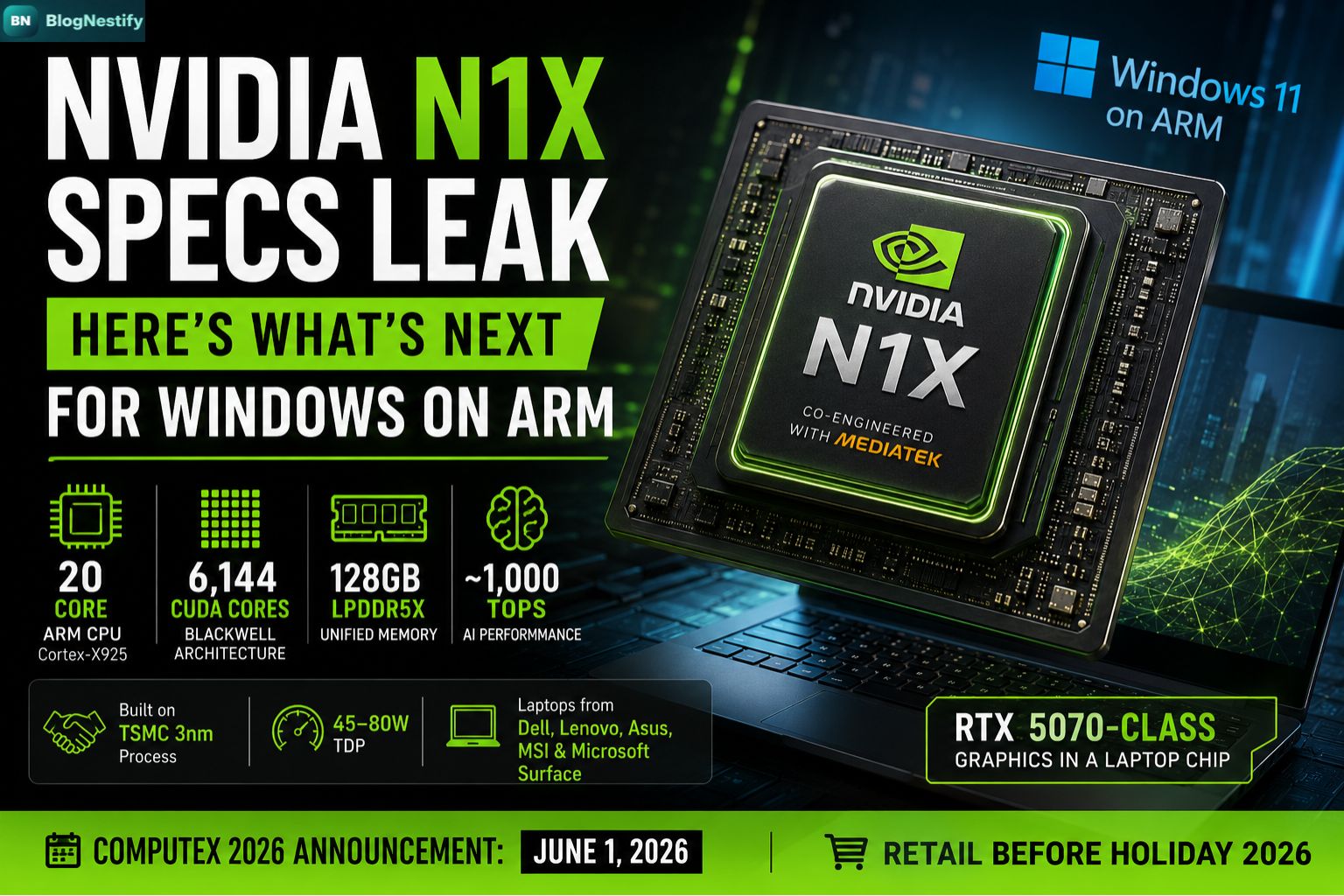
Just hours before Jensen Huang takes the Computex 2026 stage, the complete spec sheet for Nvidia's N1X and N1 chips has leaked online — and the numbers are hard to ignore. RTX 5070-class graphics in a laptop SoC, 128GB of unified memory, and the full CUDA stack on Windows. The ARM PC race just got crowded.
- N1X flagship: 20-core Arm CPU (Cortex-X925 + A725), 6,144 CUDA cores (Blackwell), 45–80W TDP✓
- N1X cut-down: 18 cores, 5,120 CUDA cores — same 45–80W envelope✓
- N1 mainstream: 12- or 10-core, 2,560 or 2,048 CUDA cores, 18–45W✓
- Up to 128GB LPDDR5X unified memory, ~273 GB/s bandwidth✓
- Co-developed with MediaTek, built on TSMC 3nm✓
- Full CUDA software ecosystem on a portable Windows device — a first✓
- Dell, Lenovo, Asus, MSI, and Microsoft Surface already building devices✓
- Official Computex 2026 announcement: June 1; retail before holiday 2026✓
What Just Leaked — and Why It Matters
Nvidia hasn't officially announced the N1X yet. But thanks to internal documents surfaced by VideoCardz the day before Computex 2026 kicked off, the industry effectively has the full spec sheet already. This isn't a blurry screenshot or a vague benchmark entry — it's a detailed breakdown of every SKU, memory config, PCIe lane count, and power envelope across both the N1 and N1X families.
The timing is no accident. Microsoft and Nvidia ran near-identical "new era of PC" teasers on social media in the days leading up to June 1, a coordinated signal that was almost impossible to miss. OEMs including Dell, Lenovo, Asus, and MSI were already preparing embargoed announcements. The leak just got there first.
Nvidia N1X Full Spec Breakdown
The N1X is the high-performance tier. It comes in two configurations, both sharing the same 45–80W power profile. The chip is co-developed with MediaTek, fabbed on TSMC's 3nm process, and pairs two chiplets — a CPU die from MediaTek and a GPU die from Nvidia — connected through Nvidia's NVLink C2C interconnect at 300 GB/s bidirectional bandwidth.
Cortex-X925 / A725
Blackwell Architecture
16-channel, ~273 GB/s
NVFP4 Tensor Cores
| Specification | N1X Flagship | N1X Cut-Down | N1 High | N1 Base |
|---|---|---|---|---|
| CPU Cores | 20 (10+10) Top | 18 (9+9) | 12 (8+4) | 10 (7+3) |
| P-Cores | 10× Cortex-X925 | 9× Cortex-X925 | 8× Cortex-X925 | 7× Cortex-X925 |
| E-Cores | 10× Cortex-A725 | 9× Cortex-A725 | 4× Cortex-A725 | 3× Cortex-A725 |
| GPU (SMs) | 48 SMs | 40 SMs | 20 SMs | 16 SMs |
| CUDA Cores | 6,144 RTX 5070-class | 5,120 | 2,560 | 2,048 |
| GPU Architecture | Blackwell 2.0, 5th Gen Tensor Cores, DLSS 4, Ray Tracing | |||
| Max Memory | 128GB LPDDR5X (16-ch) Unified | Up to 64GB LPDDR5X | ||
| Memory BW | ~273 GB/s | ~136 GB/s | ||
| PCIe Lanes | 12× PCIe 5.0 + 5× PCIe 4.0 | 8× PCIe 5.0 + 3× PCIe 4.0 | ||
| M.2 Drives | 3× NVMe | 2× NVMe | ||
| TDP | 45–80W | 18–45W | ||
| Process Node | TSMC 3nm (CoWoS 2.5D packaging) | |||
| AI Performance | ~1,000 TOPS (NVFP4) | ~500 TOPS (est.) | ||
One detail worth flagging: the leaked documents reportedly date to 2024, so treat spec granularities with some caution. The broad architecture is consistent across multiple independent leaks, but exact figures like memory speeds and PCIe configurations could shift in the official announcement.
The DGX Spark Connection — How Close Is the N1X?
If the N1X looks familiar, it should. Nvidia already shipped the GB10 Superchip inside the DGX Spark — a $3,999 compact AI workstation announced at CES 2025. That chip packs a 20-core Arm CPU, the same Blackwell GPU cluster, and unified LPDDR5X memory in a 2.5D chiplet package.
The N1X laptop chip shares that GPU die wholesale, with identical SM count, Tensor Core generation, and FP4 precision support. What changes is the CPU side: the DGX Spark uses custom Nvidia Grace cores tuned for server-class throughput, while the N1X laptop variant uses off-the-shelf Arm Cortex-X925 and A725 cores designed by MediaTek. The TDP also drops significantly from the desktop's higher power ceiling.
CUDA on a Windows Laptop — Why Developers Are Paying Attention
The chip specs matter. But there is an argument that the software story matters even more.
Every major AI framework — PyTorch, TensorRT, CUDA Graphs, cuBLAS, the Hugging Face accelerate stack — is built around Nvidia's CUDA programming model. Qualcomm's Hexagon NPU, Apple's Neural Engine, and AMD's XDNA all require software ported and optimized specifically for those platforms. CUDA code just runs on the N1X. There is no port, no rewrite, no compatibility layer.
For AI developers who spend most of their time cloud-hosted on A100 or H100 instances, the N1X offers something genuinely new: a local machine for inference, experimentation, and fine-tuning that speaks the same language as their production stack. Running 7B to 13B parameter LLMs locally without cloud costs, or fine-tuning on a laptop during a flight, stops being theoretical.
N1X vs. The Competition — How It Stacks Up
Nvidia isn't entering a quiet market. Qualcomm's Snapdragon X Elite has spent two years building OEM relationships, driver infrastructure, and end-user recognition. AMD's Strix Halo sits as the benchmark for integrated GPU performance in x86 laptops. And Apple Silicon quietly keeps setting the pace from macOS. Here's where things stand.
| Chip | CPU Cores | GPU Performance | Max Memory | AI (TOPS) | OS |
|---|---|---|---|---|---|
| Nvidia N1X | 20 (Arm) | RTX 5070-class, 6,144 CUDA | 128GB LPDDR5X | ~1,000 | Windows 11 (Arm) |
| Snapdragon X Elite | 12 (Oryon) | Adreno, ~4.6 TFLOPS | 64GB LPDDR5X | ~45 | Windows 11 (Arm) |
| AMD Strix Halo | 16 (Zen 5) | 40 CU RDNA 3.5 Radeon | 128GB LPDDR5X | ~50 (XDNA 2) | Windows 11 (x86) |
| Apple M4 Max | 16 (Apple) | 40-core Apple GPU | 128GB LPDDR5X | ~38 | macOS only |
| Intel Core Ultra 9 285HX | 24 (Lion Cove) | Arc iGPU (~16 Xe2) | 192GB DDR5 | ~120 (Meteor Lake NPU) | Windows 11 (x86) |
Pre-release Geekbench traces give the N1X approximately 3,096 in single-core and around 18,837 in multi-core — about 15% ahead of the Snapdragon X Elite in single-core, and roughly 10–15% behind Intel and AMD's best in multi-threaded CPU work. The GPU gap, though, is where Nvidia makes its sharpest argument: 6,144 CUDA cores in the flagship N1X against the Snapdragon X Elite's graphics, which are competitive for productivity but not in the same tier for gaming or GPU compute.
Where Qualcomm Still Holds Ground
Qualcomm's Snapdragon X platform has two years of driver work, OEM relationships, and Windows software optimization that Nvidia is starting from scratch on. Compatibility, battery-optimized power states tuned for the Windows scheduler, and a proven thin-and-light design footprint all take time to build. The N1 (not N1X) will go head-to-head with Snapdragon X devices in the sub-$1,500 range, and that battle will be won on shipping products, not leaked spec sheets.
Which OEMs Are Building N1X Devices?
The device pipeline is already in motion. Lenovo's internal product database accidentally went public earlier this year, naming multiple N1 and N1X designs in development. Dell has an embargoed XPS variant reportedly set to reveal on May 31, one day before the official Computex keynote. Reports link the following brands to first-generation N1/N1X hardware:
MSI has also been named in regional coverage. Retail availability for first devices targets Q4 2026, ahead of the holiday window. Wider availability across more price points is expected into early 2027. Pricing hasn't been confirmed, but Tom's Hardware estimates N1X flagship laptops above the $2,000 mark — roughly competing against the MacBook Pro in positioning — while N1-based devices should land below $1,500.
What This Means for Windows on Arm as a Platform
Microsoft has been working to get Windows on Arm taken seriously as a mainstream platform for several years, and until this year, that work was entirely tied to Qualcomm. A second major silicon partner changes the nature of that project.
Internally, Microsoft is preparing a platform-targeted branch of Windows 11 — visible in Insider builds as version 26H1 — explicitly designed to support new silicon categories without disrupting the x86 installed base. That's the foundation N1X devices will launch on. The fact that Microsoft ran coordinated teasers with Nvidia ahead of Computex suggests the relationship here isn't just hardware certification — it's a joint go-to-market effort.
There are also early signals about a next-generation follow-up. Reports point to N2 and N2X chips targeting a Q2 2027 window, built on a more advanced process and presumably with Grace-class or newer CPU cores. If those timelines hold, Nvidia is signaling a committed, multi-generation roadmap in this space — not a one-off experiment.
What We Still Don't Know
Leaks fill in the spec sheet. They don't answer the questions that actually matter for buyers.
Gaming compatibility on Windows on Arm has improved dramatically — Minecraft, Roblox, and GTA V run natively on Snapdragon X — but no AAA title has confirmed N1X-specific support yet. Nvidia's DLSS 4 and ray tracing cores are present in the N1X's Blackwell GPU. Whether they work with existing Windows Arm game builds, or whether developers need to ship updated binaries, is an open question that will only resolve with shipping hardware and real-world testing.
Driver maturity is the other unknown. Qualcomm's advantage isn't just hardware — it's two years of firmware work tuned to the Windows power management stack, a curated set of driver bugs already filed and fixed, and OEM-specific optimizations baked into shipping SKUs. Nvidia starts from a clean slate. Early N1X devices will almost certainly have rough edges that a second or third generation won't.
Key Takeaways
- The N1X flagship packs 20 Arm cores and 6,144 CUDA cores — GPU power on par with a discrete RTX 5070 — inside a 45–80W laptop SoC.→
- Co-developed with MediaTek, built on TSMC 3nm, with the same Blackwell GPU die as the DGX Spark GB10 Superchip.→
- Up to 128GB of LPDDR5X unified memory at ~273 GB/s bandwidth mirrors Apple Silicon's architectural philosophy for Windows.→
- CUDA on a Windows laptop is the real story: developers get a portable device that speaks natively to their existing AI stack.→
- Dell, Lenovo, Asus, MSI, and Microsoft Surface are building devices. Retail before holiday 2026, broader availability in early 2027.→
- Software compatibility, driver maturity, and gaming support remain the critical unknowns that shipping hardware must answer.→
- Qualcomm's Windows on Arm monopoly ends here. Genuine competition between N1X, Snapdragon X2, AMD, and Intel reshapes the platform's future.→
0 Comments
Leave a Comment