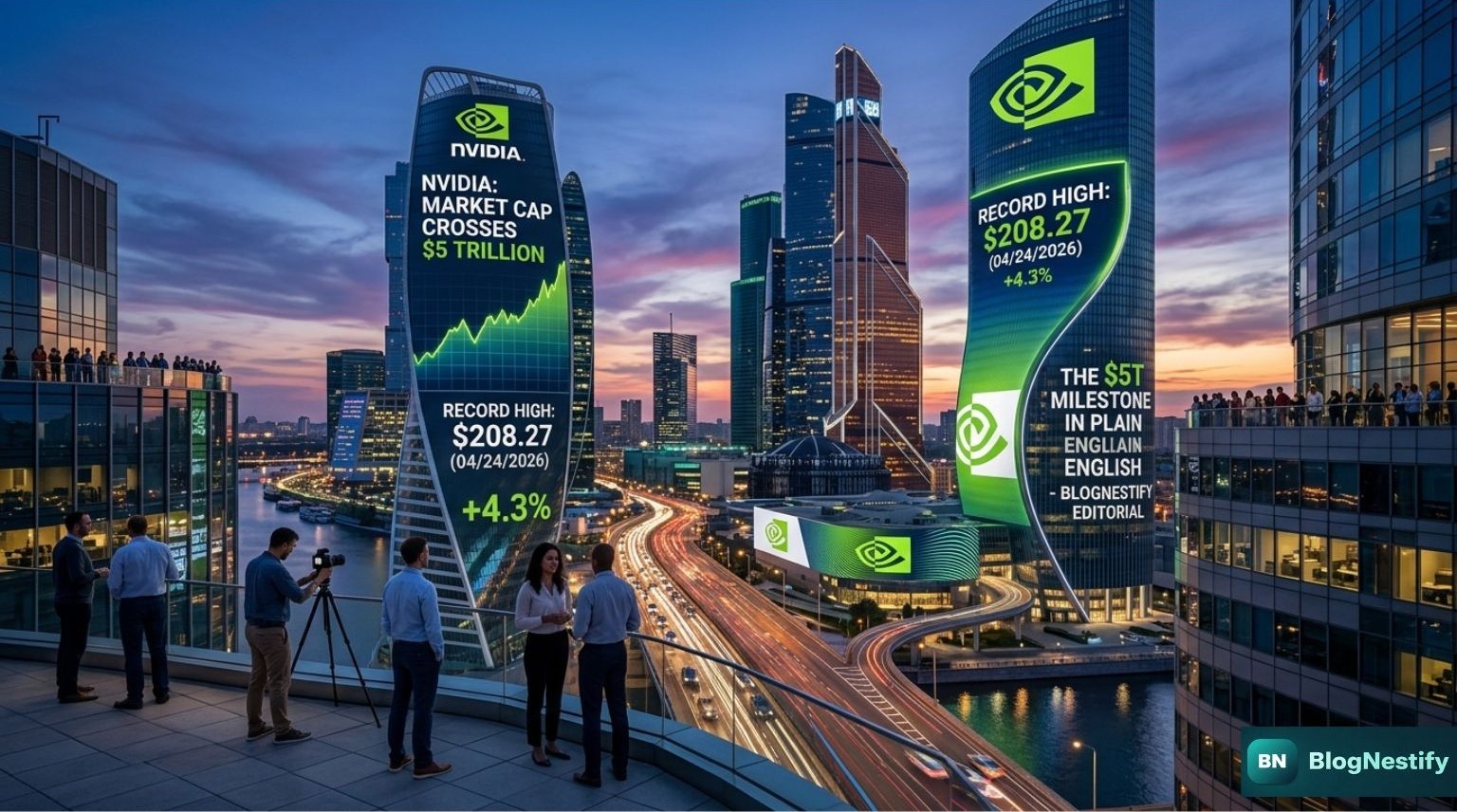
A chip company worth $5 trillion. That number sat in my head for a while before it really landed. On Friday, April 24, 2026, Nvidia closed at a record $208.27 — up 4.3% in a single session — and its market cap hit $5.12 trillion at its peak. Not briefly. Not intraday-only. It held.
If you follow tech stocks, you probably saw it coming. But even then, the actual moment feels different from the forecast. This isn't a company that makes phones or runs search ads. It makes chips. And right now, those chips are the most wanted piece of hardware on the planet.
How Did Nvidia Get Here?
Go back to late 2022. Nvidia was known mainly for gaming GPUs. Good company, solid reputation, not exactly the kind of name that made financial news every week. Then ChatGPT launched, AI spending went vertical, and Nvidia happened to make the exact hardware everyone needed to build it. The stock is up more than 1,400% since then. That's not a typo.
The reason is straightforward. Nvidia's GPUs train AI models. Google, Microsoft, Meta, Amazon, OpenAI, Anthropic — they all buy them in massive quantities. Demand shot up faster than Nvidia could build chips, which means customers are paying whatever it costs to get them. That kind of pricing power doesn't show up often.
📊 Key Numbers at a Glance
- Closing price: $208.27 (record high close)
- Single-day gain: +4.3% on April 24, 2026
- Market cap: $5.12 trillion (peak intraday)
- Stock rise since end-2022: Over 1,400%
- Lead over #2 (Alphabet): $1 trillion more in market cap
What Triggered Friday's Surge?
Oddly, it wasn't Nvidia's own news that lit the fuse. Intel reported earnings Thursday night that nobody expected to be good — and they were genuinely good. Shares jumped 24% Friday morning, the best single-day move for Intel since 1987. When a beaten-down chipmaker like Intel surprises to the upside, the whole sector gets repriced.
April has been wild for semiconductors broadly. The Philadelphia Semiconductor Index gained around 47% over 18 straight winning sessions. That kind of streak doesn't happen on noise — it's investors repositioning ahead of what they expect to be a long, expensive AI buildout. Nvidia, sitting at the center of all that spending, got the biggest slice of the rally.
The AI Money Keeps Flowing — And It's Going Into Nvidia
The numbers here are hard to sit with calmly. Amazon, Microsoft, Google, and Meta have committed somewhere between $650 and $700 billion in combined capital spending for 2026. A big chunk of that goes to data centers. Data centers run on GPUs. Nvidia makes the GPUs everyone wants. The math isn't complicated.
Jensen Huang recently said Nvidia could hit $1 trillion in revenue over the next two years. Wall Street already had high expectations, but that forecast put even analysts on the back foot. Nvidia's Q4 revenue grew 73% year over year. For a company this large, 73% growth is the kind of number that makes you double-check the report.
Nvidia controls roughly 84% of the high-end AI GPU market. Competitors exist — AMD is trying, Intel is trying — but switching away from Nvidia also means rebuilding years of code written for CUDA, Nvidia's software platform. Most teams don't want to do that. So even companies that would prefer an alternative often end up back in Nvidia's queue.
Should You Be Worried About the Risks?
The risks are real, and worth saying plainly. Meta, Microsoft, Google, and Amazon are all building their own AI chips in-house. Google's TPUs already handle a meaningful share of its AI workloads. These custom chips won't replace Nvidia overnight — but over a few years, they could quietly eat into demand, especially for the simpler, more predictable jobs.
There's also regulatory pressure. An 84% market share in any industry tends to attract scrutiny, and Nvidia is no exception. Antitrust investigations are slow-moving, but they're not nothing. Any serious enforcement action could complicate the company's ability to operate as freely as it does today.
Still, 38 analysts cover the stock and the consensus is "Strong Buy," with an average price target of $266.24 — about 28% above where it closed Friday. The next real test comes on May 20, 2026, when Nvidia reports fiscal Q1 2027 earnings. That's when we'll see whether the demand story actually holds or starts to wobble.
Frequently Asked Questions
The Bottom Line
Five trillion dollars is a lot to think about for a company that, four years ago, most people outside gaming hadn't given much thought to. What changed wasn't Nvidia — it was what the world decided it needed. AI turned out to need exactly what Nvidia was already building. That's partly luck, partly years of technical bets that paid off, and partly Jensen Huang being more right about GPU computing than almost anyone else was willing to admit.
Whether the stock keeps climbing from here, nobody actually knows. But the underlying demand — hundreds of billions in committed spending, no clear substitute for Nvidia's hardware, and a software ecosystem that takes years to learn — isn't going anywhere fast. That's the part worth paying attention to, regardless of what the stock does on any given Friday.
0 Comments
Leave a Comment