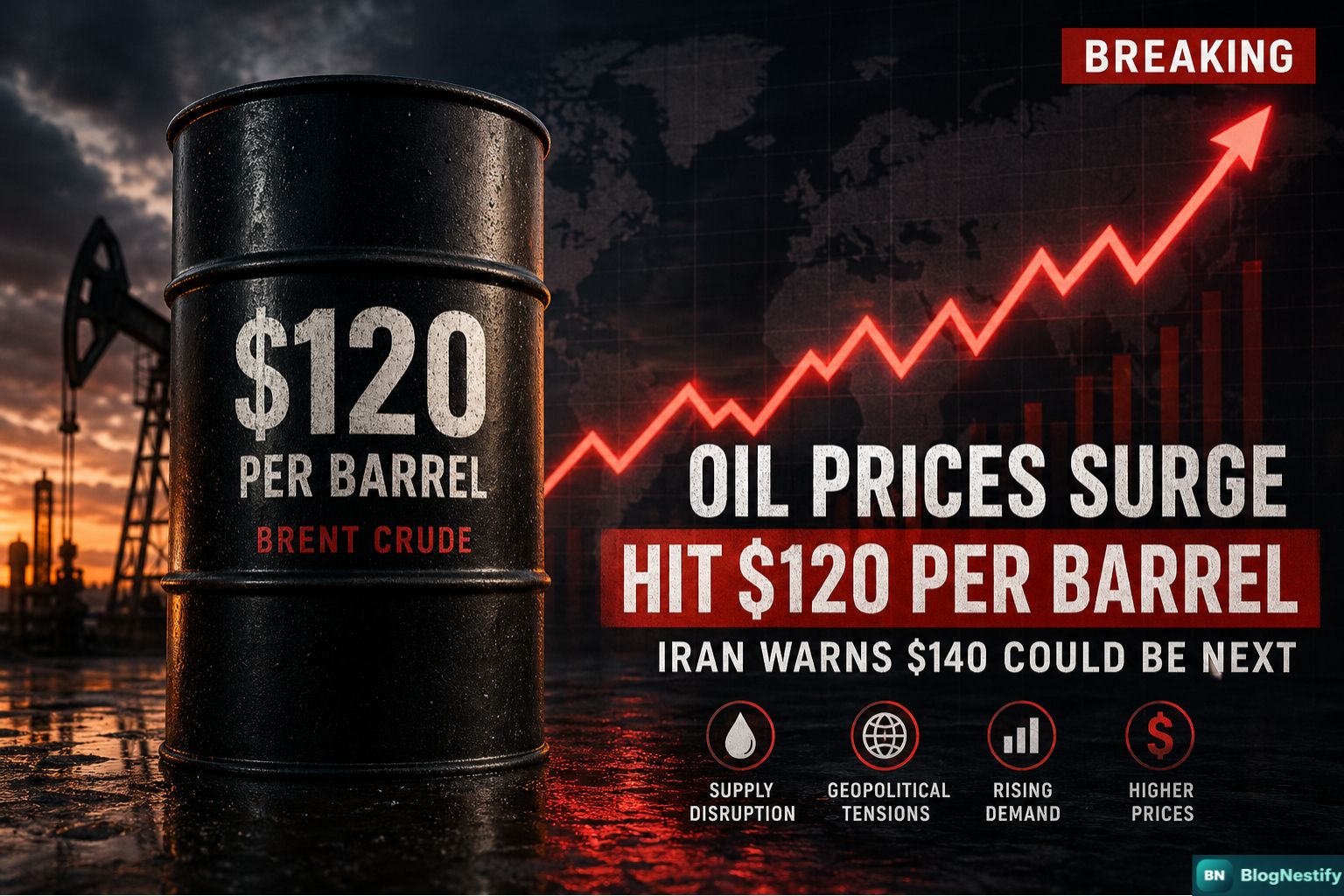
Oil Prices Hit $120 Per Barrel — And Iran Says $140 Is Next
The US-Iran standoff has rattled global energy markets. Here's why the price jumped, what Iranian officials are warning, and what it actually means for your fuel bill and grocery costs.
What Actually Happened to Oil Prices
Crude oil prices crossed $120 per barrel this week — a number not seen since Russia's invasion of Ukraine rattled energy markets in 2022. This time, the trigger is the US-Iran standoff, which has progressively squeezed Iranian oil supply out of global markets through a tightened sanctions regime.
Iran currently produces around 3.4 million barrels per day. Sanctions threats and new enforcement actions have rattled buyers — especially in Asia — who have started backing away from Iranian crude to avoid secondary penalties. When roughly 500,000 to 700,000 barrels per day effectively disappear from available supply, markets respond fast.
Brent crude — the international benchmark — hit $120.40 per barrel at open on Monday. WTI (West Texas Intermediate), the US benchmark, followed close behind at $117.80. Both numbers are significant not just because they're high, but because the speed of the climb caught traders off guard.
The broader market context matters here. OPEC+ has been holding production cuts through 2025, which means there's limited spare capacity sitting idle that could offset an Iranian supply shock. Saudi Arabia could theoretically pump more, but analysts note Riyadh has little incentive to bail out markets at these price levels — they're earning record revenues.
Iran's $140 Warning — Is It Realistic?
Iranian officials — including senior figures tied to the National Iranian Oil Company and the country's foreign ministry — have publicly stated that if the US escalates pressure further, global oil could reach $140 per barrel. The statement is partly political posturing. But it's also partly accurate.
Here's the logic: If Iran's oil exports are fully blocked — rather than partially curtailed — global supply would face an immediate shortfall. Iran exports roughly 1.5 to 2 million barrels per day under current conditions. A hard cutoff would be a meaningful shock. Combine that with tightening OPEC+ supply and a still-resilient global demand picture (India and China are still buying heavily), and the math for $140 oil isn't crazy.
That said, $140 is not guaranteed. Several scenarios could keep prices from hitting that level. The US and Iran could reach a partial diplomatic accommodation. OPEC could quietly ease cuts. Or demand in China — which has been patchy through 2025 — could soften further. Oil markets can move both ways quickly.
"If the US continues on this path, the world will see oil at $140. We are not making a threat. We are making a calculation."
— Senior Iranian official, April 2026
The Goldman Sachs commodities desk updated its 12-month Brent forecast to $128 per barrel, with a tail risk scenario of $145 if "significant Iranian supply is removed from the market." JPMorgan analysts have flagged similar numbers. These aren't fringe predictions — they're mainstream Wall Street risk scenarios now.
Why This Matters Beyond the Petrol Station
Most people register high oil prices at the fuel pump. A few cents more per litre, a higher bill, some grumbling. But the real damage from $120 oil spreads much wider than that, and it spreads fast.
Food Gets More Expensive
Agriculture runs on diesel — tractors, irrigation pumps, harvesting machinery, refrigerated trucks. When oil costs more, food production and distribution cost more. That cost gets passed to consumers. The UN Food and Agriculture Organization has already flagged that fuel costs are a major driver of food insecurity in lower-income countries. At $120 oil, those pressures intensify considerably.
Airfares Go Up
Aviation fuel (jet fuel) is directly derived from crude. Airlines hedged aggressively after the 2022 price spike, but those hedges run out. IATA has projected that at $120 crude, average short-haul airfares could rise 8–12% within one quarter. Long-haul could see even steeper increases. Summer travel is already being repriced.
Inflation Doesn't Cool Down
Central banks — particularly the US Federal Reserve and the European Central Bank — have been working to get inflation back to target. High energy prices are essentially inflationary gasoline thrown on a fire that was just starting to die down. If oil stays at or above $120, rate cut expectations for late 2026 will get pushed back. That means higher mortgage rates, tighter credit, and a slower economy for longer.
Emerging Markets Take the Hardest Hit
Countries in South Asia, Sub-Saharan Africa, and Southeast Asia import most of their oil and pay for it in US dollars. When oil prices surge, their import bills balloon, their currencies weaken, and their central banks face an impossible choice between defending the currency and supporting growth. Pakistan, Sri Lanka, and Kenya are already under IMF programs. $120 oil makes their situations materially harder.
How the World Is Responding
The reactions have been swift — and predictably scattered. Every major player is trying to manage the situation in ways that serve their own interests, which means there's no coordinated global response. That's actually part of what's keeping prices elevated.
The White House has called on Saudi Arabia and the UAE to increase production. Saudi officials have so far responded with polite deflection — noting that the market is "adequately supplied" and that the price rise reflects geopolitical risk rather than a physical supply shortfall. That's technically accurate, which makes it harder to argue with.
The Biden successor administration has floated the idea of releasing more from the Strategic Petroleum Reserve (SPR), but the SPR is already at historically low levels after the 2022 drawdown. Analysts say a further release would have only a short-term psychological effect — a week or two of price pressure — before markets refocus on the underlying supply picture.
China and India — both major buyers of discounted Iranian oil — are watching carefully. Neither country has formally signed onto US sanctions. Both have continued purchasing Iranian crude through intermediaries and shadow tanker networks. If the US decides to more aggressively enforce secondary sanctions against Chinese or Indian companies, that's a significant escalation with consequences well beyond the oil market.
Key Players & Their Positions
What Happens If Prices Keep Climbing
If oil stays above $120 for more than a few weeks, we'll start seeing concrete economic adjustments. Airlines will add fuel surcharges. Trucking companies will raise freight rates. Some petrochemical plants — which use crude as a feedstock — will start reassessing production economics. Plastic prices go up. Fertilizer prices go up.
The threshold that really matters, according to energy economists, is $130. At that level, demand starts to genuinely pull back — not because people choose to drive less voluntarily, but because the economic pressure becomes unavoidable. Businesses cut back on logistics. Consumers delay trips. Air travel softens. That demand destruction is actually what eventually breaks oil price rallies, but it takes time and causes real economic pain in the interim.
A $140 oil scenario would be qualitatively different. At that price point, analysts at Rystad Energy and Wood Mackenzie have modelled a significant global growth slowdown. Emerging market currency crises become a real risk. US consumer confidence, already fragile, would take another hit. The political fallout domestically — in both the US and Europe — would be considerable.
Price Scenario Outlook
What You Can Do Right Now
Most of this is genuinely out of your hands. Geopolitical crises don't respond to individual consumer choices. But there are a few practical things worth considering if oil stays high for months rather than weeks.
If you drive regularly, now is a reasonable time to check your tyre pressure (underinflated tyres cut fuel efficiency by 2–3%), consider carpooling for longer commutes, and look at whether hybrid or EV ownership makes financial sense at your mileage. These aren't revolutionary ideas — but at $120 oil, the numbers start to look different than they did at $80.
For investors, high oil tends to boost energy sector equities. Companies like ExxonMobil, Shell, TotalEnergies, and Saudi Aramco see earnings rise sharply with crude prices. Conversely, airlines and shipping stocks tend to suffer. If you have a portfolio with discretionary rebalancing room, that's worth keeping in mind — though nobody should be making major investment moves based on short-term oil volatility.
And if you're planning international travel — especially long-haul flights — booking sooner rather than later may save money before airlines fully reprice their fares to reflect current fuel costs. Most airlines update dynamic pricing models within 2–4 weeks of sustained oil price moves.
Frequently Asked Questions
Why are oil prices at $120 per barrel right now?
The primary driver is the US-Iran standoff, which has reduced Iranian oil supply available to global markets. Combined with existing OPEC+ production cuts and sustained demand from Asia, the market has moved sharply upward. It's not a physical shortage yet — it's a risk premium baked into prices by traders anticipating further disruption.
Could oil prices really hit $140 per barrel?
It's possible but not certain. Goldman Sachs and JPMorgan have both modelled $140+ scenarios if Iranian exports are significantly curtailed and OPEC doesn't compensate. The conditions for $140 oil exist — what's uncertain is whether diplomacy or demand destruction intervenes first.
How does high oil price affect everyday consumers?
Beyond higher fuel costs at the pump, $120 oil pushes up food prices (through higher farming and transport costs), airfares, heating bills, and plastic-based products. It also fuels broader inflation, which delays central bank rate cuts and keeps borrowing costs elevated.
What is OPEC's role in the current oil price surge?
OPEC+ has maintained significant production cuts through 2025, which means there's limited spare capacity available to offset the supply disruption from Iran. Member states — particularly Saudi Arabia — are currently earning record revenues at these prices and have limited financial incentive to ramp up output quickly.
Will the US release oil from the Strategic Petroleum Reserve?
The White House has floated the idea, but the SPR is at historically low levels after the 2022 drawdown. Most analysts think a further release would have only a short-lived effect — a week or two of price pressure — before markets refocus on the underlying supply dynamics from Iran.
Bottom Line
Oil at $120 is already causing real pain — at the pump, in food prices, and across the broader economy. Whether prices stay here, pull back, or climb toward $140 depends almost entirely on how the US-Iran situation develops over the next few weeks. There's no clear resolution in sight.
Watch what the US does on secondary sanctions enforcement. Watch whether Saudi Arabia quietly signals any willingness to add supply. And keep an eye on China's reaction — if Beijing pushes back against sanctions pressure, it could shift the entire dynamic. This story is nowhere near over.
Related Reading on Blognestify
Khushal Charaniya
Khushal Charaniya is a financial and geopolitics writer at Blognestify, covering global energy markets, macroeconomics, and international affairs. He has tracked commodity markets and geopolitical risk for over five years, with a focus on how global events translate into economic outcomes for everyday people.