OpenAI & Anthropic Are Entering the Services Business — And Indian IT Might Just Win
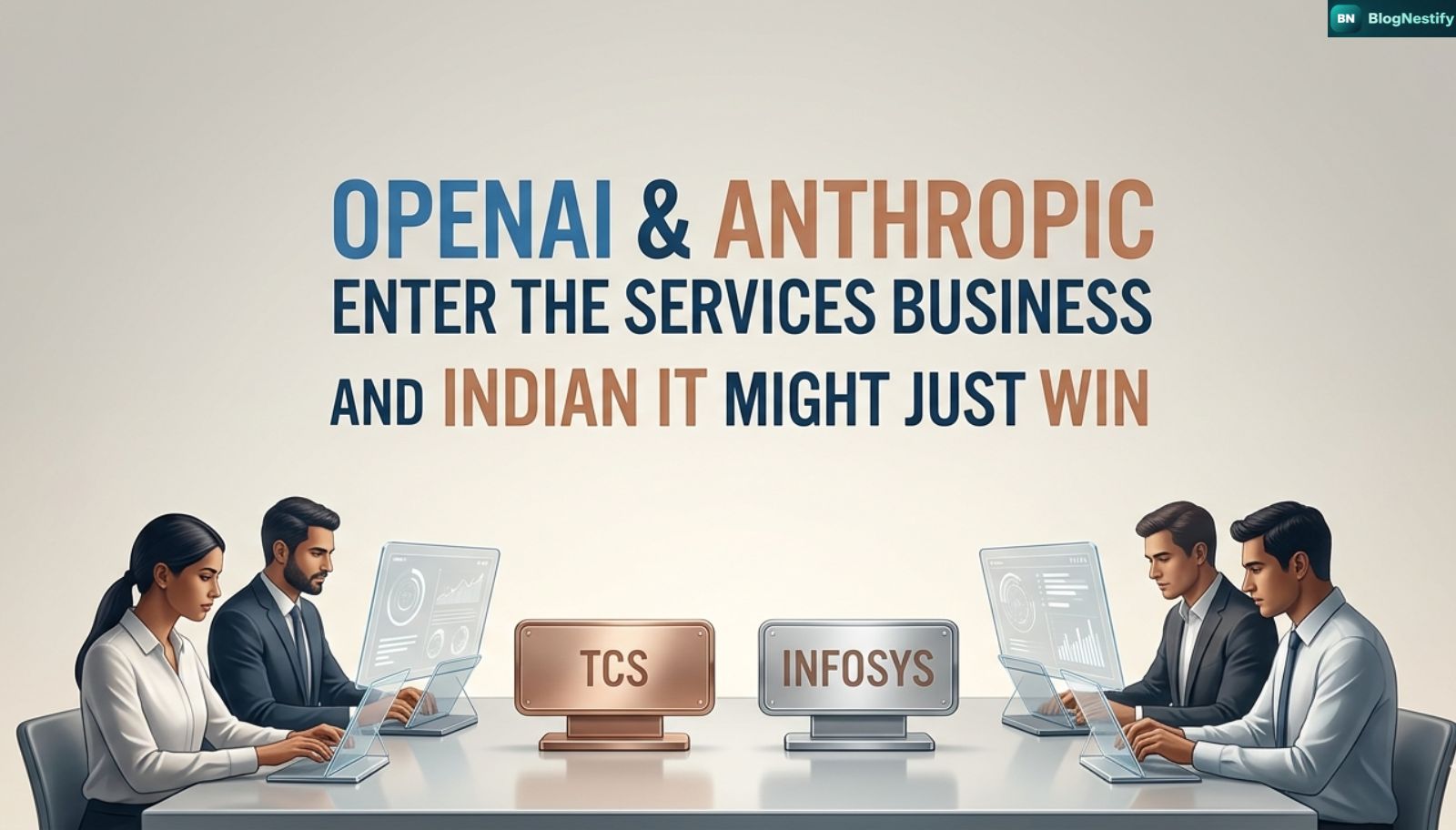
The two most powerful AI labs in the world just announced billion-dollar ventures to compete directly with consulting and IT firms. Everyone's calling it a threat to TCS and Infosys. Look closer — it might be the biggest tailwind Indian IT has seen in a decade.
What Actually Happened — The Quick Version
On May 4, 2026, two things happened in the same week that sent analysts scrambling. First, Anthropic announced a $1.5 billion joint venture with Blackstone, Goldman Sachs, and Hellman & Friedman to embed its Claude AI directly inside businesses — not sell it as software, but actually show up, sit with teams, and build the workflows. Then, hours later, Bloomberg reported that OpenAI was raising $4 billion for a nearly identical venture called The Development Company, backed by 19 investors including TPG, Brookfield, and Bain Capital.
These are not product launches. Both ventures are explicitly designed to compete with consulting firms and systems integrators. Anthropic's own announcement describes a model where "the company's engineering team sits down with clinicians and IT staff to build tools that fit into workflows that staff already use." That is exactly what Accenture, Deloitte, TCS, and Infosys have been selling for the past thirty years.
For every dollar companies spend on software, they spend six on services. Anthropic and OpenAI are betting they can capture a piece of that six-dollar side — a market historically owned by large IT services firms.
Marc Nachmann, Goldman's global head of asset and wealth management, framed it plainly: "There's a big shortage of people who know how to apply these tools into businesses and then transform them." That sentence is the entire thesis. And it's both the threat and the opportunity for India's IT sector in one line.
Why This Looks Scary on the Surface
Honestly, it should make Indian IT executives uncomfortable. The traditional outsourcing model — hire thousands of engineers, bill by headcount, add more people as projects grow — is built on a labor-arbitrage logic that AI is beginning to erode. TCS reported a 2.4% decline in annual revenue in FY26 in constant currency terms, its first annual decline since going public. India's top five IT firms collectively shed nearly 7,000 employees last year.
And the threat from Anthropic and OpenAI is not imaginary. They are moving directly into enterprise execution — the higher-margin, strategic layer that Indian IT firms have been trying to climb into for years. If an enterprise can hire Anthropic's engineers to directly build their AI workflows, why do they need a systems integrator in between?
| Service Layer | AI Firms (Anthropic / OpenAI) | Indian IT (TCS / Infosys / Wipro) | Overlap? |
|---|---|---|---|
| AI model development | Core strength | Limited | Low overlap |
| Enterprise AI deployment | New capability (2026) | Growing rapidly | Direct competition |
| Legacy system integration | Very limited | Core strength | Opportunity |
| Regulatory / compliance | Limited | Deep expertise | Opportunity |
| Long-term managed services | Not focus area | Core revenue stream | Opportunity |
| Scale of delivery | Small teams, high-cost | Massive delivery scale | Opportunity |
The Real Opportunity Nobody's Talking About
Enterprise transformation is messy. Large banks and manufacturers do not plug in an AI model and transform overnight. That's where Indian IT still wins.
Here is what the headlines keep missing: Anthropic and OpenAI are targeting mid-sized companies owned by private equity firms. They want to work with a few hundred businesses, embed small high-skill teams, and show measurable ROI fast. That is a very specific and quite narrow slice of the market.
What they are not built for — and probably cannot scale into quickly — is the sprawling, messy, multi-year reality of enterprise transformation at large banks, telcos, government clients, and manufacturing giants. That kind of work involves integrating forty-year-old legacy systems, navigating local data regulations, managing change across thousands of employees, and providing round-the-clock support across time zones. Indian IT firms have spent three decades building exactly those capabilities.
According to reporting by the Economic Times, the experts who have looked most carefully at this situation largely agree: the joint ventures are likely to rely on Indian IT firms for large-scale implementation and execution, while AI companies capture the higher-value strategy and transformation layers. In other words, Anthropic and OpenAI need an execution partner. Who better than TCS, which already has 600,000 engineers and deep relationships inside thousands of global enterprises?
Understanding the STDC Framework for This Shift
The way enterprises will adopt AI services follows the classic See-Think-Do-Care model — and Indian IT firms are positioned at every stage.
Indian IT Is Already Pivoting
This is not a future strategy — it is already happening. Infosys currently has 4,600 AI projects in flight across its client base and has generated over 28 million lines of code using AI internally. The company reports working with 90% of its 200 largest clients on AI initiatives and has built over 500 AI agents through its Topaz platform. That is not a firm that is standing still.
What is interesting is the way Infosys has positioned itself: it has signed partnerships with both Anthropic and OpenAI, even as those firms compete with it for enterprise budgets. This is deliberate. Infosys knows that being inside the ecosystem — as the delivery partner for AI firms' ideas — is more durable than fighting the AI labs head-on.
In February 2026, Infosys signed a strategic partnership with Anthropic specifically to build and deploy enterprise AI across telecommunications, financial services, manufacturing, and software development. They are simultaneously a partner and a competitor — what analysts call "co-opetition."
Tata Group went further. Earlier this year it signed a multi-dimensional strategic partnership with OpenAI, under which OpenAI became the first tenant of Tata's HyperVault data centre — a 100-megawatt planned facility. TCS and Tata are not just adapting to the AI shift; they are becoming infrastructure for it.
What This Means for Indian IT Employees
Honestly — the picture for workers is more complicated, and it would be wrong to pretend otherwise.
Generic, low-complexity roles are under real pressure. If AI can generate code, handle documentation, manage basic customer support queries, and draft compliance reports, then the demand for large pools of entry-level engineers doing repetitive work will drop. That is not speculation — it is already showing up in the headcount numbers.
But that is not the same as saying Indian IT employment is collapsing. What's happening is more of a structural upgrade than a wipeout. The roles that are growing are in AI implementation, data engineering for AI pipelines, AI agent design, change management, and AI-augmented delivery. These require deeper skills, but they also pay significantly more and are far harder for AI firms based in San Francisco to replicate at scale across thousands of Indian engineers.
The message for workers is uncomfortable but clear: the people who learn to work alongside AI will find more demand, not less. Generic roles will shrink. AI-augmented roles will grow.
The upgrade path is real and accessible. Prompt engineering, AI system integration, and understanding how to govern and audit AI outputs are skills that can be learned — and Indian universities and training ecosystems are beginning to move in that direction faster than most international observers realize.
The Co-opetition Reality
The most accurate lens for understanding what happens next is not "AI firms vs. Indian IT" — it is "how do these ecosystems interlock?" Anthropic's Claude Partner Network already includes Accenture, Deloitte, and multiple Indian IT firms. OpenAI's enterprise push similarly relies on implementation partners who know how to get AI working inside complex, regulated, messy enterprise environments.
India's tech sector has navigated transitions before — from hardware to software, from custom development to packaged software implementation, from on-premise to cloud. Each transition created panic headlines and then created more opportunities than it destroyed, because Indian IT's core skill is adapting to whatever the global tech stack demands and delivering it at scale.
The analysts who get this right are not saying "Indian IT is fine, nothing to worry about." They are saying something more nuanced: the firms and workers who adapt will emerge stronger, with higher margins and higher-value work; the ones who cling to the old model without upgrading will genuinely struggle. That is a meaningful distinction, and it matters for the decisions that both companies and individuals in India's IT sector make in the next eighteen months.
Frequently Asked Questions
Not directly. OpenAI and Anthropic are targeting mid-sized, PE-owned businesses with small, high-cost implementation teams. They are not set up for the kind of large-scale, multi-year delivery that TCS and Infosys run across thousands of enterprise clients. The more likely outcome is co-opetition — AI firms handle strategy and model deployment, Indian IT firms handle complex on-ground execution, legacy integration, and long-term support. Infosys has already formalized this by partnering with both Anthropic and OpenAI even while competing with them.
Announced in May 2026, Anthropic launched a joint venture with Blackstone, Goldman Sachs, and Hellman & Friedman — each contributing roughly $300 million, with Goldman adding approximately $150 million, and General Atlantic, Sequoia, Apollo, Leonard Green, and GIC also participating. The venture will embed Anthropic engineers and Claude AI directly into business operations, initially targeting mid-sized companies owned by the investment firms. OpenAI announced a similar entity called The Development Company, backed by $4 billion from 19 investors including TPG, Brookfield, Bain Capital, and Advent.
Focus on AI implementation skills over generic programming. The most in-demand capabilities are prompt engineering, AI agent design, data pipeline engineering for AI, AI governance and risk management, and change management for AI adoption. These are skills that complement AI tools rather than compete with them — and they are difficult for AI labs in San Francisco to deliver at scale through Indian engineers. Upskilling in these areas shifts you from the shrinking category of "replaceable by AI" to the growing category of "can make AI work in the real world."
TCS reported a 2.4% annual revenue decline in FY26 — its first since going public — and the broader top-five Indian IT firms posted only 2–5% growth expectations for FY27. But the pressure is less about AI companies stealing clients directly and more about the overall shift in how enterprises buy technology. AI tools are compressing the amount of labor required for many traditional IT projects, which reduces revenue from time-and-material contracts. TCS's strategic response includes its partnership with Tata Group and OpenAI's HyperVault data centre, which positions TCS inside the AI infrastructure buildout rather than against it.
The Development Company is OpenAI's enterprise services venture, targeting $4 billion from 19 investors at a reported $10 billion valuation. Backed by TPG, Brookfield Asset Management, Bain Capital, and Advent, the venture mirrors Anthropic's model: embed OpenAI engineers directly inside businesses to implement and operate AI systems. It operates at a significantly larger scale than Anthropic's venture and is positioned as a direct competitor to large consulting firms and IT service integrators for corporate AI transformation engagements.
0 Comments
Leave a Comment