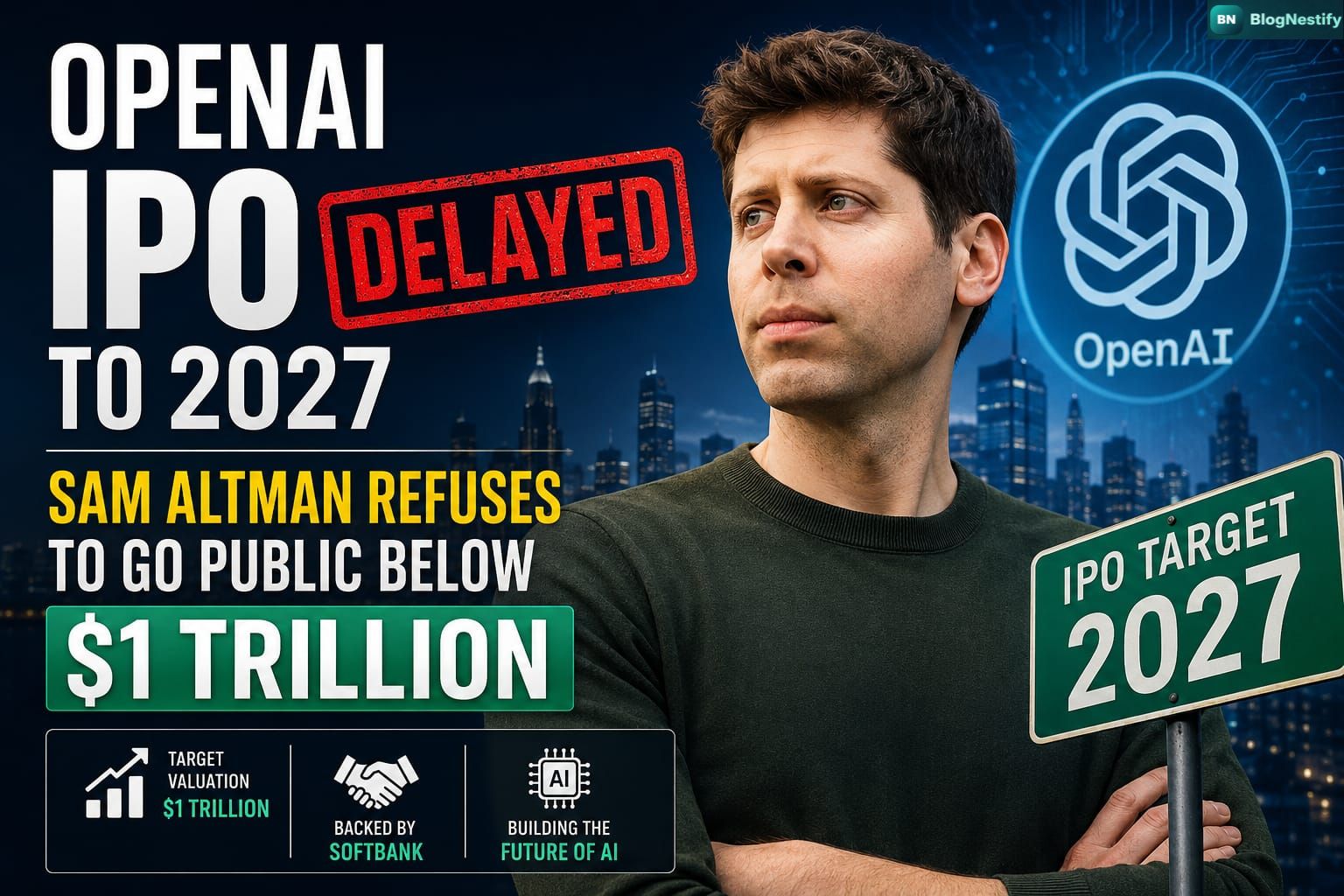
OpenAI IPO Delayed to 2027: Sam Altman Refuses to Go Public Below $1 Trillion
Quick Summary
- OpenAI is leaning toward pushing its IPO to 2027, according to the New York Times.
- CEO Sam Altman called any valuation below $1 trillion a "non-starter."
- The company's current private valuation stands at $852 billion.
- SoftBank lost $38 billion in market cap in a single session after the news broke.
- Rival Anthropic now has a 77% chance of going public before OpenAI, per prediction markets.
When Sam Altman's advisers sat him down and laid out two options — list OpenAI in 2026 at a valuation below $1 trillion, or wait until 2027 and take a shot at the full number — the answer was immediate. He called any cut a "non-starter." That single word, reported by the New York Times citing three people close to the discussions, sent shockwaves through global markets this week and effectively signalled that the most anticipated tech IPO of 2026 may now belong to 2027.
The story is bigger than one CEO's stubbornness about a number. It touches on volatile public markets, a $40 billion SoftBank problem, an AI rival closing fast, and a government asking OpenAI to slow down its newest model release. The $1 trillion question is really several questions at once.
The Two-Option Problem
OpenAI has been laying IPO groundwork for months. The company confidentially filed its draft registration statement with the U.S. Securities and Exchange Commission on May 22, 2026, making a public announcement on June 9. Goldman Sachs and Morgan Stanley are on the underwriting team, with Citigroup and JPMorgan also reportedly added to the syndicate.
The original plan targeted a listing as early as Q3 or Q4 of this year. But over the past week, advisers started getting cold feet. The primary reason: SpaceX.
The SpaceX Warning Signal
SpaceX listed on the Nasdaq on June 12, raising over $85 billion in what became the largest IPO in U.S. history. Its first-day valuation hit $2.77 trillion. Then the stock started falling — from above $225 to around $153 by June 26, a decline of roughly 32% from peak in under two weeks. OpenAI's advisers read that clearly: retail enthusiasm for mega-cap tech IPOs has a ceiling, and the ceiling gets tested fast.
That dynamic pushed the advisory team to present Altman with the binary: accept a lower valuation now, or hold out for $1 trillion in 2027. He chose to hold. CFO Sarah Friar, for her part, had already been privately advocating for the delay, telling associates that the company needs more time before subjecting itself to public-company reporting requirements — particularly given $600 billion in infrastructure commitments through 2030.
The Numbers Behind the Valuation Gap
To reach $1 trillion, OpenAI needs to add about 17% to its last private valuation of $852 billion — set in March 2026 when the company closed a $122 billion funding round co-led by SoftBank, Amazon, and Nvidia. That gap sounds manageable until you look at the financials underneath it.
OpenAI's CFO confirmed in January 2026 that annualised revenue had crossed $20 billion, up from $13 billion in 2025. That growth is real. But so is the burn rate — around $27 billion projected for 2026, rising to an estimated $63 billion in 2027. The company doesn't expect to reach positive cash flow until 2030, and its revised 2030 revenue target of $39 billion is less than half what earlier projections had pencilled in. Expenses are growing faster than revenue.
That $1 trillion figure would place OpenAI alongside Nvidia, Microsoft, Apple, and Alphabet — the only companies to have sustained that threshold in public markets. The difference is that all of them are profitable. OpenAI is not, and won't be for years.
The SoftBank Problem
When the New York Times story broke on June 26, the markets responded immediately. SoftBank shares fell as much as 14% in Tokyo before settling down over 12% by close — a single-session wipeout of roughly $38 billion in market capitalisation. It was one of the sharpest single-day drops for the Japanese investment giant in recent memory.
SoftBank's exposure to OpenAI is substantial and structured in a way that makes the delay painful. The firm holds a 13% stake and has invested heavily through the Stargate joint venture. More pressingly, SoftBank faces a $40 billion bridge loan coming due in March 2027. The original assumption was that an OpenAI public exit would arrive in time to help service that debt. Now, with the IPO possibly slipping to late 2027 at the earliest, that timeline is uncomfortably tight.
The Competitive Landscape: Anthropic Closes In
The timing problem for OpenAI is compounded by what's happening at its main rival. Anthropic filed its confidential S-1 on June 1, 2026 — a full week before OpenAI — and is reportedly targeting a late-2026 listing at a valuation of $965 billion, having just closed a $65 billion Series H that pushed it past OpenAI's private valuation for the first time.
| Company | Current Valuation | 2026 Revenue (ARR) | IPO Timeline | Path to Profit |
|---|---|---|---|---|
| OpenAI | $852 billion | $20B+ | Likely 2027 | 2030 |
| Anthropic | $965 billion | $30B+ (Apr 2026) | Late 2026 | 2028 |
| SpaceX | ~$1.5T (post-drop) | Diversified | Listed June 12 | Profitable |
The numbers tell a story that's becoming awkward for OpenAI. Anthropic's annualised revenue run rate grew from $9 billion at end-2025 to over $30 billion by April 2026. CNBC reported that Anthropic expects roughly $10.9 billion in Q2 2026 revenue and around $559 million in operating income — which would make it its first profitable quarter. OpenAI was still loss-making in Q1. On prediction markets, Anthropic now carries a 77% probability of beating OpenAI to the public markets. Polymarket gives OpenAI only a 22% chance of listing before December 31, 2026.
What "Delay" Actually Means for Investors
For anyone who's been waiting on the OpenAI IPO as an investment event, the shift to 2027 has practical consequences. The most direct public exposure to OpenAI remains through companies that hold equity stakes — Microsoft (roughly 27%), SoftBank, Amazon, and Nvidia. ARK Invest's ETFs (ARKK, ARKW, ARKF) reportedly bought approximately $240 million of OpenAI Series C shares in late March 2026, giving retail investors indirect exposure without accreditation requirements.
The delay also reshapes the broader 2026 AI IPO narrative. The "AI IPO wave" — built around SpaceX, OpenAI, and Anthropic raising a combined $200 billion or more — was supposed to be the defining market event of the year. SpaceX completed its part. If Anthropic lists on schedule and OpenAI steps back, it becomes a two-company story instead of a trio, and the sequencing shifts the reference point investors use to benchmark OpenAI's eventual debut.
The Bigger Question: Is $1 Trillion Justified?
This is where the debate gets genuinely interesting, and where reasonable people land in different places. Bulls argue that OpenAI's $20 billion-plus in annualised revenue, its 900 million weekly active ChatGPT users, its Stargate infrastructure positioning, and its first-mover brand in consumer AI justify a premium that no existing valuation framework really captures. The enterprise AI market is still early. If you believe OpenAI is building the infrastructure layer for the next decade of computing, $1 trillion is conservative.
Bears point to the profitability gap. OpenAI won't reach positive cash flow until 2030 at the earliest. Its revised 2030 revenue projections are already well below earlier estimates. Competition is intensifying — Google's Gemini has taken web traffic market share from ChatGPT, Anthropic is growing faster on a percentage basis, and the API price war that's brewing would compress margins at the worst possible time. Gary Marcus isn't alone in his scepticism. Nate Elliott at EMARKETER described OpenAI as "filing to go public at a precarious moment." Investor Dan Niles said he views Anthropic more favourably than OpenAI ahead of both listings.
One figure worth sitting with
OpenAI is projected to spend $600 billion on compute infrastructure through 2030. That's not a rounding error. It's a commitment that would dwarf the GDP of many countries and means OpenAI is, among other things, a massive bet on the price of compute staying high and the AI demand curve holding. If either assumption shifts, the path to profitability moves further out — and the $1 trillion valuation becomes harder to defend.
What to Watch Next
The immediate datapoint to track is Anthropic's IPO progress. If it lists successfully in late 2026 at or near its $965 billion valuation, that establishes a floor — and possibly a ceiling — for how public markets value pure-play AI model companies. OpenAI's advisers will read that data closely. A strong Anthropic debut might actually accelerate the OpenAI timeline, not slow it. A disappointing one would give them more reason to wait.
Beyond that: OpenAI's quarterly revenue updates, GPT-5.6's actual rollout under government oversight, and the broader tech market's mood heading into Q3 2026 will all feed into whether a 2027 listing happens at the start of the year or the end of it.
What's not changing: Sam Altman's number. He wants $1 trillion, and everything else in the IPO discussion flows from that starting point.
- OpenAI is leaning toward a 2027 IPO after advisers warned that volatile markets make a $1 trillion debut unlikely in 2026.
- CEO Sam Altman refused any valuation cut, calling it a "non-starter."
- The delay cost SoftBank $38 billion in market cap in a single session and creates real pressure given its March 2027 loan deadline.
- Anthropic is now likely to go public before OpenAI, with a 77% probability on prediction markets.
- OpenAI's profitability target remains 2030, with cash burn of ~$27 billion expected in 2026 alone.
- The U.S. government has asked OpenAI to release its next model (GPT-5.6) gradually, adding another variable to its near-term outlook.
0 Comments
Leave a Comment