OpenAI Real-Time Audio Models: GPT-Realtime-2, Translate & Whisper — What They Do and Why It Matters
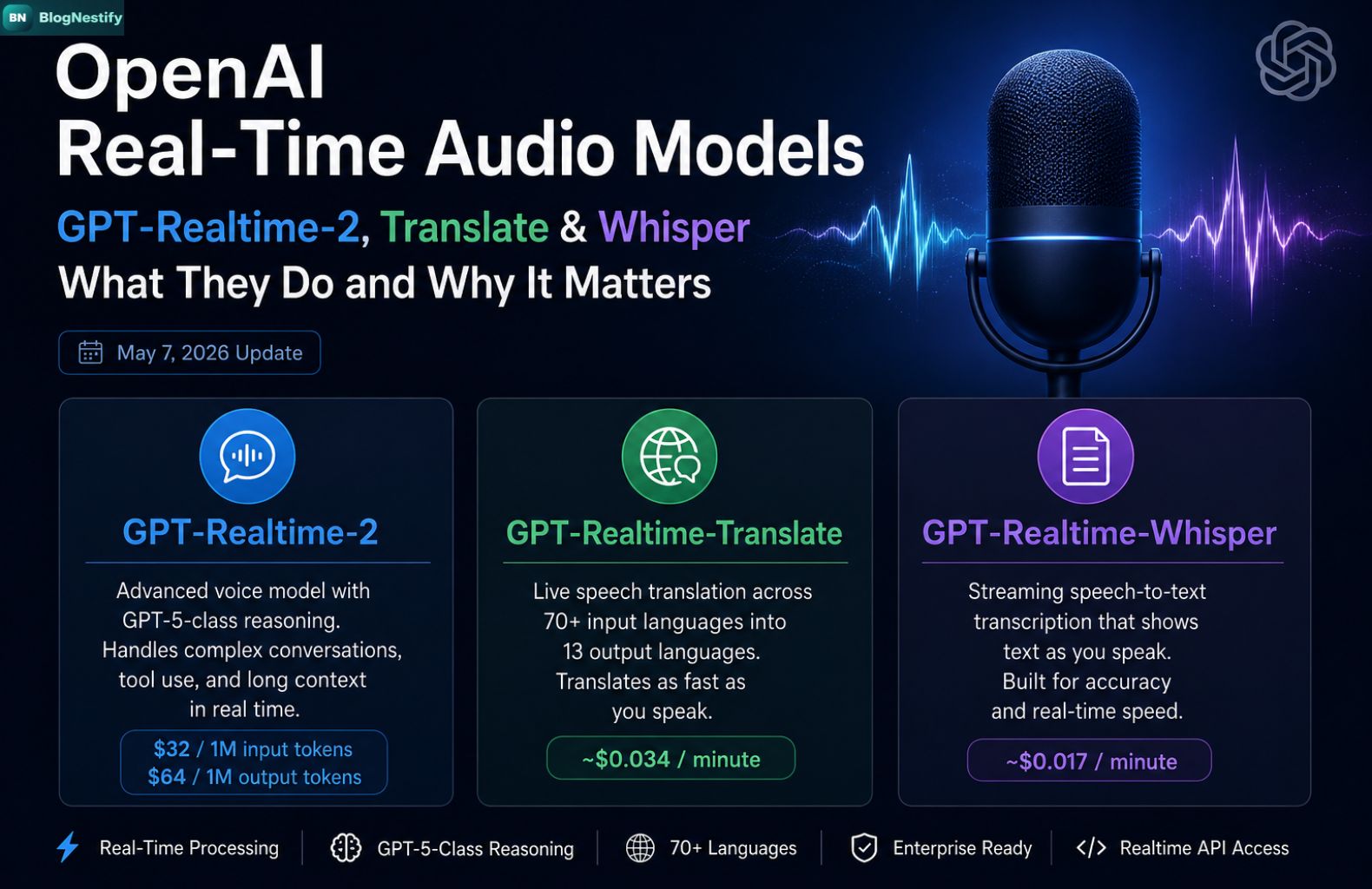
Voice AI just got a serious upgrade. On May 7, 2026, OpenAI released three new audio models built specifically for live, real-time voice tasks — and they're a lot more capable than anything the company has shipped for voice before.
Why This Release Is Different From Past Voice AI Updates
Most voice AI progress over the last few years has followed a predictable pattern: slightly better speech recognition, a bit lower latency, marginally cleaner output. Incremental stuff. What OpenAI just released doesn't fit that mold.
The three new models — GPT-Realtime-2, GPT-Realtime-Translate, and GPT-Realtime-Whisper — aren't just performance bumps on existing systems. They cover three separate problems in live voice AI that developers have been wrestling with for years: reasoning during conversation, real-time multilingual translation, and continuous speech-to-text without a processing gap. And they're all available now through OpenAI's Realtime API.
This matters because live voice is genuinely hard. The models that power text-based AI can take their time — a second or two of latency is forgettable when you're reading. Voice is different. A half-second delay in conversation feels wrong to human ears. Building something that reasons, translates, or transcribes while keeping up with natural speech has always required painful engineering trade-offs. These models are OpenAI's answer to that problem.
GPT-Realtime-2: Voice With Actual Reasoning Power
GPT-Realtime-2
OpenAI's most advanced voice model. First to bring GPT-5-class reasoning into a live, continuous voice interface.
$32 / 1M input tokens · $64 / 1M output tokensThe honest way to describe GPT-Realtime-2 is: it's what people expected from voice AI a few years ago but didn't get. Earlier voice models processed speech, then thought about a response, then spoke. The gap was noticeable. GPT-Realtime-2 is built to work as a continuous stream — it interprets what you're saying while you're still saying it, reasons through the request, and responds without the awkward pause that made earlier voice assistants feel robotic.
What makes it genuinely different from GPT-Realtime-1.5 is the reasoning layer. OpenAI describes it as carrying "GPT-5-class reasoning" — meaning the model can handle requests that require actual thinking, not just pattern matching on speech. If you interrupt it mid-sentence, it recovers. If a tool call fails, it handles the fallback naturally rather than getting stuck. It supports parallel tool calls, which means it can check multiple external systems at once during a spoken conversation.
The context window is 128,000 tokens. That's large enough for long, multi-topic conversations without the model losing track of what was said earlier — something that was a real limitation in previous voice models.
What It's Built For
- ✓ Voice-enabled agents that use tools — scheduling, database queries, booking systems, enterprise APIs
- ✓ Customer support bots that handle complex, multi-step problems through spoken dialogue
- ✓ Conversational AI that needs to maintain context across a long, interrupted, or redirected conversation
- ✓ Developers who want reasoning depth — OpenAI lets you tune this from "low" (fast) up to "xhigh" (slower but more thorough)
GPT-Realtime-Translate: Live Speech Translation That Keeps Up With You
GPT-Realtime-Translate
Translates spoken language in real time across 70+ input languages into 13 output languages, as fast as the speaker talks.
~$0.034 / minuteGPT-Realtime-Translate does exactly one thing and focuses all its capacity on doing it well: translating spoken language live, without making the conversation wait. You don't have to finish a sentence. You don't have to pause. The model processes incoming speech continuously and generates the translated output in near-real-time.
The language coverage is substantial — over 70 input languages, 13 output languages. One benchmark that stood out: in testing across Hindi, Tamil, and Telugu, the model delivered 12.5% lower word error rates compared to any other tested model, with better task completion rates and lower fallback rates. For a model competing in regional Indian language processing, that's a meaningful lead.
Companies are already testing it in production. Deutsche Telekom is using it for multilingual voice interactions. Vimeo demonstrated it translating product education videos live as they play, so international audiences hear content in their own language without waiting for dubbed versions.
Where This Gets Useful
- ✓ Customer support centers handling callers across multiple countries in a single queue
- ✓ International business calls, sales, and negotiations where each person speaks their native language
- ✓ Educational platforms streaming live classes to global students
- ✓ Media and content platforms — live broadcasts, creator content, event coverage
- ✓ Government, healthcare, and public services where language barriers create serious problems
"Building voice AI for India means handling diverse regional phonetics. GPT-Realtime-Translate delivered 12.5% lower Word Error Rates than any other model we tested." — Developer testimonial via OpenAI
GPT-Realtime-Whisper: Transcription That Doesn't Wait Until You're Done Talking
GPT-Realtime-Whisper
Extends OpenAI's Whisper technology into a real-time streaming system — text appears as you speak, not after.
~$0.017 / minuteOpenAI's original Whisper model was already well-regarded for transcription accuracy across multiple languages. The problem with it was the same problem every transcription system had: it worked on recorded audio. You uploaded a file or waited for a recording to finish, and then you got your text. That's fine for some workflows. It doesn't work for live captions, real-time meeting notes, or anything where the transcript needs to appear as the words come out.
GPT-Realtime-Whisper is Whisper rebuilt for continuous, streaming operation. It transcribes as the speaker talks — words and sentences appear live, without a processing delay at the end. The result is transcription that feels responsive rather than like a system catching up.
At $0.017 per minute, it's also the most affordable of the three new models by a fair margin. For applications that need high-volume transcription — all-day meeting coverage, live events, call center logging — that pricing makes the economics work.
Who Needs This
- ✓ Accessibility tools: real-time captions for deaf and hard-of-hearing users
- ✓ Meeting platforms where participants want notes appearing during the meeting, not after
- ✓ Newsrooms, courtrooms, and legal proceedings requiring live verbatim records
- ✓ Enterprise systems logging spoken interactions for compliance or training purposes
- ✓ Developers building voice interfaces that need text output from audio in real time
Pricing Breakdown: What Each Model Costs
All three models are accessed through the OpenAI Realtime API. Pricing differs significantly depending on what you're building, so here's the full picture:
| Model | Pricing Structure | Price | Best For |
|---|---|---|---|
| GPT-Realtime-2 | Per 1M audio tokens | $32 input / $64 output $0.40 cached input |
Complex voice agents |
| GPT-Realtime-Translate | Per minute of audio | ~$0.034 / min | Live translation apps |
| GPT-Realtime-Whisper | Per minute of audio | ~$0.017 / min | Streaming transcription |
Real-World Use Cases Across the Buyer Journey
Whether you're a developer deciding whether to build with these models, a product manager exploring what's now possible, or a business evaluating AI voice tools — the STDC (See, Think, Do, Care) lens is a useful way to think about where these models actually fit.
Awareness
Developers discover these models while exploring what's new in the OpenAI API ecosystem.
Evaluation
Product teams compare GPT-Realtime models vs alternatives like Deepgram, Assembly AI, or Whisper v3.
Action
Dev teams integrate via Realtime API for live meeting transcription, multilingual support queues, or voice agents.
Retention
Businesses that deploy successfully stay in the ecosystem, expand to more models, and upgrade as new versions drop.
Industry-Specific Applications
Healthcare: Doctors using voice dictation during consultations now have a model that transcribes in real time, reducing documentation time without requiring post-session uploads.
Legal: Court reporters and legal transcription services can use GPT-Realtime-Whisper to generate live records, with far lower per-minute costs than specialized legal transcription software.
Education: Language learning platforms can pair GPT-Realtime-Translate with live instruction to give students real-time bilingual support, or use GPT-Realtime-2 to build spoken tutors that reason through student questions.
Global Commerce: E-commerce and customer support teams covering markets across Asia, Europe, and Latin America can run a single voice support pipeline where callers speak any of 70+ languages and agents hear translations instantly.
What This Actually Means for Developers and Businesses
The obvious question is: does this change anything, or is it another incremental update dressed up in a press release?
I think it changes a few things concretely. The reasoning capability in GPT-Realtime-2 is the headline — a voice model that can use tools, manage long context, and reason through complex requests without pre-processing pauses is qualitatively different from what existed before. Earlier voice models were essentially fast transcription + fast text generation bolted together. This is closer to a thinking system that happens to use speech as its interface.
GPT-Realtime-Translate is interesting for a different reason. Live translation has been technically possible for a while, but the word error rates in regional languages were bad enough to make it unreliable in practice. A 12.5% WER improvement in South Asian languages isn't a rounding error — it's the difference between a product that works and one that frustrates users.
And Whisper's streaming version closes a gap that developers have been hacking around for years. The original Whisper was accurate but batch-only. Getting real-time transcription meant using third-party streaming solutions with their own reliability issues. Having a first-party streaming transcription model removes that dependency.
Frequently Asked Questions
What are OpenAI's new real-time audio models?
OpenAI released three new real-time audio models in May 2026: GPT-Realtime-2 (a voice reasoning model with GPT-5-class intelligence), GPT-Realtime-Translate (live speech translation across 70+ input languages into 13 output languages), and GPT-Realtime-Whisper (streaming speech-to-text transcription). All three are accessible through the OpenAI Realtime API.
How much does GPT-Realtime-2 cost?
GPT-Realtime-2 is priced at $32 per million audio input tokens and $64 per million audio output tokens. Cached inputs cost $0.40 per million tokens. It is the most premium of the three models, aimed primarily at enterprise deployments.
What languages does GPT-Realtime-Translate support?
GPT-Realtime-Translate supports over 70 input languages and 13 output languages for live real-time speech translation. It is priced at approximately $0.034 per minute of audio processed.
What is GPT-Realtime-Whisper used for?
GPT-Realtime-Whisper is a streaming speech-to-text model that transcribes audio in real time as speech happens — not after it finishes. It is ideal for live captions, meeting transcription, courtroom documentation, accessibility tools, and enterprise call logging. At around $0.017 per minute, it is the most affordable of the three models.
How is GPT-Realtime-2 different from GPT-Realtime-1.5?
GPT-Realtime-2 adds GPT-5-class reasoning, a 128k token context window, improved tool-use capabilities, support for parallel tool calls, and better recovery behavior when tasks fail or conversations are interrupted. OpenAI reports improvements in audio intelligence, instruction-following, and context management over the previous version.
Can these OpenAI audio models be used in production apps?
Yes. All three models — GPT-Realtime-2, GPT-Realtime-Translate, and GPT-Realtime-Whisper — are available now through OpenAI's Realtime API for developers to integrate into voice applications, customer support tools, multilingual platforms, accessibility products, and enterprise workflows.
0 Comments
Leave a Comment