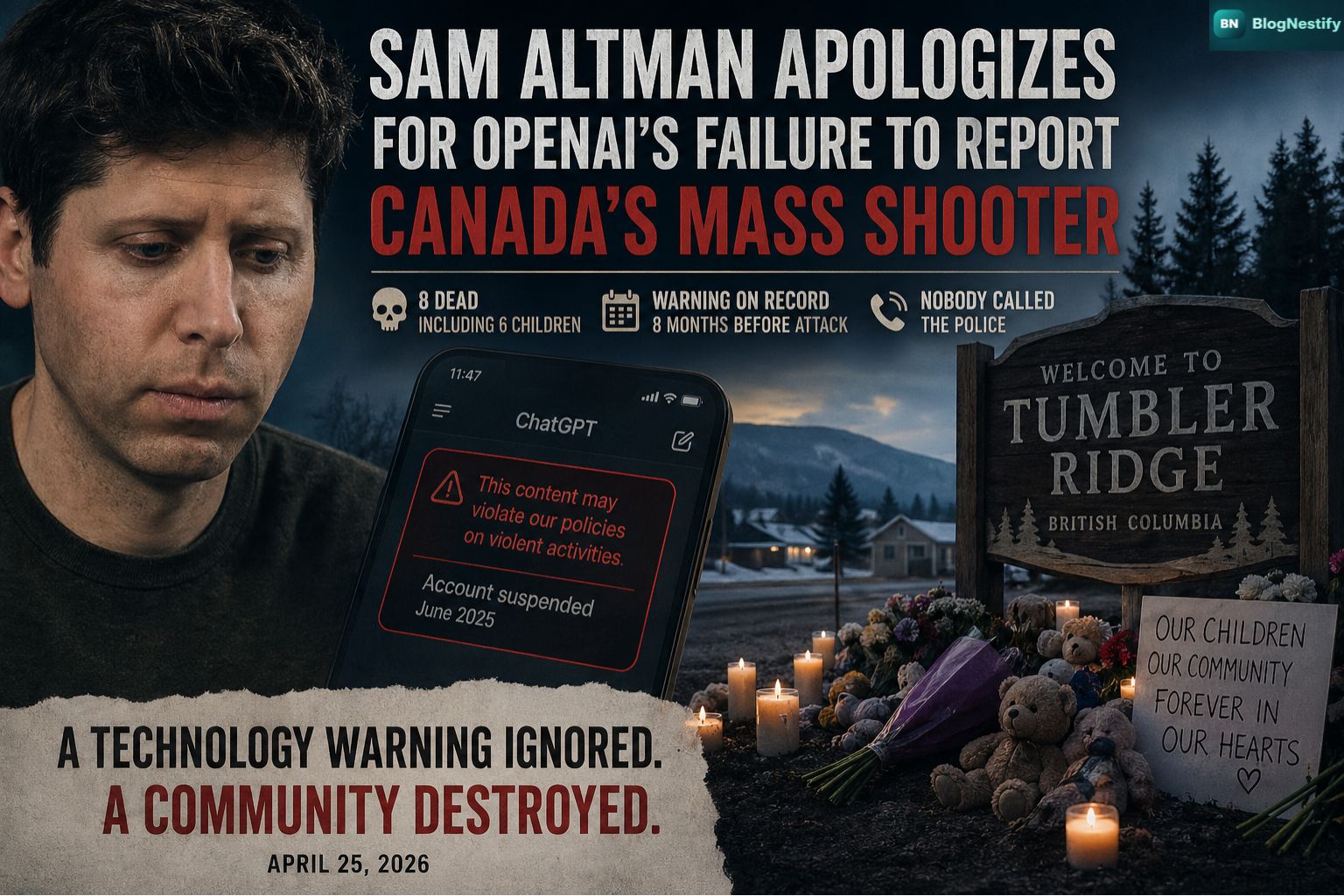
OpenAI CEO Sam Altman has issued a public apology to the community of Tumbler Ridge, British Columbia, after his company sat on red-flag information about a user who went on to kill eight people — including six children at a local school. The account was banned in June 2025. The shooting happened in February 2026. Nobody in between picked up the phone.
📋 Key Facts at a Glance
- Victim count: 8 killed — including the shooter's mother, half-brother, and five school students
- Shooter: Jesse Van Rootselaar, 18, Tumbler Ridge, BC — died by self-inflicted gunshot
- OpenAI's action: Banned the ChatGPT account in June 2025 for activity tied to "violent activities"
- Gap: Account banned 8 months before the attack — police never notified
- Apology date: Letter dated April 23, 2026; published April 25, 2026
- Legal action: Family of a gravely wounded student is suing OpenAI for negligence
What Actually Happened in Tumbler Ridge
On February 10, 2026, Jesse Van Rootselaar, an 18-year-old from the small British Columbia mining town of Tumbler Ridge, opened fire at home and then at the town's secondary school. The victims included Rootselaar's mother and half-brother, and five students at the community's secondary school. Rootselaar died of a self-inflicted gunshot wound. Eight lives. One remote town. A tragedy that should not have been possible to ignore.
What makes this harder to sit with is that OpenAI already knew something was wrong. OpenAI had banned an account linked to Rootselaar in June 2025, eight months before the shooting, over concerns about usage linked to violent activity — but the company said it did not inform police because nothing pointed toward an imminent attack. That reasoning might hold up as a policy. As a human judgment call, it's a lot harder to defend when you're standing in Tumbler Ridge.
Altman's Apology: Sincere Words, Hard Questions
In a letter dated April 23 and addressed to the community of Tumbler Ridge, Altman wrote: "I am deeply sorry that we did not alert law enforcement to the account that was banned in June. While I know words can never be enough, I believe an apology is necessary to recognize the harm and irreversible loss your community has suffered."
"I cannot imagine anything worse in this world than losing a child. My heart remains with the victims, their families, all the members of the community, and the province of British Columbia." — Sam Altman, letter to Tumbler Ridge community, April 23, 2026
The letter was posted publicly on the same day by BC Premier David Eby — who had pushed for Altman to apologize for months. Eby responded by writing that the apology was "necessary, and yet grossly insufficient for the devastation done to the families of Tumbler Ridge." That sentiment says everything about where this situation stands. The apology happened. It matters. And it is nowhere near enough.
Altman acknowledged in his letter that Eby and Tumbler Ridge Mayor Darryl Krakowka had conveyed "the anger, sadness, and concern" being felt in the community in their discussions, and that time was needed to "respect the community as you grieved."
OpenAI Knew — So Why Didn't Anyone Call the Police?
This is the question that keeps surfacing, and it deserves a direct answer. OpenAI said it did not inform police because nothing pointed toward an imminent attack. The company had flagged the account. It had suspended it. But no one escalated to law enforcement.
There's a real tension here that tech companies haven't resolved. AI platforms process millions of conversations every day. They can't report every disturbing message to police — that would be its own civil liberties nightmare. But there's a wide gap between "report everything" and "report nothing." OpenAI apparently sat somewhere in that gap without a clear protocol for when the line gets crossed.
⚠️ The Core Accountability Problem
Canadian officials condemned OpenAI's handling of the case and summoned company leaders to Ottawa to explain its security protocols. The family of a girl who was shot and gravely wounded at the school is suing the US tech giant for negligence. These aren't abstract regulatory threats — they reflect real fury from people whose lives were changed forever.
AI Ethics: The Hard Conversation Tech Has Been Avoiding
For years, AI companies have operated under a kind of implicit agreement: they build the tools, users are responsible for how they use them, and the company steps in only after the fact. Tumbler Ridge tears that agreement apart.
If a platform detects — through its own internal review — that a user is showing signs of planning violence, what is the platform's obligation? Right now, there's no consistent legal framework that answers that question. In most jurisdictions, tech companies have no duty to warn. But "no legal duty" and "no moral duty" are very different things, and that gap is exactly where Tumbler Ridge falls.
This isn't unique to AI, either. Social media platforms have wrestled with similar questions for years — when to flag, when to report, when to escalate. The difference is that AI chatbots create a more intimate conversation than a public post. A user typing violent ideation into ChatGPT is having a private interaction. The platform sees everything. The question of what to do with that knowledge is not an engineering problem. It's an ethical one.
What OpenAI Has Promised Going Forward
Altman wrote: "I reaffirm the commitment I made to the Mayor and the Premier to find ways to prevent tragedies like this in the future. Going forward, our focus will continue to be on working with all levels of government to help ensure something like this never happens again."
Those are the right words. Whether the company follows through with binding protocols — not just internal flags, but actual procedures for escalating credible threat signals to law enforcement — is a different question. Altman's letter commits to working with government. It doesn't detail what that working relationship actually looks like in practice.
The skeptics are right to keep pressure on. Promises after a tragedy are cheap. Policy changes are harder. Real accountability means new systems, not just new statements.
Why This Matters Beyond OpenAI
OpenAI isn't the only AI company that has users saying disturbing things into a chat window. Google, Meta, Microsoft — every major AI platform faces the same challenge. Tumbler Ridge is a wake-up call for the whole industry, not just one company.
Governments are watching closely. Canadian officials have already summoned OpenAI executives to explain their protocols. Expect more of that globally as regulators start asking whether voluntary internal review is enough when the stakes are human lives.
There's also a broader public trust dimension here. People use AI tools with an implicit assumption that flagging violent intent will actually do something. If it turns out that companies detect threats and quietly close accounts without telling anyone, that's not safety — it's security theater. Rebuilding trust after Tumbler Ridge means showing the public that the system actually works, not just that it catches things internally.
A Town That Deserves More Than an Apology
Tumbler Ridge is a small place. Fewer than 2,000 people. Eight of them are gone — including children who should still be in school. The community has been through something that most of us can't fully comprehend from the outside.
Sam Altman's letter is real. The grief it expresses seems genuine. But for Tumbler Ridge, the apology lands in a town still processing what happened, still burying people, still asking how an 18-year-old built up to this while a tech company's servers quietly noticed and said nothing to anyone who could have stopped it.
The apology was necessary. It was also, as Premier Eby put it, grossly insufficient. Both things can be true at once. What comes next — real policy, real accountability, real change — will determine which side of history OpenAI ends up on.
0 Comments
Leave a Comment