Oscar AI Rules 2026: The Academy Just Drew a Hard Line on Human Performance
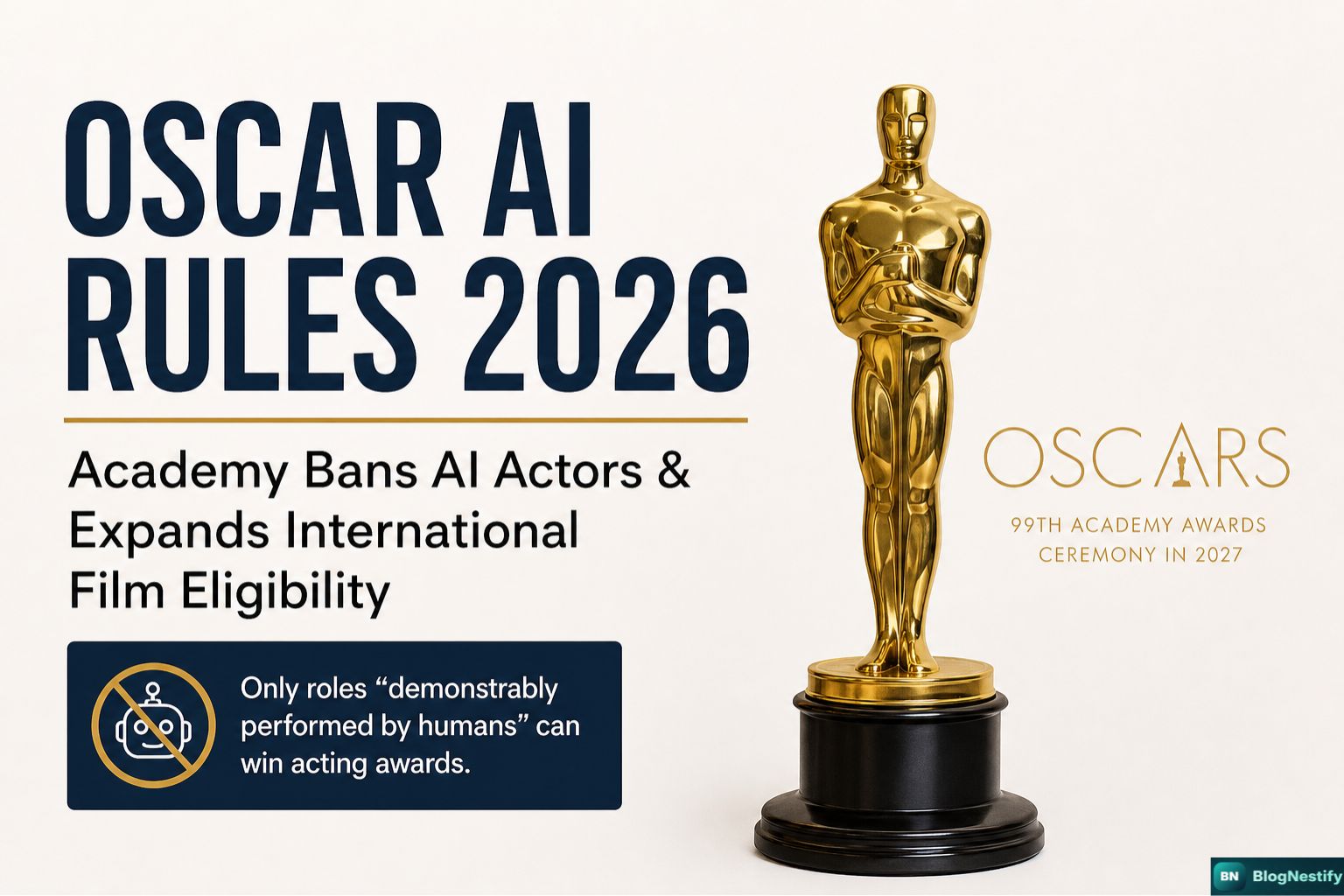
Only roles "demonstrably performed by humans" can win acting awards — and the 99th Oscars bring a string of other sweeping changes that finally put Hollywood's AI anxiety on paper.
Key Takeaways
- AI-generated performers are now officially barred from Oscar acting nominations, effective for all films released in 2026.
- Screenplays must be "human-authored" — and the Academy can now investigate any submission for AI use.
- International films can qualify via major festival wins (Palme d'Or, Golden Bear, Golden Lion, etc.) instead of only through country submissions.
- Actors can earn multiple nominations in the same category if separate performances each land in the top five votes.
- All changes cover the 99th Oscars; the ceremony is scheduled for 2027.
Something changed on Friday, May 1, 2026. Not a tweet or a trade-press rumor, but an actual rule — signed, approved, binding. The Academy of Motion Picture Arts and Sciences told the film industry in plain terms: if an AI generates your performance, you cannot win an Oscar for it. Full stop.
The announcement covered the 99th Academy Awards, but the AI language is the piece that will matter most over the coming years. Hollywood has argued about synthetic talent and AI-generated scripts since at least the 2023 strikes. The Academy just put its position in writing.
What the New AI Rules Actually Say
The exact language is careful and specific. Only roles "credited in the film's legal billing and demonstrably performed by humans with their consent" are eligible for acting awards. That word "demonstrably" is doing real work here. Claiming human involvement is not enough. The performance has to be provably human.
Only roles "demonstrably performed by humans with their consent" will be eligible for acting awards.
— Academy of Motion Picture Arts and Sciences, May 1, 2026The writing categories follow the same logic. Screenplays must be "human-authored." And on top of that, the Academy reserved the right to request more information from filmmakers about their AI use and about "the degree of human authorship" in any submission. That is essentially an investigative mechanism — one the Academy probably needed but did not have spelled out until now.
What counts as "human authorship" for screenplays?
The Academy did not define it precisely, which is both a strength and a complication. Using AI to clean up grammar? Probably fine. Using AI to generate a first draft that a writer then polishes? That is the gray zone the industry will spend the next two years arguing over. The Academy's investigative reservation suggests it knows bright lines are hard to draw here — and that it wants flexibility to make judgment calls rather than follow a formula.
This echoes what the 2023 WGA strike was about. Writers fought hard against studios using AI to generate first drafts that humans would rewrite for minimum pay. The Academy's new language backs the writers' position: the creative origin matters, not just whether a human touched the work at some point.
All the Major Rule Changes at a Glance
| Category | Old Rule | New Rule |
|---|---|---|
| Acting Eligibility New | Any credited performer | "Demonstrably performed by humans with their consent" — AI performers excluded |
| Multiple Nominations New | Only highest vote-getter advances if two performances land in top five | Both performances nominated if each independently lands in the top five |
| Screenplay Eligibility New | No explicit AI restriction | Must be "human-authored"; Academy may investigate any submission |
| International Feature Film New | Country submission only; director's name not on statuette | Country submission OR major festival win (Palme d'Or, Golden Bear, Golden Lion, etc.); director's name now on statuette |
| Casting Category | Maximum 2 statuettes awarded | Maximum 3 statuettes awarded |
| Cinematography Shortlist | 10–20 films shortlisted | Fixed at 20 films |
The International Film Change Is a Bigger Deal Than It Looks
Lost a little in the AI conversation is a genuinely historic shift in how the Academy handles international cinema. For nearly a century, the Best International Feature Film award worked one way: each country selects one film, and that film represents the country. If a selection committee passes on your movie, you are out — regardless of how critically acclaimed it is.
That produced some striking situations. The most cited case: Justine Triet's "Anatomy of a Fall" won the Palme d'Or at Cannes in 2023 — one of cinema's highest honors — but France did not select it to represent the country at the Oscars. The film found its way into the ceremony through a workaround and ultimately won Best Original Screenplay. Under the old system, that nearly did not happen.
The director's name will now appear on the International Feature Film statuette — a correction that was long overdue. International film wins had previously not been counted toward the personal Oscar tally of the directors who made them. That always seemed like a strange asterisk on the record.
What This Means for Hollywood Going Forward
The acting rule change is partly symbolic — nobody was going to let an AI character win an Oscar without a serious fight anyway. But symbols matter in Hollywood. The Academy is now explicitly on record, and that changes how studios, producers, and insurers think about AI-generated content in productions they are funding for awards consideration.
The multiple-nominations change is quietly fascinating. It is the first significant acting eligibility tweak in decades — the last notable one was at the 17th Oscars in 1945, when Barry Fitzgerald became the only performer nominated for both lead and supporting for the same role. For years, campaigns gamed the system by moving stronger performances into supporting categories to avoid vote-splitting. This new rule removes some of that pressure, at least when an actor genuinely has two strong performances in the same year.
Anne Hathaway has five major films scheduled for 2026. That is the example trade writers keep raising. Could she theoretically land three nominations in Best Actress if three performances hit the top five? Technically, yes. Would it actually happen? Almost certainly not. But the rule now allows it, which is new.
The Broader Context: Where This Sits in Hollywood's AI War
The Academy's position did not come from nowhere. The 2023 WGA and SAG-AFTRA strikes were driven in large part by AI concerns — writers fought against studios using AI to generate scripts, and actors fought against studios using digital replicas without consent or pay. SAG-AFTRA eventually won contract language on AI consent and residuals after a 118-day strike.
The Academy's new language mirrors what actors fought for: consent matters, and a performance needs to actually be a performance. That is a values statement as much as an eligibility rule.
The Academy framed the change by comparing AI to past technology shifts — sound, color, CGI. That is true as far as it goes. But AI differs from CGI in one key respect: CGI extended what human actors could do on screen. AI, at its limit, replaces them entirely. That is the line the Academy just decided to hold.
What This Really Comes Down To
Here is the thing about Tilly Norwood posting "Can't wait to go to the Oscars!" on Instagram. Whether you find it charming or unsettling, it forced a real question: what is a performance, exactly? Is it the sound of a voice hitting the right notes? The image of a face expressing emotion? Or does it require a human being — with a history and a nervous system and something genuinely at stake — to be in the room?
The Academy's answer, for now, is that it requires the human. That is not a technical standard. It is a philosophical one. And for an industry that makes its living telling human stories, it is not a surprising place to land.
The rules cover films released in 2026. The 99th Oscars are scheduled for 2027. Between now and then, studios will keep experimenting with AI tools, and the Academy will almost certainly face edge cases the new language does not fully anticipate. But at least there is a foundation now — something written down and approved, not just assumed.
0 Comments
Leave a Comment