PM Modi's Five-Nation Tour: What Happened in the Netherlands — and What Comes Next in Sweden
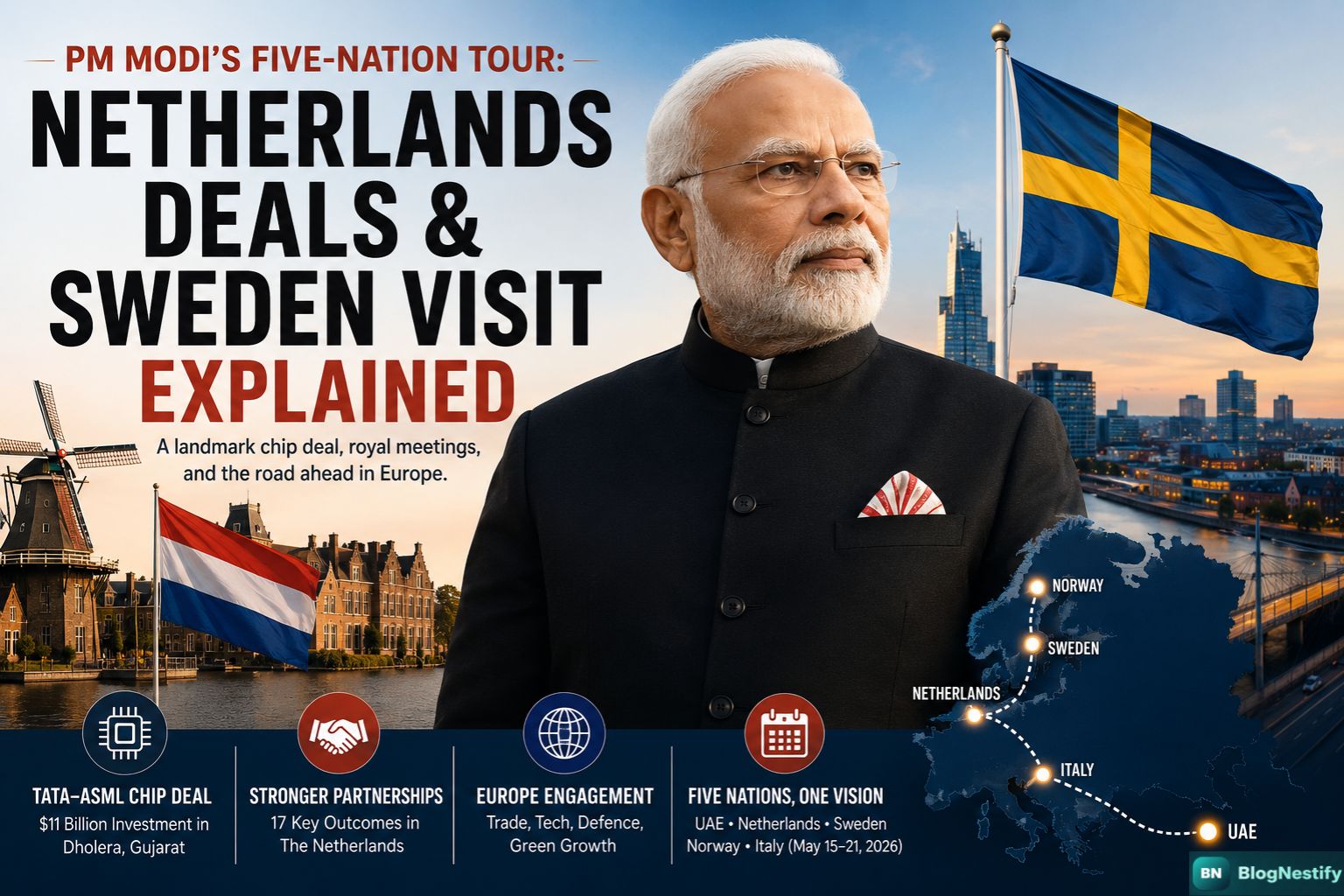
A landmark chip deal, a royal luncheon, and now Gothenburg. Here's a clear-headed look at what India's Prime Minister is building on his current European swing.
What's Actually Going On
Prime Minister Narendra Modi left for a five-country European and Middle Eastern tour on May 15, 2026. The itinerary: UAE, Netherlands, Sweden, Norway, Italy — in that order. Five stops, seven days, a packed diplomatic calendar.
The UAE leg was largely about energy and the long-running India-UAE Comprehensive Strategic Partnership. Then the focus shifted to Europe — and that's where things got genuinely interesting.
Today, Sunday May 17, Modi arrives in Gothenburg, Sweden, the third stop of the tour. But before we get there, it's worth spending a moment on what went down in The Hague.
Netherlands: The Chip Deal That Matters
Modi's two-day Netherlands visit (May 15–17) wasn't just protocol. The headline was a deal between Tata Electronics and ASML — the Dutch semiconductor giant that essentially controls the global supply of advanced chip-making lithography machines.
What they signed: an MoU to support Tata's upcoming semiconductor fabrication plant in Dholera, Gujarat. Tata plans to invest $11 billion in the facility. ASML will supply the advanced lithography tools needed to manufacture chips for AI, automotive, and other industries. The agreement was signed in The Hague in the presence of both Modi and Dutch PM Rob Jetten.
"India's strides in the world of semiconductors offers immense opportunities for the youth of our nation. This is a sector in which we will keep adding vigour."
— PM Narendra Modi, The Hague, May 16, 2026
ASML CEO Christophe Fouquet called India's semiconductor sector full of "compelling opportunities" and described a long-term commitment to the region. That's not boilerplate corporate language from a company of ASML's standing — they make machines that only they can make, and they don't sign deals casually.
Beyond semiconductors, Modi met Dutch CEOs from Philips, NXP Semiconductors, KLM Royal Dutch Airlines, Heineken, and the Port of Rotterdam — all of whom expressed interest in expanding their India footprint. Areas on the table: ports and logistics, clean energy, healthcare, digital technologies, and artificial intelligence.
The Netherlands, it turns out, is already India's 4th largest investor globally. Modi used the CEO roundtable to pitch India's economic reforms — citing reforms in taxation, labour code, and governance — and to call for deeper partnerships. He also referred to the India-EU Free Trade Agreement as "the mother of all deals," which gives you a sense of the stakes he's framing this trip around.
On the diplomatic side, Modi called on King Willem-Alexander and Queen Máxima at the Royal Palace Huis ten Bosch in The Hague on May 16 — a bilateral meeting followed by a luncheon hosted in his honour. He recalled the royal couple's 2019 state visit to India as having "injected fresh momentum" into bilateral ties. Both sides also agreed to announce a new Strategic Partnership and pushed for early implementation of the India-EU FTA.
Sweden: Gothenburg, Today
Modi's Sweden leg runs May 17–18, based in Gothenburg — Sweden's second city and its industrial heart. He's there at the invitation of Swedish Prime Minister Ulf Kristersson, and the two will hold bilateral talks covering trade, green technology, AI, defence, space, and startups.
India and Sweden don't get as much attention as, say, India and Germany, but the trade relationship has grown steadily. Bilateral trade hit $7.75 billion in 2025; Swedish FDI into India has reached $2.825 billion since 2000. Swedish companies like Volvo, Ericsson, H&M, and IKEA already have a meaningful presence in India.
The big set-piece is an address at the European Round Table for Industry (ERT) — a forum of Europe's most senior CEOs. Modi and Kristersson will speak there alongside European Commission President Ursula von der Leyen. That's a significant platform: the ERT shapes European industrial and trade policy, and positioning India as a partner at that table sends a clear signal.
Modi last visited Sweden in 2018 for the first-ever India-Nordic Summit. This is a bilateral visit — different format, more focused. The agenda has a practical quality to it: green transition collaboration, supply chain resilience, and emerging tech. Sweden's strengths in clean energy and industrial automation make it a natural fit for where India wants to go.
What Comes After: Norway and Italy
The Norway stop (May 18–19) carries its own kind of historical weight. This will be the first standalone bilateral visit by an Indian Prime Minister to Norway in 43 years. Modi will co-chair the 3rd India-Nordic Summit alongside leaders from Norway, Denmark, Finland, Iceland, and Sweden. He'll also address the India-Norway Business and Research Summit.
The final stop is Italy (May 19–21). India and Italy have been quietly building momentum — bilateral trade stood at $16.77 billion in 2025, with cumulative FDI of $3.66 billion from April 2000 to September 2025. Both sides are implementing a Joint Strategic Action Plan (2025–2029). Modi will meet Italian President Sergio Mattarella and hold talks with PM Giorgia Meloni.
The Bigger Picture
There's an obvious thread running through all of this: India positioning itself as Europe's trusted technology and manufacturing partner at a time of global supply chain realignment. With China's relations with the West strained, Europe is actively looking for alternative partners — and India is making the case that it can fill that role.
The ASML-Tata deal is the clearest expression of that argument. Semiconductors are the century's most strategic resource. Getting ASML — the gatekeeper of advanced chip manufacturing — to commit to India's chip ecosystem is not a minor footnote. It's the kind of deal that takes years of relationship-building to produce.
The India-EU Free Trade Agreement, which Modi called "the mother of all deals," sits in the background of almost every conversation on this tour. When it eventually gets finalized, it will reshape trade flows significantly. These bilateral visits are partly about keeping that process warm.
Modi has completed 12 years as Prime Minister. His foreign tours at this point aren't about introductions — they're about converting long-built relationships into concrete deals. The Netherlands visit produced 17 documented outcomes in two days. That's a different pace than diplomatic tourism.
Frequently Asked Questions
Which countries is PM Modi visiting on his five-nation tour in May 2026? +
PM Modi is visiting five countries: UAE, Netherlands, Sweden, Norway, and Italy. The tour runs from May 15 to 21, 2026. Each stop has a distinct bilateral agenda.
What was the outcome of PM Modi's visit to the Netherlands? +
The Netherlands visit produced 17 key outcomes documented by India's Ministry of External Affairs. The landmark deal was a Tata Electronics–ASML MoU to support India's first front-end chip fabrication plant in Dholera, Gujarat, with a planned investment of $11 billion. Modi also met King Willem-Alexander and held talks with Dutch PM Rob Jetten, announcing a new Strategic Partnership between the two countries.
Why is PM Modi visiting Gothenburg, Sweden? +
Modi is in Gothenburg on May 17–18 at the invitation of Swedish PM Ulf Kristersson. The two leaders will hold bilateral talks covering trade, green technology, AI, defence, and space. They will also address the European Round Table for Industry alongside European Commission President Ursula von der Leyen — a major platform for European industrial policy.
What is the significance of the ASML–Tata Electronics semiconductor deal? +
ASML is the world's sole maker of extreme ultraviolet (EUV) lithography machines — the tools without which you cannot manufacture advanced semiconductors. Their agreement to help build and scale up Tata's Dholera plant is a critical step in India's goal of becoming a semiconductor manufacturing nation, not just an assembly hub.
What is India's current trade relationship with Sweden? +
India-Sweden bilateral trade reached $7.75 billion in 2025. Swedish FDI into India has totalled $2.825 billion between 2000 and 2025. Key focus areas for expansion include green transition, AI, emerging technologies, startups, resilient supply chains, defence, and space.
Khushal writes on Indian foreign policy, geopolitics, and South Asian affairs at Blognestify. He tracks India's evolving partnerships across Europe and the Indo-Pacific.
More articles by Khushal →
0 Comments
Leave a Comment