Quad Summit 2026: India Hosts Historic Foreign Ministers Meeting — Critical Minerals, Fuel Security Forum & Indo-Pacific Outcomes
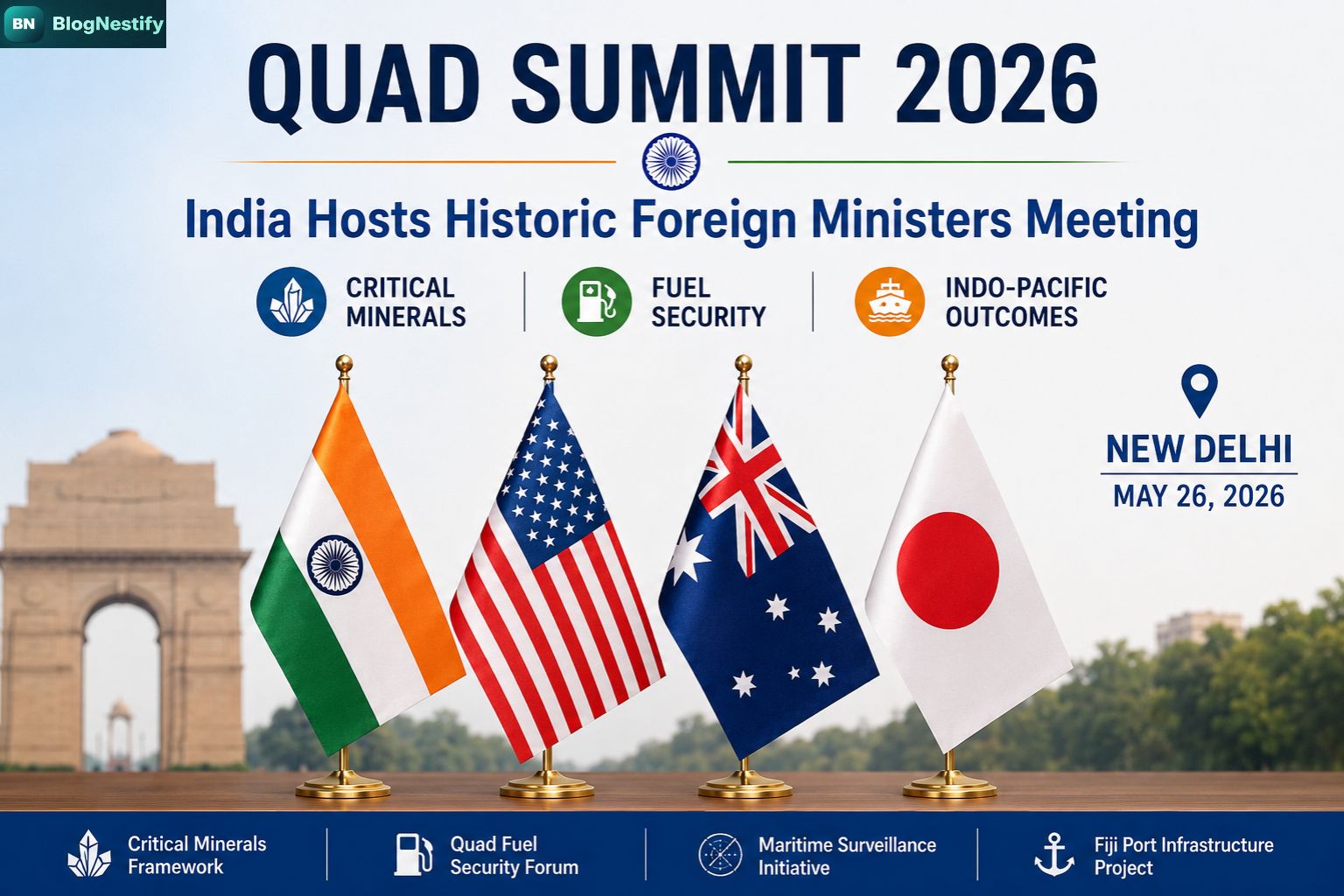
India chaired the 11th Quad Foreign Ministers Meeting at Hyderabad House, New Delhi. Three landmark outcomes — a Critical Minerals Framework, a Fuel Security Forum, and a Maritime Surveillance Initiative — signal a grouping shifting from dialogue to action.
Quick Summary: What Came Out of New Delhi
- ✓ Quad Critical Minerals Framework — a multilateral coordination mechanism covering mining, processing, recycling, and supply chain investment across rare earths and strategic minerals
- ✓ India-US Bilateral Critical Minerals Agreement — a separate bilateral framework signed on the sidelines by EAM Jaishankar and Secretary Rubio
- ✓ Quad Initiative on Indo-Pacific Energy Security — broad energy resilience framework covering tech, policy, market analysis, and emergency response
- ✓ Quad Fuel Security Forum — high-level coordination body to be hosted by the US Department of Energy later in 2026
- ✓ Indo-Pacific Maritime Surveillance Initiative — integrates all four nations' surveillance capabilities into a Common Operating Picture
- ✓ Fiji Port Infrastructure Project — the Quad's first joint infrastructure project in the Pacific Islands
- ✓ Pahalgam Terror Condemnation — joint statement calling for accountability over the April 2025 attack
India Takes the Chair: What Made This Meeting Different
There's been a lot of talk about the Quad becoming more than a security dialogue. The May 26, 2026 meeting in New Delhi offered the clearest evidence yet that the grouping means it. Hosted by External Affairs Minister S. Jaishankar at Hyderabad House and attended by US Secretary of State Marco Rubio, Australian Foreign Minister Penny Wong, and Japanese Foreign Minister Toshimitsu Motegi, this wasn't a conversation about intent — it was a meeting that produced frameworks with real operational teeth.
India holds the Quad chairmanship throughout 2025–26, and the New Delhi venue made a statement. The discussions centred on four pillars: maritime and transnational security, economic prosperity and supply chain resilience, critical and emerging technologies, and humanitarian assistance and disaster response. Each pillar generated at least one concrete deliverable — something the Quad's critics have long said the grouping was incapable of doing.
"The Quad continues to evolve as a practical and action-oriented platform delivering tangible benefits for the region."
— Nagaraj Naidu, Additional Secretary, Ministry of External Affairs, IndiaThe Critical Minerals Framework: Why Rare Earths Are the New Oil
The single biggest structural announcement from the New Delhi meeting is the Quad Critical Minerals Initiative Framework. This is a multilateral coordination architecture that will guide the four nations in leveraging economic policy tools, coordinating investment, and strengthening supply chains across the entire lifecycle of critical minerals — from mining and processing through to recycling and e-waste recovery.
Why does this matter? Right now, a handful of countries — and one in particular — dominate the processing of rare earth elements used in everything from electric vehicle batteries and wind turbines to defence electronics and semiconductor manufacturing. The Quad framework is a direct response to that concentration risk. India, Australia, Japan, and the US each bring different assets: Australia and India have significant geological reserves; Japan has advanced processing and recycling technology; the US has capital markets and end-use manufacturing.
What the Framework Actually Covers
Mining Cooperation
Joint identification and development of strategic mineral deposits across member nation territories and partner countries.
Processing & Refining
Technology sharing and investment coordination to build out processing capacity outside existing single-source dependencies.
Recycling & E-Waste Recovery
Frameworks for critical mineral recovery from electronic waste, reducing dependence on virgin ore extraction.
Investment Facilitation
Regulatory coordination and private sector engagement to mobilize capital for supply chain diversification projects.
On the sidelines of the Quad meeting, India and the United States also signed a separate bilateral Critical Minerals Framework — a sign that even within the multilateral format, the two countries want direct, legally anchored commitments on securing rare earth supply chains. The groundwork for this bilateral agreement was reportedly laid as far back as February 2026.
Strategic context: Australia's geological reserves include lithium, cobalt, and rare earth deposits that are among the world's largest. India has significant thorium and rare earth deposits. Japan processes and recycles critical minerals at scale. The US provides capital and end-market demand. The Quad Critical Minerals Framework is, in effect, an attempt to build a full supply chain across allied territory.
The Quad Fuel Security Forum: Energy as Strategy
The second headline outcome is the Quad Initiative on Indo-Pacific Energy Security, which formalizes energy resilience as a collective strategic priority for the four nations. But what gives it operational weight is a specific mechanism buried inside it: the Quad Fuel Security Forum, which the US Department of Energy will host for Quad partners later in 2026.
This matters for several reasons. The meeting took place against the backdrop of genuine energy market stress — disruptions to global energy flows from the Strait of Hormuz crisis have been felt across the Indo-Pacific, and Japan's Foreign Minister Motegi specifically flagged the importance of diplomatic efforts to ensure free navigation through the strait. When Quad foreign ministers are talking about Hormuz, the energy security framing is not theoretical.
Scope of the Energy Security Initiative
| Area of Cooperation | What It Covers | Lead Mechanism |
|---|---|---|
| Technology | Clean energy tech, LNG infrastructure, grid resilience | Bilateral working groups |
| Management & Policy | Regulatory harmonization, strategic reserve coordination | Quad Energy Working Group |
| Market Analysis | Joint analysis of Indo-Pacific energy pricing and supply shocks | Shared intelligence platform |
| Emergency Response | Joint exercises, crisis communication protocols, supply reallocation | Quad Fuel Security Forum (US-hosted) |
| Regional Capacity | Support for small island developing states and Pacific partners | Japan POWERR Asia + Australia investments |
Each country brings distinct energy sector strengths. Australia is a major LNG exporter. The US has significant shale production and energy technology exports. Japan has world-leading energy efficiency technology and financial tools for infrastructure development. India is the world's third-largest energy consumer with a rapidly expanding renewable sector. The Fuel Security Forum will try to make those complementary strengths work as an integrated regional system rather than four separate national strategies.
The Strait of Hormuz carries roughly 20% of global oil trade and a significant share of LNG flows bound for Asia. Disruptions there hit Japan and South Korea particularly hard. The Quad's energy security initiative is partly a hedge against exactly this kind of chokepoint vulnerability.
Maritime Surveillance: Seeing the Indo-Pacific Together
The third major announcement — the Indo-Pacific Maritime Surveillance Cooperation Initiative — tackles something the Quad has been building toward for years. Announced by Rubio during the joint press conference, the initiative integrates the maritime surveillance capabilities of all four Quad nations and aims to establish a Common Operating Picture across the maritime domain.
Think of it as a shared situational awareness layer for the entire Indo-Pacific. Instead of four national surveillance networks operating in relative isolation, the Quad Maritime Surveillance Initiative will fuse data from satellite imagery, maritime patrol aircraft, undersea sensors, and coast guard assets into a unified picture that all four nations can access in real time.
Accompanying Maritime Announcements
The maritime package from New Delhi wasn't limited to surveillance. Jaishankar's post-meeting social media update outlined several related commitments. An expert panel on port infrastructure will be established to assess gaps and coordinate development priorities. Undersea cable connectivity — increasingly recognized as a strategic vulnerability — will be a focus of joint Quad protection efforts. And all Pacific Islands Forum members, the statement indicated, should have access to undersea cable networks.
The grouping also reaffirmed and expanded its Indo-Pacific Maritime Domain Awareness (IPMDA) cooperation, which uses commercial satellite technology to help partner nations track vessels in their own waters — an initiative specifically designed to address illegal fishing and other maritime security concerns without the political baggage of direct military surveillance.
The Fiji Port Project: The Quad's First Joint Infrastructure Bet
Perhaps the most symbolically significant announcement — though not the largest in scope — is the pilot port infrastructure project in Fiji. This is the first time the Quad has committed to a joint physical infrastructure project, and its location in the Pacific Islands is not accidental.
Pacific island nations have become one of the most contested diplomatic spaces in the Indo-Pacific over the past several years. China has pursued security and infrastructure agreements with several Pacific island governments, and the Quad's infrastructure push — formalized through the "Quad Ports of the Future Partnership" framework — represents a direct counter-offer. The Fiji project is described as a pilot: the intention is to use it as a model for broader port development cooperation across the region.
Why Fiji? Fiji is geographically central in the Pacific Islands and has existing port infrastructure that benefits from modernization. Rubio called it the Quad's "first joint regional infrastructure project" — the word "first" doing a lot of work in terms of signaling future intent across the wider Pacific Islands Forum.
Pahalgam, Counter-Terrorism, and the Quad's Security Pillar
The meeting's security discussions extended beyond the maritime domain. Counter-terrorism featured prominently, and the joint statement from the meeting specifically condemned the April 2025 terrorist attack in Pahalgam, Jammu and Kashmir — an attack that claimed 25 Indian lives and one Nepali national. The statement called on all UN member states to cooperate in bringing perpetrators, organizers, and financiers to justice.
Jaishankar's formal statement was pointed: zero tolerance for terrorism, and an explicit affirmation that nations subject to attacks have the right to defend themselves. This language carries weight given ongoing India-Pakistan tensions following the Pahalgam attack and subsequent Indian military operations.
The grouping also issued a warning against what the joint statement called "coercion" in the Indo-Pacific — language that, without naming China directly, clearly references Beijing's behaviour in the South China Sea, around Taiwan, and in its economic pressure campaigns against Australia and other regional partners.
Key Takeaways: Reading the Quad's Direction
🔎 What This Meeting Tells Us About the Quad's Trajectory
- →The Quad is shifting from dialogue platform to implementation body — frameworks with real operational mechanisms, not just communiqués
- →Critical minerals have become the Quad's primary economic security vehicle, with both multilateral and bilateral tracks now running simultaneously
- →Energy security is now formally embedded in the Quad's mandate — the Fuel Security Forum gives it an institutional home
- →Maritime surveillance integration represents years of IPMDA capacity-building translated into a real-time shared picture
- →The Fiji infrastructure project signals serious Pacific Islands engagement — and sets a template for wider regional infrastructure competition
- →India's role as chair has been substantive: the New Delhi meeting produced more concrete deliverables than several predecessors
- →A Quad Leaders' Summit remains unconfirmed for 2026, but Rubio signalled US officials are actively working toward one
Who Was in the Room: The Four Ministers
| Minister | Country | Key Emphasis at Meeting |
|---|---|---|
| S. Jaishankar (Chair) | 🇮🇳 India | Maritime surveillance, critical minerals bilateral with US, zero tolerance on terrorism, right of self-defence |
| Marco Rubio | 🇺🇸 United States | Maritime surveillance initiative, Fuel Security Forum hosting, critical minerals, pathway toward Leaders' Summit |
| Penny Wong | 🇦🇺 Australia | Critical minerals supply chain reliability, "Ports of the Future" partnership, Pacific island engagement |
| Toshimitsu Motegi | 🇯🇵 Japan | Strait of Hormuz navigation, energy security, POWERR Asia regional initiative |
0 Comments
Leave a Comment