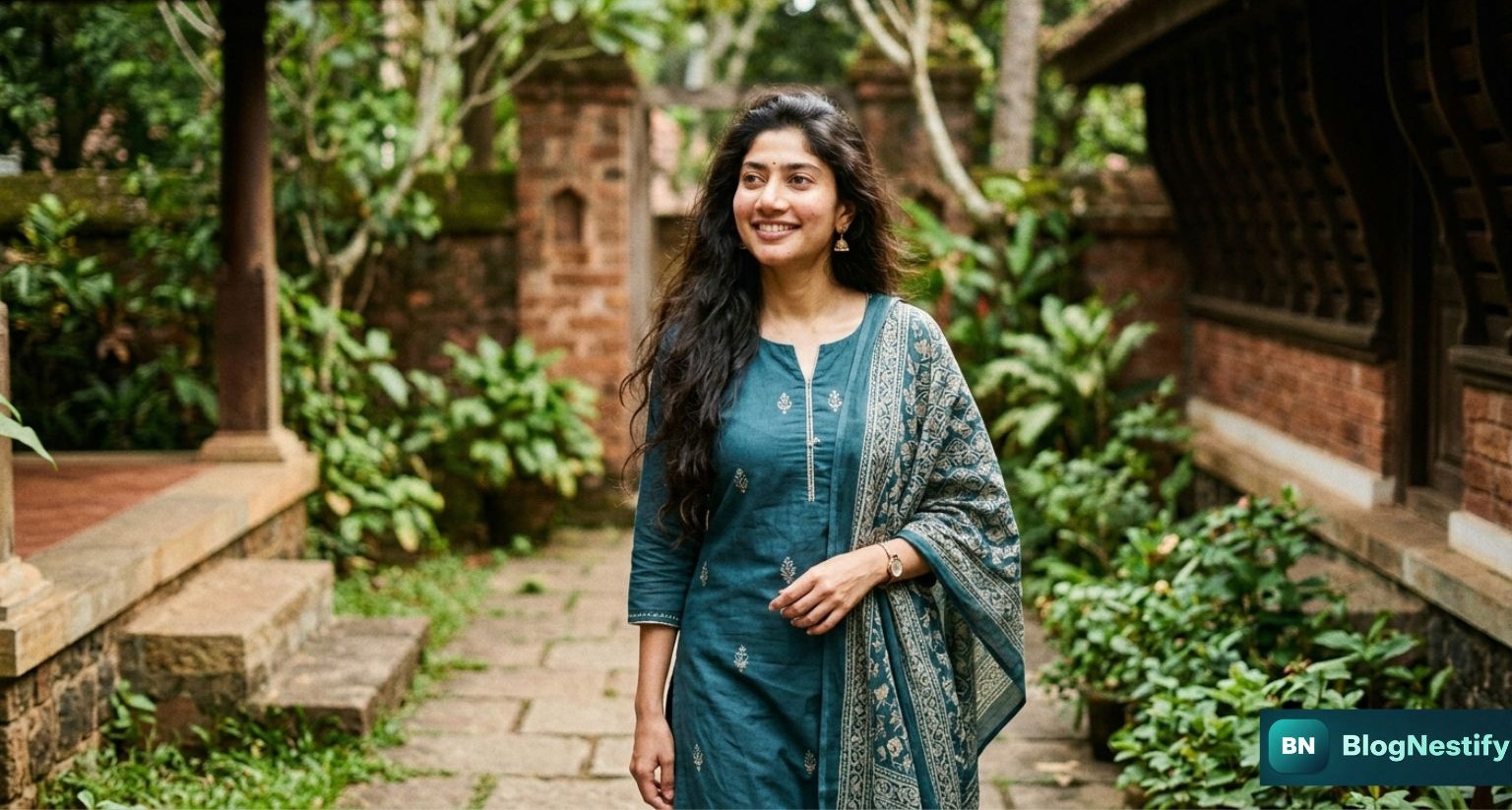
There's a particular kind of quiet confidence that takes years to build — the kind where you stop explaining yourself and let the work speak. Sai Pallavi has been doing this for ten years. Bollywood is only now catching on.
When news broke that she'd be playing Sita in one of Hindi cinema's most ambitious productions, a certain corner of the internet reacted as if this were a surprise. It wasn't. Not to anyone paying attention since 2015.
The surprise — if there is one — is that it took this long. And even that isn't really surprising, if you understand how she's operated her entire career.
The Woman Who Said No
Most careers in Indian cinema run on yes. Yes to the big banner film. Yes to the item number. Yes to the fairness cream deal that pays three times your acting fee. The architecture of the industry rewards compliance, and there's nothing wrong with working within it — people have families to feed, careers to build.
Sai Pallavi said no, repeatedly, to things that would have made her richer and more visible faster. She turned down endorsements that conflicted with her values on skin tone and body image. She walked away from films she didn't believe in. She didn't chase a Bollywood entry the way most actors from the South do — with calculated PR, with strategic Hindi cameos, with films chosen for maximum crossover potential.
The result is that she arrived in Bollywood with something most debut actors don't have: a track record. She wasn't unknown, asking for a chance. She was known, finally agreeing to show up.
A Decade Worth Mapping
The career reads cleanly in hindsight, though it was never a straight line. Each phase added something different — a language, a genre, a register she hadn't explored before.
Three Languages, One Consistent Identity
Here's something that gets overlooked in the "crossover" conversation: working across Tamil, Telugu, and Malayalam isn't just logistically complicated — it's artistically demanding. These industries have different rhythms, different audience expectations, different ways of shooting emotion. An actor who can shift between them without losing coherence is doing something real.
Most actors who cross language barriers end up slightly off. Their performances feel like translations. There's always a small delay between intention and execution, like they're thinking in one language and performing in another. Sai Pallavi doesn't have that problem. Watch her in Premam, then watch her in Fidaa, then watch her in Gargi — these are three different people, but they all feel entirely inhabited, entirely present.
That's a skill set. It's also, frankly, exactly what a Hindi film industry that talks about "pan-India appeal" should have been looking for all along.
What Bollywood Actually Gets
When Sai Pallavi agrees to a Hindi film, Hindi cinema doesn't get an actress trying to prove herself. It gets someone with ten years of work, a loyal audience who'll follow her across language lines, and — crucially — a reputation for choosing projects carefully.
That last point matters more than it sounds. Audiences in India are sophisticated about star personas. They know when an actor is cashing a check versus showing up. The fact that Sai Pallavi has consistently chosen roles that challenge her, rather than ones that merely pay well, has created a kind of goodwill that money genuinely can't buy.
Her Sita casting in Ranbir Kapoor's Ramayana project is instructive. This isn't a supporting role. It's one of the most mythologically significant characters in Indian culture — a role that invites comparison not just to other screen portrayals but to the cultural imagination of hundreds of millions of people. The filmmakers putting her in that position clearly weren't thinking of her as a South Indian actress making a Bollywood debut. They were thinking of her as the right actor for the part.
The Body Image Thing — Because It Has to Be Said
Indian cinema has a long, uncomfortable history of what it considers a "presentable" female body. The industry's beauty standards are aggressive, and the pressure on actresses — particularly those crossing over to larger markets — to conform is real.
Sai Pallavi has resisted this consistently. She has spoken openly about not wanting to alter her appearance for roles, about turning down campaigns that promoted a single standard of skin tone, about the gap between how the industry talks about "natural beauty" and how it actually treats it.
This isn't just admirable — it's strategically significant. A large part of her fanbase, particularly among young women in South India, is built on exactly this refusal. She represents something to them that is genuinely rare: a mainstream actress who looks like a person, acts like a person, and hasn't slowly edited herself into the industry's preferred version of a woman.
Bollywood inherits all of that when she enters. That's not nothing. That's actually quite a lot.
The Doctor in the Room
It's easy to mention that Sai Pallavi has an MBBS degree as a fun fact — as a quirky detail in an interview, a trivia question at the end of a profile. But it tells you something important about who she is.
She completed a full medical degree, from a college in Georgia (the country), while working as an actress. That's not an accident or a lucky overlap of timelines. That's a person who decided what mattered to her and found a way to do both things properly. The discipline that takes — the refusal to treat career momentum as the only thing worth protecting — is the same discipline that explains every other choice in her filmography.
She is, in a very specific sense, a person who does not make impulsive decisions. And in an industry where careers are often built on impulse — the next big offer, the current hot director, the project that looks good right now — that is an unusual thing to be.
A Takeover, Not a Debut
The language around "Bollywood debut" frames this wrong. A debut is something you do at the beginning, when you need validation from a bigger stage. Sai Pallavi already has the stage. She has the audience, the credibility, and the filmography. What's happening now is that Hindi cinema is being added to her portfolio — not the other way around.
That framing matters because it changes what success looks like. If this were a debut, the question would be: will Bollywood accept her? Since it's a takeover, the question is: what does Hindi cinema do with the standard she's already set?
That's a harder question. And it's the right one to be asking.
The industry tends to flatten actresses into categories — the girl next door, the glamour queen, the serious actor who gets awards but not franchises. Sai Pallavi doesn't fit cleanly into any of these, and that's precisely what makes her interesting. She's been commercially successful without becoming a commercial product. She's been critically recognized without retreating into art films. She speaks to mass audiences in three languages without dumbing anything down.
Bollywood hasn't had to deal with that combination for a while. It's going to be interesting to watch it try.
0 Comments
Leave a Comment