Samsung Crossed $1 Trillion on AI Chips. Apple Just Paid $250M for Lying About Siri. Same Week.
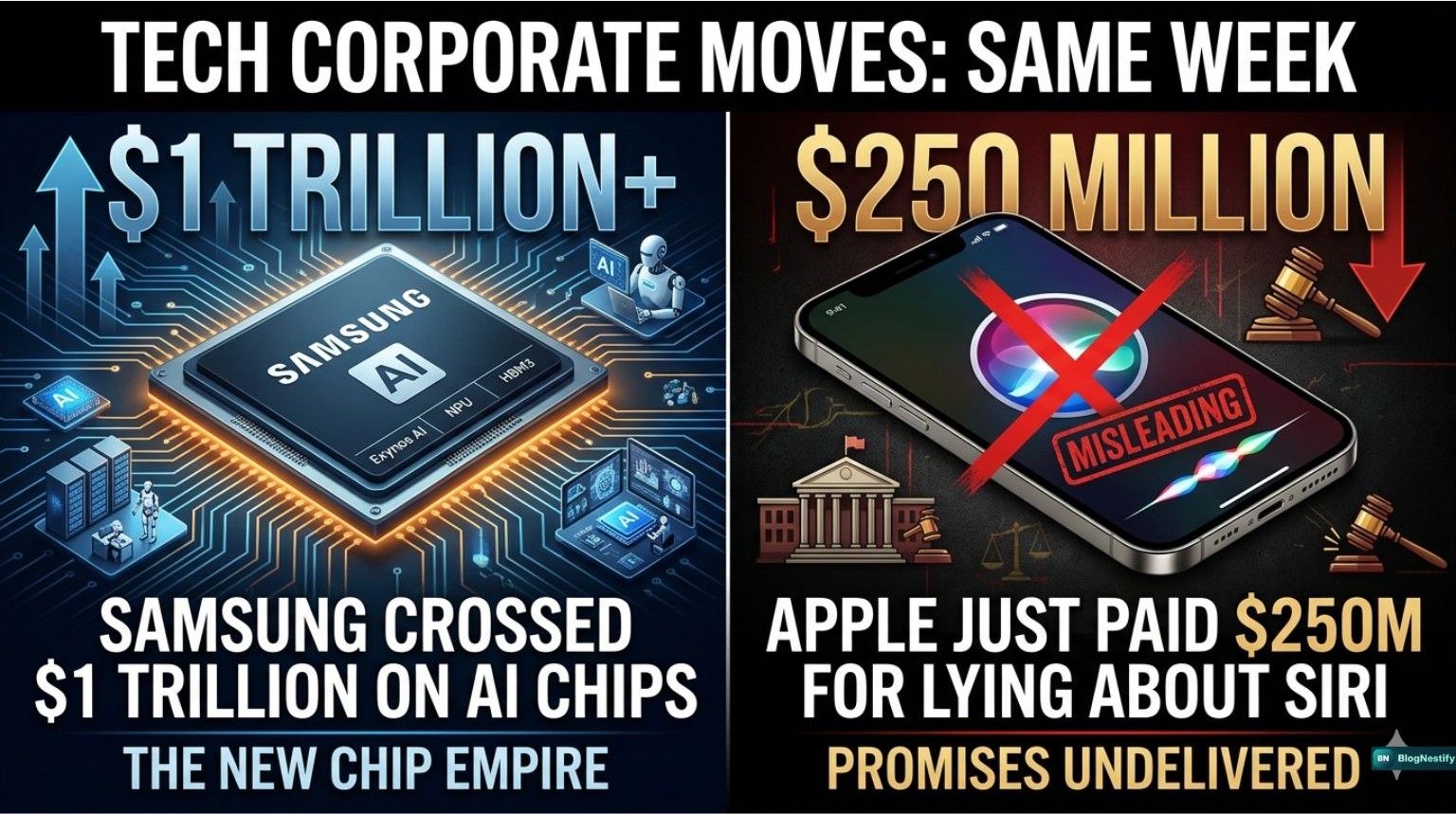
Two headlines. Two very different stories about where tech companies stand in the race to own AI — one built a chip empire, the other got caught promising something it couldn't deliver.
Two things happened in tech this week that, on the surface, look completely unrelated. Samsung hit a $1 trillion market cap for the first time. And Apple quietly agreed to pay $250 million to settle a lawsuit accusing it of lying about its AI features. Put them side by side and you get a pretty clear picture of which direction the AI era actually rewards — and which direction it punishes.
Neither story is simple. Samsung's trillion-dollar moment is real, but it comes with some serious caveats. Apple's lawsuit is embarrassing, but the company's response says a lot about how it plans to move forward. Both deserve more than a headline.
Samsung's $1 Trillion: What the AI Chip Boom Actually Looks Like
On May 6, 2026, Samsung Electronics shares jumped more than 15% in a single trading session — the company's largest single-day gain on record. That pushed Samsung's market capitalization past $1 trillion, making it only the second Asian company in history to reach that milestone. TSMC got there first. Everyone else is still watching.
The rally wasn't random. It followed a jaw-dropping earnings report. Samsung's Q1 2026 operating profit jumped more than eightfold compared to the same period a year earlier, to 57.2 trillion Korean won. Revenue hit a record 133.9 trillion won. To put that in perspective: the company's entire 2025 full-year operating profit was 43.6 trillion won. Samsung beat it in three months.
"There is a tremendous shortage in DRAM and NAND memory chips due to torrid AI demand, which is very memory hungry due to AI's high bandwidth and storage needs." — Yu Jing Jie, Technology Equity Analyst, Morningstar
The driver behind all of this is AI infrastructure spending — specifically, the explosion in demand for high-bandwidth memory (HBM) chips. Every large language model, every AI data center, every Nvidia GPU running inference needs these chips to function. And right now, supply can't keep up with demand. That's Samsung's sweet spot.
HBM4: The Chip Behind the Boom
Samsung's HBM4 chips — the sixth generation of high-bandwidth memory technology — are expected to play a central role in Nvidia's upcoming Vera Rubin AI architecture. Analysts expect Samsung's semiconductor division to keep posting record-breaking numbers for several quarters, as contract prices continue climbing against a backdrop of constrained supply.
Foreign investors added nearly 2.9 trillion won (about $2 billion) in Korean stocks in a single session. Samsung and SK Hynix together make up more than 43% of South Korea's benchmark Kospi index. The index crossed 7,000 for the first time in history on the same day Samsung hit the $1 trillion mark.
That said, not everything in Samsung's house is in order. While the chip division is printing money, the mobile and display units are struggling — rising component costs are squeezing margins. And on the labor front, Samsung workers are threatening an 18-day general strike later in May. The profits are enormous, but they're not evenly distributed inside the company.
| Metric | Q1 2026 | Full Year 2025 |
|---|---|---|
| Operating Profit | 57.2 trillion KRW | 43.6 trillion KRW |
| Revenue | 133.9 trillion KRW (record) | — |
| Share Price Move | +15% (largest single day ever) | +4× over prior year |
| Market Cap | $1 Trillion+ | Sub-trillion |
Apple's $250 Million Lesson: Don't Promise AI You Can't Ship
Apple's story this week is a different kind of milestone. The company agreed to pay $250 million to settle a class-action lawsuit that accused it of advertising AI-powered Siri features that simply didn't exist — and wouldn't exist for years.
The lawsuit traces back to the iPhone 16 launch in 2024. Apple's marketing at the time was heavy on Apple Intelligence: a smarter, more context-aware Siri, capable of doing things previous versions couldn't. The problem? None of those features were actually ready. The "more personalized Siri" kept getting pushed back, and by March 2025, Apple formally acknowledged the delay. The lawsuit argues Apple "saturated the internet, television, and other airwaves" with claims that created a clear consumer expectation — an expectation that was never met.
Who's Eligible — and What They Can Claim
The settlement covers about 36 million devices sold in the United States between June 10, 2024 and March 29, 2025. If you bought one of the following, you may have a claim:
| Device | Estimated Payout | Condition |
|---|---|---|
| iPhone 16 | $25–$95 per device | US purchase, June 2024–March 2025 |
| iPhone 16 Pro | $25–$95 per device | US purchase, June 2024–March 2025 |
| iPhone 16 Pro Max | $25–$95 per device | US purchase, June 2024–March 2025 |
| iPhone 15 Pro | $25–$95 per device | US purchase, June 2024–March 2025 |
| iPhone 15 Pro Max | $25–$95 per device | US purchase, June 2024–March 2025 |
Apple will begin accepting claims within 45 days of May 5, 2026. You'll need proof of purchase, the device's serial number, your phone number, and Apple account information to file.
As of this writing, the advanced Siri capabilities at the center of the lawsuit remain unavailable to users. Apple expects to roll them out with iOS 27, set to debut at WWDC 2026 on June 8. The settlement doesn't require Apple to admit wrongdoing — or to ship the features by any deadline.
Apple's official response was characteristically brief. A company spokesperson told the press that Apple "resolved this matter to stay focused on doing what we do best, delivering the most innovative products and services to our users." That's the kind of statement companies issue when they want the story to go away.
There's a separate lawsuit still in progress, led by South Korea's National Pension Service, which is arguing Apple's delays caused billions in stock market losses through what it calls securities fraud. That case is still being fought and hasn't been settled.
Two Companies, One Lesson: Infrastructure Wins. Hype Loses.
Read these two stories together and a pattern becomes pretty hard to ignore. Samsung built real infrastructure — actual silicon, actual manufacturing capacity, actual chips powering actual AI workloads. The market rewarded that with a trillion-dollar valuation. Apple built marketing — announcements about features it hadn't finished, timelines it couldn't keep, promises made to sell hardware. The legal system responded with a $250 million bill.
That's not to say Apple is doomed. The company is still one of the most profitable in human history. And there's a reasonable chance that iOS 27 does deliver on at least some of what was originally promised. But the Siri episode is a lesson in what happens when the AI hype cycle runs faster than actual AI development — and consumers are patient enough to sue.
"Corporate earnings in aggregate keep getting stronger and it's mainly coming from one place — from the technology sector." — Mark Davids, APAC Head, JPMorgan Asset Management
For Samsung, the question is whether the AI memory super-cycle holds. Analysts who follow the chip market tend to split into two camps: those who think this is a structural shift (AI memory demand is baked into the economy now, permanently) and those who think it's a cyclical spike that will correct. Samsung is trading at just 5.9 times one-year forward earnings — historically low — which suggests the market isn't pricing in permanent bliss. But right now, the chip shortage is real and the demand is real, and that combination doesn't usually unwind overnight.
Both companies are navigating the same underlying reality: AI is reshaping what it means to be a successful tech company in 2026. Samsung figured out where to position itself. Apple is still working on it.
0 Comments
Leave a Comment