SpaceX IPO 2026: The $1.75 Trillion SEC Filing, SPCX Nasdaq Date, and What Every Investor Needs to Know
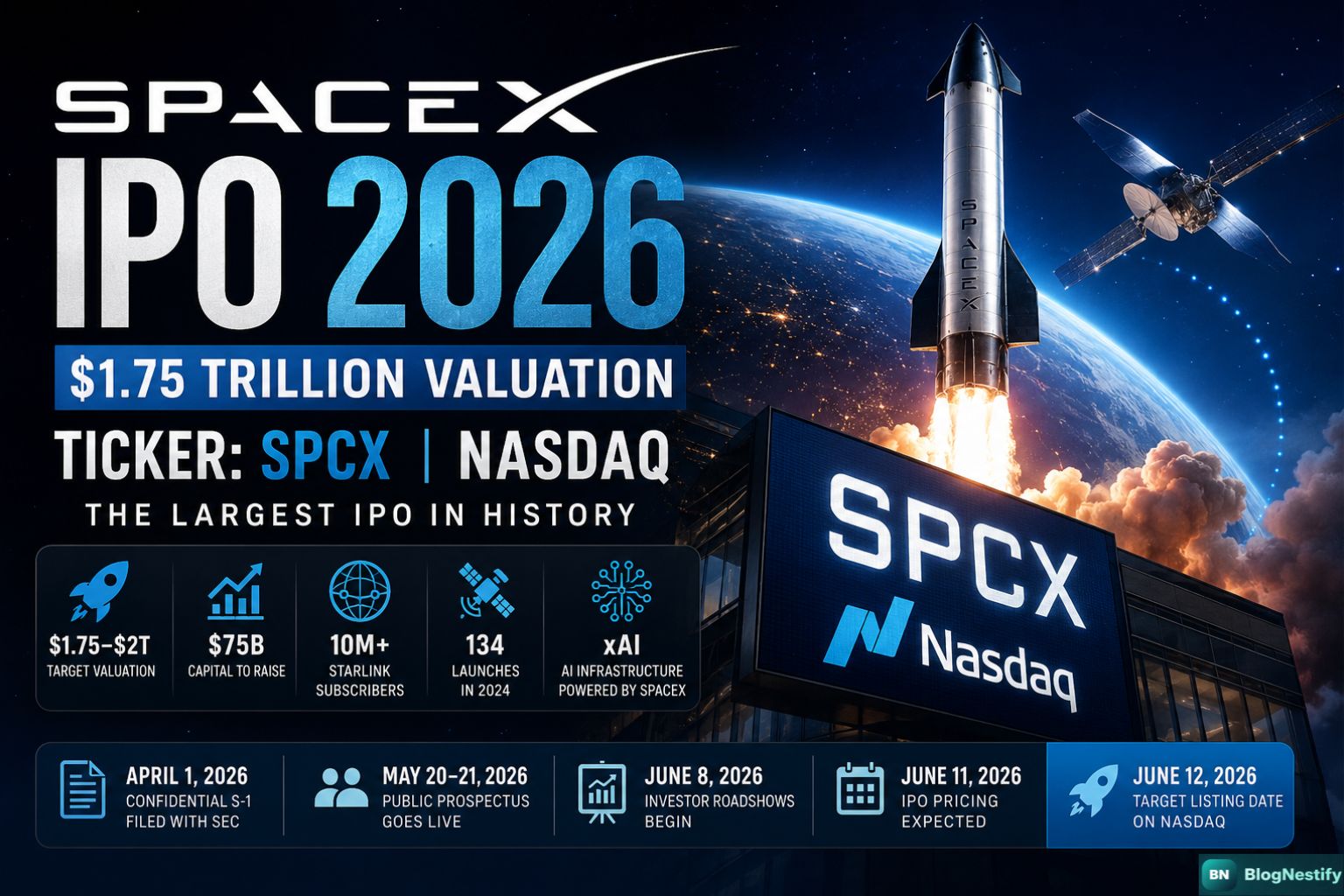
Elon Musk's rocket company has officially filed for the largest IPO in history — bigger than Aramco, bigger than Alibaba, bigger than anything Wall Street has ever priced. Here's what the filing actually says, and what it doesn't.
On April 1, 2026, SpaceX quietly filed a confidential draft S-1 registration statement with the U.S. Securities and Exchange Commission. "Quietly" is relative, of course — within hours, Bloomberg, CNBC, and Reuters were all confirming the filing. By the time the public prospectus hit, Wall Street was already assigning a nickname to the deal: Project Apex.
The numbers are hard to wrap your head around. A valuation somewhere between $1.75 trillion and $2 trillion. A fundraising target of roughly $75 billion — that's more than double Saudi Aramco's 2019 record, which had previously held the title of world's largest IPO. And behind all of it, a company that still posted a $4.94 billion net loss in 2025.
None of that is necessarily disqualifying. But it does mean investors are being asked to price something that has never existed before: a space company, a satellite internet provider, and an AI infrastructure company, all rolled into one, with a single eccentric founder controlling 85% of the votes.
What the Filing Actually Shows
The S-1 lays out three distinct businesses under the SpaceX umbrella, each at a very different stage of financial maturity.
Starlink: The One That Works
Starlink is the reason this IPO is happening. The satellite internet service ended 2025 with 9.2 million subscribers and crossed 10 million by February 2026. It generated roughly $11.4 billion in segment revenue in 2025, with $7.2 billion in EBITDA — the kind of numbers that make institutional investors pay attention. It was also the only segment that posted an operating profit in Q1 2026, bringing in $1.19 billion despite the losses elsewhere.
The business model is largely subscription-based. Consumer plans run $120 to $250 per month; enterprise clients pay $500 to $3,000. That recurring revenue gives it a software-company feel in an otherwise capital-heavy industry. Analysts at Bloomberg and Quilty Space project Starlink's 2026 revenues could land anywhere between $15.9 billion and $24 billion, depending on how fast the subscriber base keeps growing.
Starlink isn't just SpaceX's best product. It's the financial anchor holding this entire IPO together. Strip it out and the valuation math gets very complicated, very fast.
The Launch Business: Entrenched but Expensive
SpaceX completed 134 orbital launches in 2024 — more than every other launch provider on the planet combined. That's an extraordinary operational fact, and it's why no competitor has seriously threatened SpaceX's market position. But the launch segment itself posted a $657 million operating loss in 2025, largely because the company poured $3 billion into Starship research and development.
Starship is the next chapter. The vehicle is designed to carry hundreds of Starlink satellites at once and eventually support missions to Mars. Version 3 is scheduled to debut in late 2026. If it works as intended, it transforms SpaceX's cost structure in ways that would justify a serious rerating. If delays pile up, investors sitting on a $2 trillion entry price will have very little runway.
xAI: The Wild Card
In February 2026, SpaceX completed an all-stock acquisition of Elon Musk's AI company xAI, folding it in as a wholly owned subsidiary. The combined entity was initially valued at about $1.25 trillion. The gap between that number and the $1.75 to $2 trillion IPO target represents the market's bet on what the combined space and AI play could become.
The xAI segment contributed $3.2 billion in revenue in 2025. It also burned approximately $14 billion in cash — more than every other SpaceX operation generates. In Q1 2026 alone, the AI division swung to a $2.47 billion operating loss on $818 million in revenue. xAI's compute infrastructure spending consumed 76% of SpaceX's total capital expenditure in Q1. That's an annualized capex pace above $30 billion. The consolidated Q1 2026 net loss of $4.3 billion is mostly this.
The IPO Timeline
SpaceX completes all-stock acquisition of xAI. Combined valuation reported at $1.25 trillion.
Confidential S-1 draft filed with the SEC under the internal codename "Project Apex." Bloomberg confirms; CNBC and Reuters follow.
Public prospectus goes live. Goldman Sachs, Morgan Stanley, Bank of America, Citigroup, and JPMorgan named as lead underwriters alongside 18 other banks.
Formal investor roadshows begin. Elon Musk expected to present the combined space-AI vision to institutional buyers.
IPO pricing expected. Final valuation and share count confirmed.
Target first day of trading on Nasdaq under ticker SPCX.
How It Compares to the Biggest IPOs Ever
| Company | Year | Amount Raised | Valuation at IPO |
|---|---|---|---|
| SpaceX (SPCX) | 2026 (target) | ~$75 billion | $1.75–$2 trillion |
| Saudi Aramco | 2019 | $29.4 billion | $1.7 trillion |
| Alibaba | 2014 | $22 billion | ~$168 billion |
| Visa | 2008 | $17.9 billion | ~$42 billion |
| Facebook (Meta) | 2012 | $16 billion | ~$104 billion |
If SpaceX prices at its stated target and raises $75 billion, it breaks every record by a factor that doesn't usually happen in capital markets. The Aramco deal — which itself was considered a once-in-a-generation event — would be dwarfed by a factor of 2.5x.
The Share Structure: Musk Keeps the Keys
One detail in the filing that deserves more attention than it typically gets: the dual-class share structure. Elon Musk retains 85.1% of the voting power. Public shareholders will own economic exposure to SpaceX's performance but will have almost no say in how it's run. Decisions on strategy, acquisitions, CEO succession, compensation — all of it flows through Musk.
Tesla (TSLA) already owns nearly 19 million SpaceX Class A shares following a $2 billion investment, giving Tesla shareholders indirect exposure to any post-IPO upside. That's a notable wrinkle: buying TSLA now carries a partial SpaceX bet embedded in the balance sheet.
Georgetown University finance professor Reena Aggarwal noted in coverage of the filing that valuing SpaceX is genuinely hard because no comparable peer group exists. It isn't a pure aerospace company, or a telecom, or an AI infrastructure play. It's all three — which makes standard valuation multiples nearly meaningless.
The Bull and Bear Cases
Bull Case
- Starlink subscriber base more than doubled in 2025 and is still growing fast
- Launch monopoly: 85% of global orbital launches in 2024
- Government contracts worth $5.9B+ from DoD and NASA
- Starship, if operational, dramatically cuts launch costs
- xAI's Grok + orbital data centers = new AI infrastructure category
- Global space economy projected to reach $1 trillion by 2034
Bear Case
- xAI burning ~$1B/month with limited near-term revenue visibility
- Valuation multiple of ~90x revenue leaves almost no room for error
- Musk concentration risk: Tesla, X, Boring Company, DOGE all compete for his attention
- Amazon Kuiper, China's Guowang constellation accelerating competition
- Starlink ARPU declining as subscriber mix shifts to cheaper tiers
- Dual-class structure means public investors have no governance voice
Why This Isn't Just Another Tech IPO
There's a version of the SpaceX IPO story that writes itself as pure spectacle: the world's richest man, the most watched company on earth, the biggest number finance has ever tried to price. And yes, all of that is true.
But there's something more genuinely interesting under the surface. The S-1 essentially argues that rockets, satellite internet, and artificial intelligence are converging into a single infrastructure layer — and that SpaceX is building it from orbit down. The AI data center isn't in a Virginia warehouse; it's in low Earth orbit. The internet backbone isn't a fiber cable under the ocean; it's 7,000 satellites doing constant handoffs at 27,000 kilometers per hour.
Whether that vision justifies a $2 trillion price tag is a separate question. But it is a different kind of bet than most public-market investors are used to making. The rocket still matters. It just isn't the whole point anymore — and that might be the most important line in the entire filing.
What to Watch Between Now and June 12
Four things will move this IPO's final pricing more than anything else. First, the roadshow reception — how institutional investors in New York, London, and Singapore react to the combined xAI story will set the floor. Second, Starlink's Q2 subscriber data, if disclosed before pricing. Third, any Starship test milestones before listing day. And fourth, broader market conditions. A $75 billion deal needs favorable risk appetite to clear — and equity markets in May 2026 have been volatile enough that underwriters will be watching closely.
The filing set a target. The roadshow sets the real price. They aren't always the same thing.
0 Comments
Leave a Comment