SpaceX Starship V3 Just Flew for the First Time — Here's What Actually Happened
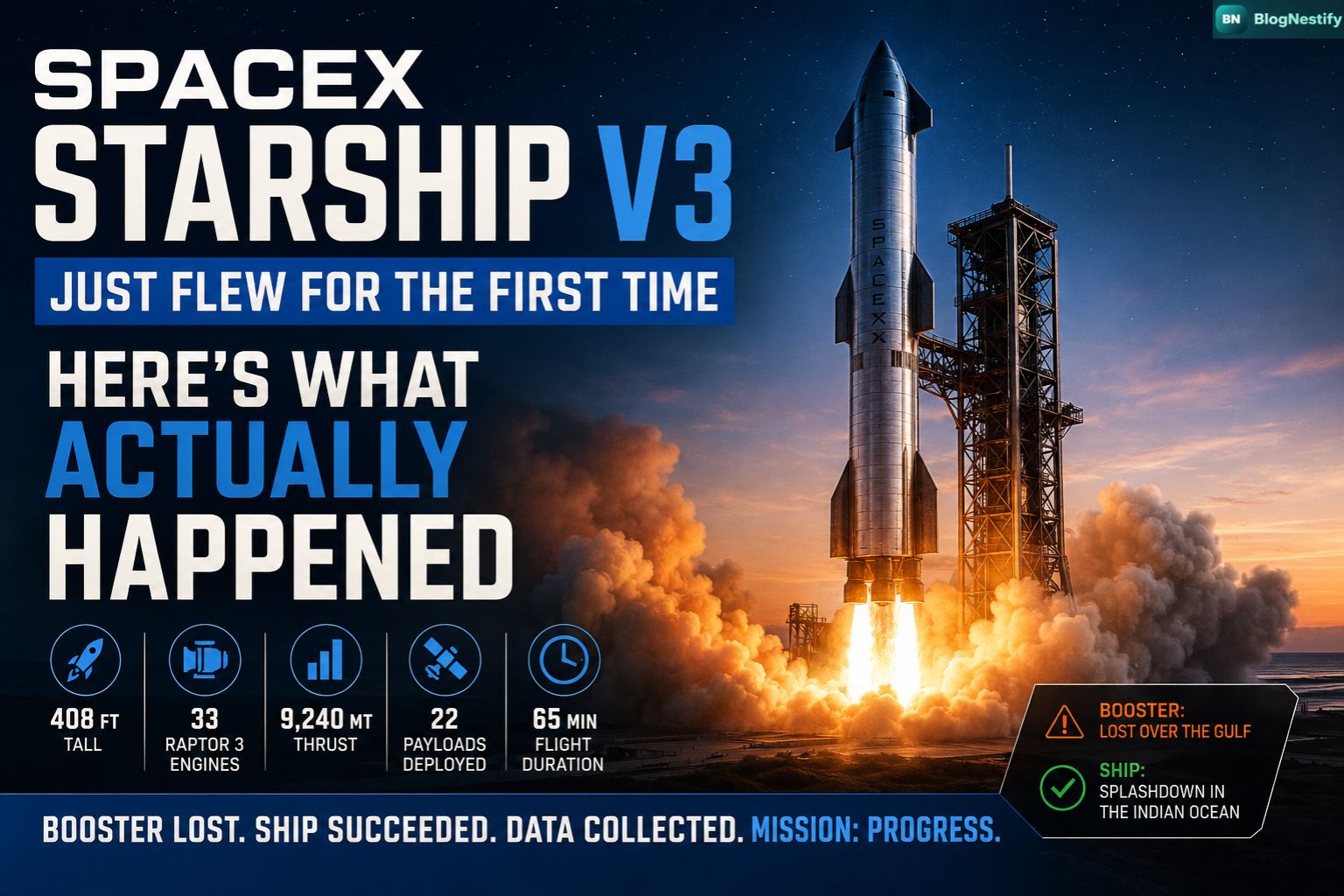
What Is Starship V3 and Why Does It Matter?
If you've been tracking SpaceX for a while, you know the company measures progress differently than most. A test flight where the rocket blows up isn't a failure — it's a data point. With that framing in mind, Flight 12, the debut of Starship Version 3, delivered quite a lot of usable data.
Starship V3 is not just an incremental upgrade. SpaceX rebuilt nearly the entire stack. The booster — Super Heavy — now runs 33 Raptor 3 engines, a new-generation design that produces more thrust while being physically lighter and mechanically simpler than its predecessor. The full rocket stands 124.4 meters (408 feet) tall and weighed in at 5,533 metric tons at liftoff. To put that in perspective: it out-masses Saturn V by more than double.
The company also trimmed 80 tons off the total vehicle mass through structural redesigns — a significant improvement that translates directly into payload capacity. SpaceX is gunning for 100 metric tons to low Earth orbit as the operational target for Starship.
Flight 12 Minute-by-Minute: What Actually Went Down
The rocket lifted off from Pad 2 at Starbase, Boca Chica, Texas, at 6:30 p.m. EDT on May 22, 2026. (A launch attempt the day before was scrubbed at T-minus 40 seconds when a hydraulic pin on the launch tower arm refused to retract. Space is hard.)
"You scored a goal for humanity."
— Elon Musk, post-flight on X, May 22, 2026
What's Actually New in Starship V3 vs V2
Version 3 isn't just a refresh. The changes run deep enough that SpaceX decided against attempting a tower catch on this first flight — the vehicle was too different from the last configuration to take that risk. Here's a side-by-side look at where V3 diverges from V2:
Beyond the engine swap, SpaceX upgraded the fuel transfer tubing inside the Super Heavy booster to deliver propellant more efficiently to all 33 engines. The gridfins — large mesh panels at the top of the booster that help stabilize it during descent — were also redesigned. And Pad 2 itself is built for higher launch cadence: faster fueling lines, a more durable flame diverter, and a layout that reduces turnaround time between flights.
Mission Objectives: What Passed, What Didn't
| Objective | Result | Notes |
|---|---|---|
| Clean liftoff | PARTIAL | 1 of 33 engines shut down at liftoff; vehicle stayed on track |
| Stage separation | PASS | Hot staging executed cleanly |
| Booster splashdown | FAIL | Boost-back burn failed; booster lost over Gulf |
| Payload deployment | PASS | 22 Starlink simulators deployed successfully |
| In-space Raptor relight | PARTIAL | Engine test impacted by propellant margin issues |
| Reentry experiment | SKIPPED | Cancelled due to propellant depletion from engine loss |
| Heat shield integrity | PASS | No burnthrough detected; major win for V3 design |
| Ship splashdown (Indian Ocean) | PASS | Controlled splashdown ~65 min after liftoff |
The heat shield result deserves emphasis. On several earlier test flights, Starship's thermal protection tiles took significant damage during reentry. Flight 12 returned Ship 39 with no burnthrough — a real engineering milestone, not a participation trophy.
Why SpaceX Genuinely Needs This to Work
This isn't just about exploration bragging rights. Starship is load-bearing infrastructure for SpaceX's core business.
Starlink's Next Leap Depends On It
Starlink is currently the only profitable division at SpaceX. The next-generation satellites — bigger, more capable, and designed for direct-to-cell coverage — are too large to fit on Falcon 9 in meaningful quantities. Starship is how SpaceX plans to deploy them in bulk. Without a working, reliable Starship, the cadence for upgrading the Starlink constellation slows down.
NASA's Artemis Moon Missions
NASA selected Starship as the Human Landing System for the Artemis program. Artemis 3, which will put astronauts on the lunar surface, is currently targeting mid-to-late 2027. Artemis 4 targets late 2028. Both missions require a fully operational, human-rated Starship. Every test flight that improves reliability and reusability directly affects whether those timelines hold.
The Financial Reality
SpaceX poured roughly $3 billion into Starship research and development in 2025 alone, contributing to a $4.9 billion overall loss that year. Another $1 billion went into the program in Q1 2026. The company's total investment in Starship now sits around $15 billion. That's not a side project. For SpaceX, getting Starship to fly reliably and cheaply isn't aspirational — it's existential to the company's long-term economics.
The Booster Loss: Is It a Problem or Expected?
Context matters here. SpaceX had caught the Super Heavy booster in mid-air twice before — Flights 5 and 7, using the "Mechazilla" chopstick arms at Starbase. Those were genuinely impressive. So losing the booster on Flight 12 feels like a step backward.
It's more nuanced than that. SpaceX deliberately chose not to attempt a tower catch on Flight 12. The V3 booster is redesigned enough that attempting a precision catch on the very first flight would have added unnecessary risk to an already complex mission. A Gulf splashdown was the plan. The engine failures that prevented even that controlled splashdown are the actual problem to solve.
The relevant question now — the one SpaceX engineers are working through — is whether the Raptor 3 engine failures on Booster 19 reflect a design issue with the new engine or an anomaly with that specific test article. That distinction determines how long the investigation takes and whether it affects the rest of the 2026 production pipeline.
SpaceX live-streamed the booster's descent all the way to impact. That transparency is worth noting. Earlier test losses sometimes came with ambiguous communication. Showing the full sequence, failures included, reflects the company's stated "move fast and learn in public" approach to rocket development.
What to Watch for in the Next Starship Flights
SpaceX's immediate priorities after Flight 12 are fairly predictable. The Raptor 3 engine reliability needs to be resolved before aggressive cadence makes sense. The boost-back burn failure, in particular, affects every future mission that relies on booster recovery and reuse.
Beyond the immediate engineering work, the milestones that would signal Starship is maturing toward operational status include:
Frequently Asked Questions
What is SpaceX Starship V3?
What happened during SpaceX Starship V3 Flight 12?
Why was the Super Heavy booster lost on Starship Flight 12?
What are the new features of Starship V3?
What missions does SpaceX need Starship V3 for?
When is the next SpaceX Starship launch?
Bottom Line
Flight 12 was SpaceX operating exactly the way SpaceX operates: push the machine to its limits, learn what breaks, fix it, and fly again faster. The upper stage performed better than many expected given the engine loss. The heat shield result was genuinely good news. The booster loss stings, but SpaceX had already accepted that outcome going in.
What matters now is whether the Raptor 3 engine issue is a manufacturing fluke or a design problem. That answer shapes the rest of 2026. If it's a fixable anomaly, SpaceX could be back on the pad within weeks. If it's deeper, the timeline gets complicated — and the Artemis and Starlink schedules feel the pressure.
Either way, the program moved forward yesterday. That counts.
0 Comments
Leave a Comment