Dry Winters, Diverse Skin: Can One Sunscreen Really Work for Every Indian Skin Type?
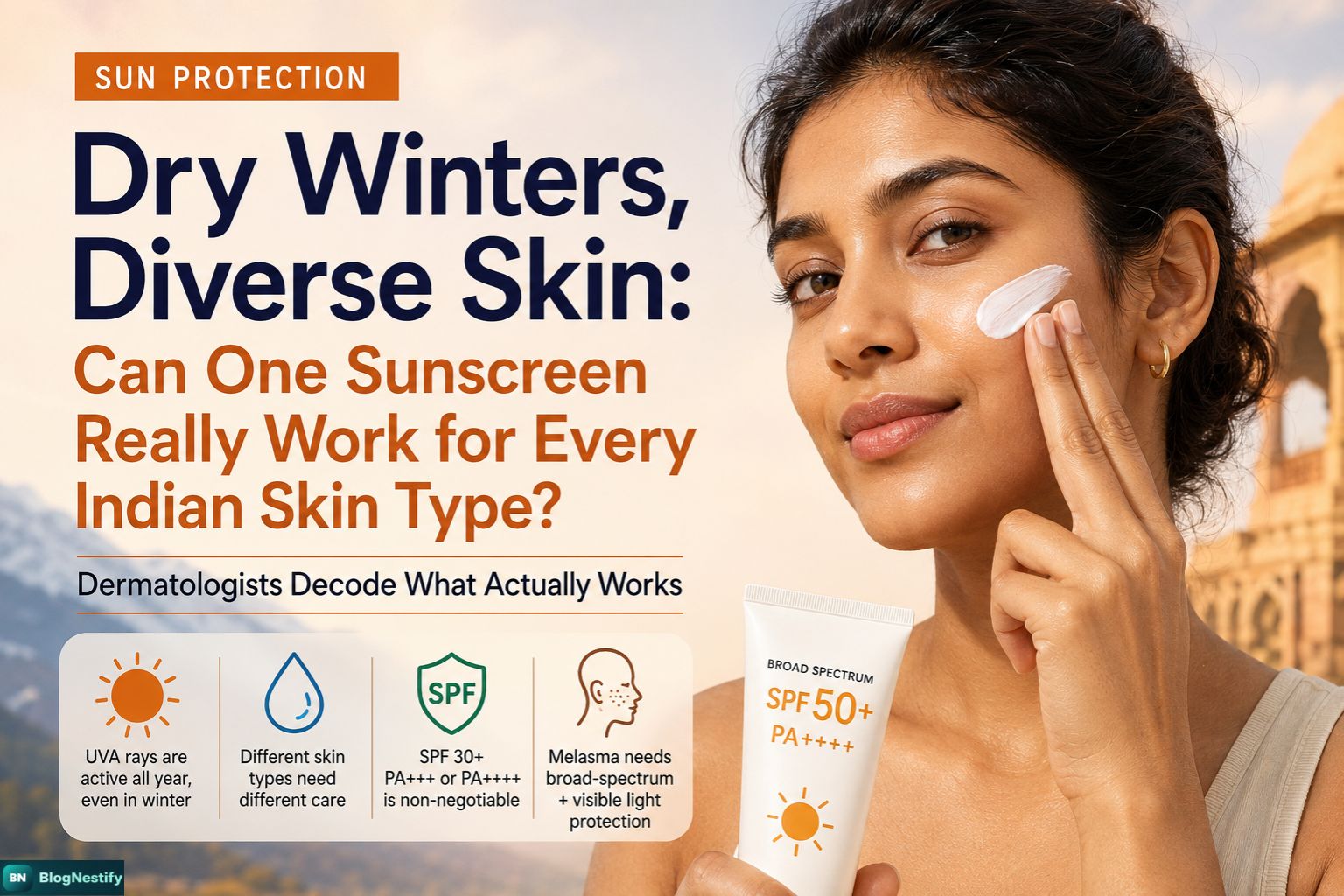
Sunscreen is more than a skincare product — but can a single formula truly suit India's wildly different skin types and weather conditions? Dermatologists decode what's actually going on beneath the surface.
Every winter, the same conversation plays out in dermatology clinics across India. Someone with dry, flaking cheeks comes in holding a gel sunscreen — the same one they used all summer — complaining it makes their skin feel worse. Someone else with oily, acne-prone skin walks in having skipped sunscreen entirely through December and January because the weather "feels gentle." Both are making the same mistake from opposite directions.
The short answer to whether one sunscreen can work for all Indian skin types is: no, and also kind of yes. The protection goal is universal. The formula is not. And in a country where skin types range from extremely oily in humid coastal cities to severely dry in arid interiors — and where the UV index stays active even in December — getting the formula right is not a cosmetic preference. It's a health decision.
Why Indian Skin Has a Unique Relationship With the Sun
India sits close to the equator. That means the UV index stays high through most of the year, and even mild winter sun delivers real UV exposure — especially UVA, which makes up roughly 95–98% of the solar UV radiation reaching ground level, according to research published in the Indian Journal of Dermatology, Venereology and Leprology.
Higher melanin content in Indian skin does provide some natural protection against immediate sunburn — equivalent to roughly SPF 4 to 13, depending on skin tone. But this creates a dangerous misconception. Darker skin tones are more prone to post-inflammatory hyperpigmentation (PIH), tanning, and melasma — all UVA-driven conditions. The same melanin that slows down sunburn speeds up pigmentation when UV exposure goes unchecked.
— Indian dermatology consensus on year-round photoprotection
What Indian skin needs from sunscreen is therefore different from what a global formula assumes. It needs robust UVA protection (the PA rating), not just UVB (the SPF number). It needs formulas that don't leave a white cast on deeper skin tones. And it needs textures suited to extremes — from the oily humidity of Mumbai summers to the dry cold of a Delhi January.
The Winter Problem Nobody Talks About Enough
Ask someone in North India whether they use sunscreen in December and most will say no. The sun feels pleasant. You want to be out in it. And sunscreen feels like extra effort when you're already layered up.
The problem: UV radiation doesn't take a winter break. UVA rays pass straight through clouds, glass windows, and the cozy interior of your car. In regions like Rajasthan and Gujarat, the UV index stays notably high even in winter months. In hill stations and high-altitude areas, UV intensity actually increases — and snow or reflective surfaces can bounce up to 80% of UV rays back at your skin.
Cold weather + indoor heating → strips skin moisture → weakened skin barrier → UV rays penetrate more easily → accelerated pigmentation, dark spots, and premature ageing. Skipping sunscreen in winter doesn't protect dry skin. It exposes it.
For people with dry skin specifically, winter sunscreen is doubly important. The combination of low humidity and dry air strips the lipid layer from the skin's surface. When that barrier breaks down, the skin becomes more sensitive to UV-induced damage, and pigmentation disorders like PIH worsen. A moisturizing sunscreen in winter acts as both a barrier repair product and a shield — two problems addressed in one step.
Does One Sunscreen Formula Fit Everyone? What Dermatologists Actually Say
The consensus from dermatologists and India's Sunscreen Forum (PRISM-ISF) is clear: the protection requirements are universal. Broad-spectrum coverage, a minimum of SPF 30 for everyday use (SPF 50+ for prolonged outdoor exposure), and a PA rating of PA+++ or higher are non-negotiable for all Indian skin types, all year round.
What changes skin type to skin type is the vehicle — the base in which those UV filters are delivered. A gel formulation that keeps oily skin matte will exacerbate dryness on an already parched face in January. A rich cream that nourishes dry skin will feel suffocating and comedogenic on acne-prone skin in humid weather. The answer to "can one formula work for everyone" is genuinely: it depends on how broadly you're willing to compromise.
- Photostability — UV filters that don't break down after 30 minutes in the sun
- Broad-spectrum efficacy — covers both UVA and UVB, not just SPF
- Non-comedogenic safety — won't clog pores or trigger breakouts
- No white cast — especially critical for medium to deep Indian skin tones
- PA+++ or higher — for real protection against India's dominant UVA exposure
Sunscreen by Skin Type: The Honest Breakdown
Here's what actually changes across India's four dominant skin types, and what dermatologists recommend for each.
Tight, Flaky, Craving Hydration
Dry skin loses moisture fast, and sunscreen can worsen this if it contains alcohol or has a mattifying formula. The skin barrier is already stressed — especially in winter.
Shiny by Noon, Pore-Sensitive
The biggest risk here is a greasy film that clogs pores and worsens breakouts. Standard cream sunscreens are a problem. Many people with oily skin skip sunscreen entirely because of this.
Oily T-Zone, Dry Cheeks
The most common skin type in India's tropical climate. A single formula tends to over-hydrate the T-zone or under-hydrate the cheeks.
Reactive, Redness-Prone
Chemical filters and fragrances commonly trigger flare-ups in sensitive skin. Post-procedure skin falls here too — post-peel or post-laser skin needs especially careful choices.
Understanding SPF vs PA: The Number That Actually Matters for Indian Skin
Most Indians look at the SPF number and stop there. SPF measures protection against UVB rays — the ones that cause sunburn. But as established, 95–98% of UV radiation reaching Indian skin is UVA, which causes tanning, melasma, post-inflammatory hyperpigmentation, and deeper collagen damage.
The PA rating (Protection Grade of UVA) is the number that matters most for Indian skin concerns. PA+ through PA++++ indicates increasing UVA protection. Dermatologists recommend PA+++ as the minimum for daily outdoor use, and PA++++ for anyone dealing with hyperpigmentation, melasma, or extended sun exposure.
| Rating | UVA Protection | Best For |
|---|---|---|
| SPF 30 | Blocks ~97% UVB | Everyday city/indoor use, minimal outdoor time |
| SPF 50+ | Blocks ~98% UVB | Outdoor use, sports, high UV index regions |
| PA++ | Moderate UVA | Low risk environments only |
| PA+++ | High UVA | Daily use, Indian climate minimum standard |
| PA++++ | Extremely High UVA | Melasma, hyperpigmentation, long outdoor hours |
The Melasma and Pigmentation Problem
Melasma affects a disproportionately large number of Indian women, and it is one condition where "any sunscreen will do" genuinely fails. Melasma is not only triggered by UVA and UVB — it is also worsened by visible light, which most standard sunscreens don't address at all.
Research published in the Indian Journal of Dermatology confirms that broad-spectrum photoprotection — including coverage against UVA, UVB, and visible light — plays a meaningful role in stabilizing and improving melasma and post-inflammatory hyperpigmentation in skin of color patients. Standard chemical sunscreens miss visible light entirely.
- Mineral sunscreens with zinc oxide + titanium dioxide block UVA, UVB, and visible light
- Tinted formulations with iron oxides provide extra visible-light protection that clear formulas miss
- Apply sunscreen as part of an integrated approach — it stabilizes existing pigmentation but dermatologists combine it with topical treatments for active melasma
- Reapply every 2–3 hours when outdoors — UV filters deplete over time, just like a battery
Physical vs Chemical vs Hybrid: Which Type Is Right for Indian Skin?
The sunscreen market has three categories, and each has real strengths and weaknesses on Indian skin.
Physical (Mineral) sunscreens use zinc oxide or titanium dioxide to sit on the skin surface and physically block UV rays. They work immediately on application, are well-tolerated by sensitive skin, and block visible light too. The historic drawback — a chalky white cast — is largely solved by modern micronized particle formulations. They're recommended for post-procedure skin and anyone dealing with melasma.
Chemical sunscreens absorb UV rays and convert them to heat before they penetrate. They blend invisibly into all skin tones, which is why they're popular for medium to deep Indian skin. They need 15–20 minutes after application to become effective, and some chemical filters (like avobenzone) can break down in sunlight unless photostabilizers are added. Not ideal for reactive or post-peel skin.
Hybrid sunscreens combine both. They're the practical choice for most Indian skin types — offering the invisible finish of chemical filters with the broadened coverage of minerals. Most dermatologist-recommended formulas for everyday Indian use fall into this category.
Regional Climate Changes Everything
India is not one climate. A sunscreen suitable for the coastal humidity of Chennai will feel heavy and pore-clogging on someone in humid Kolkata in June, and will be completely inadequate for the dry cold of a hill station in Himachal Pradesh in January.
| Region / Climate | Key Skin Challenge | Recommended Formula |
|---|---|---|
| North India (Delhi, UP, Rajasthan) — Winter | Extreme dryness, weakened barrier, active UV even in cold | Cream-based, SPF 30–50 with ceramides and hyaluronic acid |
| Coastal / South India (Mumbai, Chennai, Goa) | High humidity, excess sebum, tanning, breakouts | Lightweight aqua gel or fluid, non-comedogenic, matte |
| Hill Stations / High Altitude | Increased UV intensity at altitude, reflective surfaces | SPF 50+, PA++++, water-resistant, mineral preferred |
| Interior / Arid Regions (Rajasthan, Gujarat) | Intense direct sun, dry air, high UV index year-round | SPF 50+ PA++++, hydrating base, high photostability |
The Application Problem: Most People Aren't Getting the SPF They Think They Are
Even the right sunscreen fails if it's under-applied. This is not a small gap — it's the reason why people report their SPF 50 sunscreen didn't seem to protect them at all.
The tested SPF is calibrated at 2mg of product per square centimeter of skin. For the face and neck, that translates to roughly two full fingers of product. Most people apply about a quarter of that amount. At half the recommended dose, SPF 50 delivers roughly SPF 25 protection. At a quarter dose, the protection drops to around SPF 15 — which is why liberal application is described by dermatologists as non-negotiable.
- Apply two finger lengths of product for face + neck combined
- Chemical sunscreens need 15–20 minutes before sun exposure to activate
- Reapply every 2–3 hours outdoors — UV filters deplete with sun exposure and sweat
- For oily skin: use a SPF mist or powder for midday reapplication to avoid adding more cream
- Don't skip on cloudy days — up to 80% of UV rays penetrate cloud cover
- UVA rays pass through window glass — apply sunscreen even for desk-side or car window exposure
The White Cast Question
White cast remains the most cited reason Indian consumers skip or under-apply sunscreen. And it's a legitimate concern — a visible white film on a medium to deep Indian skin tone isn't just cosmetically undesirable, it's a real compliance barrier to daily use.
Modern formulations have largely addressed this through two routes. First, micronized zinc oxide and titanium dioxide particles in mineral sunscreens are now processed small enough to blend invisibly on darker skin tones. Second, chemical filters like avobenzone and Tinosorb are inherently invisible. The 2026 Indian market has a strong range of white-cast-free options across both categories — the challenge is choosing between them based on skin type rather than packaging or price.
The practical rule: if white cast is a persistent problem with your current sunscreen, you're likely using an older-generation mineral formula. Switch to a hybrid or well-formulated chemical sunscreen, or look specifically for micronized mineral options.
- Universal requirement: Broad-spectrum, SPF 30 minimum (SPF 50+ for outdoors), PA+++ or PA++++, photostable, non-comedogenic
- Dry skin: Cream/lotion base with ceramides or hyaluronic acid — especially important in winter when the skin barrier is weakened
- Oily/acne-prone: Gel or aqua gel, oil-free, niacinamide for sebum control, matte finish
- Combination: Lightweight fluid or gel-cream — one product, both zones, plus a light moisturizer on dry patches if needed
- Sensitive/melasma-prone: Mineral (zinc oxide), tinted with iron oxides for visible light coverage, fragrance-free
- Winter (all types): Don't switch to a lighter formula. Switch to a richer base, same protection level
Frequently Asked Questions
The Bottom Line
Sunscreen in India is not a one-size-fits-all conversation. The protection target — broad-spectrum coverage, SPF 50, PA++++ — is the same for everyone. But the skin you're putting it on, the climate you're living in, and the season you're in determine which formula actually delivers that protection comfortably enough that you'll use it every day.
Dry winters strip the barrier. Oily summers clog pores. Melasma doesn't care about either — it just needs visible light blocked too. One sunscreen can come close to working across skin types if it's a well-formulated hybrid with a neutral, fluid texture. But for most people, adjusting formula by season — lighter gel in humid months, richer cream in winter — is the practical answer that dermatologists recommend.
The best sunscreen for Indian skin is the one you'll actually apply in the right amount, every single day, year-round. Start there.
0 Comments
Leave a Comment