The Tim Cook Era: How Apple Became a $4 Trillion Empire Through Several Hits and a Few Misses
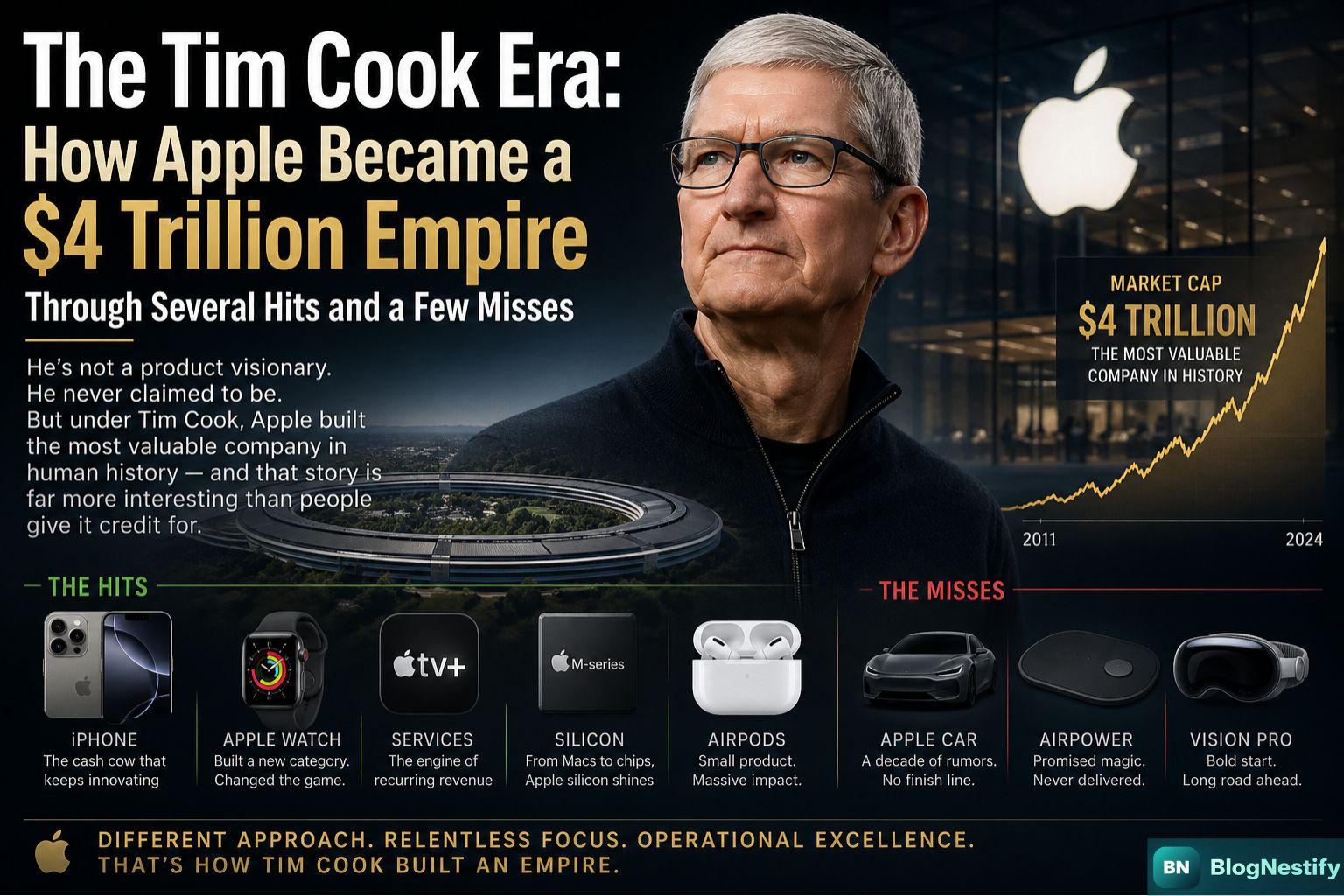
He's not a product visionary. He never claimed to be. But under Tim Cook, Apple built the most valuable company in human history — and that story is far more interesting than people give it credit for.
The Handover Nobody Expected to Work
When Steve Jobs stepped down as CEO on August 24, 2011, the tech world quietly started writing Apple's eulogy. Not because Tim Cook was unqualified — he'd been running Apple's day-to-day operations for years — but because replacing Steve Jobs felt like replacing gravity. It just didn't seem like something you could do.
Six weeks later, Jobs was gone. And Cook — the soft-spoken, deeply private operations guy from Alabama — was left holding one of the most powerful companies on the planet.
At the time, Apple's market cap sat around $350 billion. The iPhone was three years old. The iPad was brand new. The Mac was chugging along. And everyone, from Wall Street to Silicon Valley, was watching to see if Cook would run it into the ground or quietly keep the lights on.
"Nobody thought he'd be great. Most people thought he'd be fine. What actually happened was something neither camp predicted."
What Cook did over the next 14 years wasn't just "keeping the lights on." He methodically built Apple into the first company in history to hit a $4 trillion market cap. He launched new product categories, turned Services into a $85 billion-a-year business, and rebuilt Apple's supply chain into one of the most efficient ever constructed. Not bad for someone who was never supposed to be the visionary.
Tim Cook Becomes CEO
Steve Jobs resigns; Cook officially takes the helm. Apple's market cap: ~$350 billion.
iPhone 6 + Apple Pay Launch
Bigger screens, record sales, and the first serious shot at mobile payments.
Apple Watch Ships
Cook's first original hardware category. Rough first-gen, but it eventually became the world's best-selling watch.
iPhone X & Face ID
$999 starting price. The most audacious redesign since the original iPhone. It worked.
Apple Silicon (M1)
Apple ditches Intel and builds its own chips. The performance leap was genuinely shocking.
Apple Vision Pro Announced
$3,499 spatial computing headset. The most ambitious product since the iPhone — and the most uncertain.
$4 Trillion Market Cap
Apple becomes the first company in history to reach a $4 trillion valuation.
The Hits That Defined a Generation
Let's be direct: Cook's Apple has had some genuinely great products. Not everything landed, but the hits landed hard.
Apple's decision to go bigger with the iPhone 6 and 6 Plus is probably the single most important product call Cook made in his first five years. The company had held firm on smaller screens while Android makers raced upmarket. When Cook finally greenlit the bigger screens, it triggered the largest upgrade cycle in iPhone history. Apple sold over 74 million iPhones in one quarter — a number that had never been done before and hasn't been matched since. The $1 trillion milestone Apple hit in 2018 traces directly back to this phone.
The first-gen Apple Watch was awkward. Battery life was rough, it was slow, and the software felt like an afterthought. But Cook and his team iterated hard and fast. By Series 3, it was genuinely useful. By Series 4, it was detecting atrial fibrillation and saving lives. Today, the Apple Watch outsells the entire Swiss watch industry combined. That's not hyperbole. It's a category Cook built from scratch — the first since Jobs — and it now generates tens of billions in revenue per year.
Nobody expected AirPods to become what they became. When Apple ditched the headphone jack in 2016 (more on that later), AirPods were the answer. The mockery lasted about six months. Then everyone was wearing them. By 2019, AirPods were doing around $12 billion in revenue annually. They became a cultural status symbol in a way no Apple accessory ever had before — not because Apple marketed them that way, but because people just started wearing them everywhere.
This one deserves more credit than it usually gets. Cook announced in June 2020 that Apple was dropping Intel and building its own ARM-based chips for Macs. Within six months, the M1 was shipping in real computers — and those computers were embarrassingly fast. Faster than top-end Intel MacBook Pros. With battery life that lasted all day. At competitive prices. The M-series chips are, without exaggeration, some of the best processors ever built for laptops. Apple had done this before (iPhone chips), but doing it at Mac scale was a different and far more complicated challenge. They absolutely nailed it.
The Misses Nobody Talks About Enough
Here's the thing about Apple under Cook — the misses get buried under the wins. But they're worth looking at honestly, because they tell you something real about how the company works and where it still struggles.
Cook literally issued a public apology for Apple Maps in 2012. That doesn't happen often at Apple. The app launched as a replacement for Google Maps on iOS 6 and was, in a word, broken. Roads ended mid-river. Landmarks were misplaced by miles. Entire towns appeared in wrong locations. Cook acknowledged it directly and recommended users switch to competitors while Apple fixed things. Apple Maps is decent now, a decade-plus later — but it's still not meaningfully better than Google Maps in most places. The launch was a genuine disaster.
Siri launched in 2011, the day before Jobs died, and it felt like the future. By 2015, it had fallen behind Google Assistant and Amazon Alexa so badly that it became the subject of jokes. It still hasn't caught up. The reasons are complex — organizational issues inside Apple's AI teams, a privacy-first architecture that limited training data, and slower iteration than competitors. Apple Intelligence, announced in 2024, is Apple's serious attempt to fix this. But Siri's decade-plus plateau is one of the real failures of the Cook era, and it cost Apple meaningful ground in the AI race.
In September 2017, Apple announced AirPower — a wireless charging mat that could charge your iPhone, Apple Watch, and AirPods simultaneously, anywhere on the mat. It sounded perfect. Apple even printed it on iPhone X box inserts. Then nothing happened. Months passed. Then years. In March 2019, Apple quietly cancelled AirPower, saying it couldn't meet Apple's standards. The whole saga was a rare public stumble — Apple had broken its own rule of not announcing products until they're ready, and the physics of the wireless charging problem turned out to be harder than anyone anticipated.
Nobody disputes that Vision Pro is an extraordinary piece of engineering. The display resolution, the eye-tracking, the hand gestures — they're genuinely science fiction made real. But at $3,499, it didn't find mainstream adoption. Reports suggest Apple sold far fewer units in 2024 than expected, and a rumored cheaper version keeps getting delayed. Whether Vision Pro follows the Apple Watch arc (slow start, then dominant) or the Google Glass arc (technically impressive, ultimately abandoned) is the biggest open question in consumer technology right now.
The Services Bet: Apple's Quiet Masterstroke
Here's something that gets undersold in most Apple retrospectives: Tim Cook's biggest strategic contribution to Apple isn't a product. It's a business model.
When Cook became CEO, Apple's revenue was almost entirely hardware. iPhone sold, Apple made money. iPhone didn't sell, Apple didn't make money. It was a lumpy, volatile business completely dependent on people upgrading their phones every two years.
Cook saw something others missed: Apple had over a billion customers who trusted the company deeply. That trust was worth money beyond the initial hardware sale. The App Store was already generating revenue, but Cook pushed hard to build an entire Services ecosystem around it — Apple Music in 2015, Apple Pay in 2014, iCloud subscriptions expanding, Apple TV+ in 2019, Apple Arcade, Apple Fitness+, and more.
By fiscal year 2024, Apple's Services segment generated over $85 billion in annual revenue at gross margins exceeding 70%. It is now Apple's fastest-growing, most profitable business segment. It smooths out iPhone cycles, creates recurring revenue that Wall Street loves, and locks Apple's 2.2 billion active device users into an ecosystem that's increasingly expensive to leave.
"Cook didn't try to out-Jobs Jobs. He built the financial engine that will fund whoever comes after him — and that might be his most lasting contribution."
Jobs vs. Cook: A Pointless Argument
People still compare Cook and Jobs as if one is a better version of the other. It's a waste of time, mostly because they were different kinds of leaders solving different kinds of problems.
- Product visionary — saw what people wanted before they knew
- Saved Apple from near-bankruptcy
- Invented the iPod, iPhone, and iPad category
- Often brutal, sometimes wrong, always decisive
- Built Apple's design culture and brand identity
- Market cap at his death: ~$350 billion
- Operations and strategy genius
- Built Apple's supply chain into the world's best
- Created the Services business from near-zero to $85B+
- Championed privacy as a core company value
- Expanded Apple to new markets and demographics
- Market cap under his tenure: $350B → $4 trillion+
Jobs was irreplaceable as a product creator. Cook is irreplaceable as a business architect. Apple under Jobs was one of the greatest creative machines ever assembled. Apple under Cook is the most financially dominant company in history. You can prefer one era over the other — that's fair — but claiming one is "better" misses what each man was actually doing.
So, Is $4 Trillion Deserved?
Honestly? Probably, yes — though I'd caveat that "deserved" is a weird word to apply to market valuations, which are partly about earnings and partly about collective belief in a company's future.
Apple at $4 trillion rests on a few genuinely solid foundations. It has the most loyal consumer base in consumer technology. It controls both its hardware and software better than any competitor. The Services business is throwing off enormous, growing, high-margin cash. The M-series chips gave Apple performance advantages that Intel couldn't provide. And 2.2 billion active devices is a distribution advantage that's nearly impossible to replicate.
The concerns are real too. Apple's dependence on China — both for manufacturing and as a market — is a geopolitical risk that keeps getting bigger, not smaller. Antitrust pressure on the App Store is coming from multiple directions globally. Siri and Apple's AI position is behind Google and OpenAI in meaningful ways. And Vision Pro still hasn't proven it's a platform, not just a prototype.
But none of that changes what Tim Cook actually built. He took a company that was one bad product cycle from irrelevance in the late 1990s — rebuilt by Jobs — and turned it into the largest and most profitable consumer technology company in history. The $4 trillion valuation is the market's way of saying it believes Cook's foundations hold. So far, they have.
The next chapter — whoever writes it — starts from a position that would have been unimaginable in 2011 when a quiet guy from Alabama sat down in the CEO chair and tried to figure out what came next.
Frequently Asked Questions
The most common questions about Tim Cook, Apple's $4 trillion valuation, and what it all means going forward.
0 Comments
Leave a Comment