Drone Strike on UAE's Barakah Nuclear Plant: What Actually Happened — and Why Abu Dhabi Is Calling It a "Dangerous Escalation"
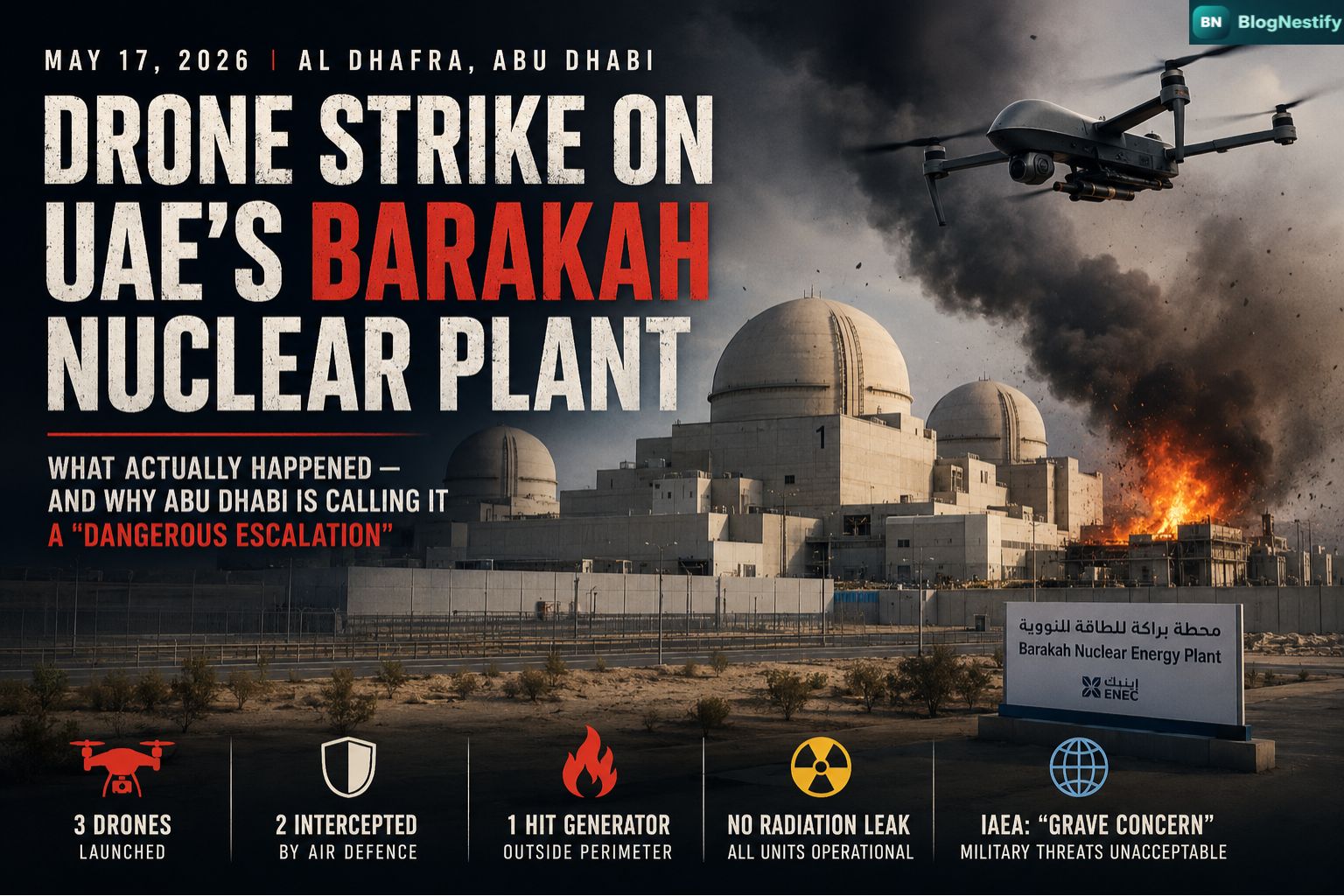
Three drones. One slipped through. A generator caught fire outside the Arab world's first nuclear power plant. No radiation. No casualties. But the message, according to sources, was anything but subtle.
- Date: Sunday, May 17, 2026 — Al Dhafra Region, Abu Dhabi
- Three drones launched from UAE's western border; two intercepted by air defence
- Third drone hit an electrical generator outside Barakah's inner perimeter
- No injuries, no radiation leak — all four reactor units operational
- Unit 3 temporarily ran on emergency diesel generators
- UAE Foreign Ministry: "dangerous escalation" and "terrorist attack"
- IAEA chief Rafael Grossi: "grave concern" — military threats to nuclear sites "unacceptable"
- No group claimed responsibility; UAE investigating; sources point to Iran or Houthis
On the morning of May 17, 2026, a fire broke out at an electrical generator on the grounds of the Barakah Nuclear Energy Plant in Abu Dhabi. The cause wasn't mechanical failure or an accident. A drone — one of three that crossed the western border — got through the air defences and struck the generator.
Nobody was hurt. The reactors kept running. Radiation levels stayed flat. But the UAE government came out hard: this was a "terrorist attack," a "dangerous escalation," and a "direct threat" to the country's security. Sheikh Abdullah bin Zayed personally called the IAEA's director general. The Foreign Ministry invoked international law. That's a lot of diplomatic firepower for an incident that left no casualties.
So what's actually going on here? Why does a fire outside a nuclear plant's fence line — not inside, not near a reactor — warrant that kind of language? The answer has a lot to do with what Barakah is, what the attack was designed to communicate, and where the Gulf sits right now.
What Happened, Step by Step
The UAE Ministry of Defence confirmed the basics: three unmanned aerial vehicles entered UAE airspace from the western border on Sunday morning. Air defences engaged and successfully neutralised two of them. The third slipped through.
It hit an electrical generator sitting outside the inner perimeter of the Barakah Nuclear Energy Plant. The generator caught fire. Emergency teams responded quickly; the fire was contained. No injuries were recorded. The Federal Authority for Nuclear Regulation (FANR) confirmed that the plant's safety systems were unaffected and all four APR1400 reactor units continued running normally.
The only operational impact: Unit 3 briefly switched from its usual power supply to emergency diesel generators while the situation was assessed. That's a designed-in backup, not a crisis. The IAEA noted this in its own statement and confirmed it was monitoring closely.
What Is Barakah — And Why It Makes This Different
Barakah isn't just another power plant. It's the first nuclear power station on the Arabian Peninsula, built in Abu Dhabi's Al Dhafra desert region. The plant runs four South Korean-designed APR1400 reactors. It achieved full-fleet operations in September 2024 and now supplies roughly 25% of the UAE's electricity needs — generating about 40 terawatt hours of clean power annually, enough to match Switzerland's total annual demand.
Beyond electricity, the plant is a statement. The UAE spent years positioning itself as a responsible, internationally compliant nuclear energy state. It signed up to the IAEA's highest safety standards. It even committed to forgo domestic uranium enrichment. Barakah is, in diplomatic terms, a showcase — proof that a Gulf state can run civilian nuclear infrastructure by the book.
"We can also strike the nuclear reactor itself and trigger a nuclear incident." — Source cited by The Jerusalem Post, describing the attack's intended message
So when a drone hits even the perimeter of that facility, it's not just an infrastructure incident. It's an attack on something the UAE has built its regional credibility around. That's why the language from Abu Dhabi was so pointed.
Who Is Behind the Attack?
No group claimed responsibility by the time this article was published. The UAE said it hasn't publicly attributed the attack to any country and that investigations are ongoing.
But context fills in some of the blanks. The UAE has been on the receiving end of drone and missile strikes since a regional conflict that escalated on February 28, 2026. A conditional US-Iran ceasefire reached on April 8 paused hostilities for a few weeks. Tehran resumed strikes on the Emirates earlier in May.
Two sources described by The Jerusalem Post as familiar with the strike said it was intended to "send a message" to the Emiratis — and that the deliberate targeting of an energy supplier near the plant was designed to demonstrate a capability and a willingness: "We can also strike the nuclear reactor itself and trigger a nuclear incident." One source said Iran ordered the attack, whether carried out by Iranian forces directly or by Houthi proxies in Yemen.
The UAE, for its part, noted that the drones came from the western border. That detail is geographically significant — Yemen is to the southwest — though officials left the attribution question officially open.
The IAEA's Position — and Why It Matters
IAEA Director General Rafael Grossi didn't mince words. He called the incident a matter of "grave concern" and stated plainly that military activity threatening nuclear safety is unacceptable. He reiterated the call for maximum military restraint near any nuclear power plant.
The IAEA confirmed it was in constant contact with UAE authorities and ready to provide assistance. It verified the radiation-level data from FANR and noted the emergency diesel situation at Unit 3 in its public statement.
What the IAEA's response signals is important: the international nuclear safety community is watching this closely. A strike near a nuclear facility — even one that causes no radiological harm — sets a precedent. It normalises nuclear infrastructure as a legitimate military target in a conflict zone. That's something the IAEA has spent decades trying to prevent.
Sheikh Abdullah's call to Grossi wasn't just diplomatic courtesy. The UAE was making sure the international community understood how seriously it viewed the incident, and that it expected the IAEA to say so publicly — which Grossi did.
What This Actually Means for the Region
The Barakah strike lands at a delicate moment. The US-Iran ceasefire is fragile. Gulf states have been caught in crossfire. Saudi Arabia and the UAE both have clear exposure to Iranian and Houthi-launched munitions, and their air defences, while capable, aren't impenetrable — as Sunday demonstrated.
| Metric | Figure |
|---|---|
| Plant location | Al Dhafra Region, Abu Dhabi, UAE |
| Reactor type | APR1400 (South Korean design) — 4 units |
| Full-fleet operations began | September 2024 |
| Share of UAE electricity supplied | ~25% |
| Annual clean electricity generated | 40 terawatt hours |
| Annual carbon emissions avoided | 22.4 million tonnes (≈ 4.8 million cars off roads) |
| Drones launched in May 17 attack | 3 (2 intercepted, 1 hit external generator) |
| Radiation impact | None — levels remained normal |
| Injuries | None reported |
The attack also raises a question that nobody in the Gulf's leadership wants to answer directly: what happens if a drone hits something inside a nuclear facility? Not the perimeter. The reactor building. A spent fuel pool. A cooling system. The scenarios get very bad very quickly, and the lesson the UAE is drawing from Sunday is that the threat is real and the air defence window is narrow.
For Iran — or whoever ordered this — the strategic logic is presumably about leverage. The ceasefire is shaky. The US-Iran talks are going nowhere fast. Striking near Barakah demonstrates a capacity and a willingness to escalate in a way that carries enormous international weight. It's coercion through implied catastrophe.
Whether it works is another question. The UAE's Foreign Ministry said it reserves the "full right to respond." That language has its own implications.
On the Radiation Question — Setting the Record Straight
Given how quickly social media fills with alarm whenever the words "nuclear" and "explosion" or "fire" appear in the same sentence, it's worth being direct: there was no radiation release. The fire was in an external generator, a piece of electrical infrastructure sitting outside the plant's inner perimeter — not in a reactor building, not near spent fuel, not anywhere close to the nuclear systems themselves.
FANR, the UAE's nuclear regulator, confirmed this. The IAEA confirmed this independently. Radiation monitoring at the site showed no change. The worst operational consequence was that Unit 3 briefly ran on backup power — a situation the plant was designed to handle and handled without incident.
That said, the close call matters. Not because of what happened, but because of what could happen if a future strike is more precisely aimed.
The Bigger Picture: Nuclear Sites as Conflict Targets
The Zaporizhzhia nuclear plant in Ukraine spent much of 2022–2024 under military pressure — shelling nearby, power cuts, staff changes forced by occupation. The world watched, alarmed, as a functioning nuclear facility became a pressure point in a conventional military conflict. No reactor went critical. But the proximity was deeply uncomfortable.
Barakah is a different situation — it's a civilian plant in a Gulf state that is not itself a combatant in the current conflict. But the principle is the same: using proximity to nuclear infrastructure as a strategic tool. The IAEA has tried to establish, repeatedly and loudly, that this is unacceptable. Grossi's response to Sunday's strike fits that pattern.
The problem is that "unacceptable" from the IAEA doesn't come with enforcement mechanisms. The political pressure on Iran — or whoever carried this out — has to come from elsewhere. That's where UAE's diplomatic response and its ties to the US matter.
Frequently Asked Questions
The Bottom Line
Sunday's strike on Barakah's perimeter didn't cause a nuclear emergency. That's the most important thing to say clearly. The plant is running. The radiation picture is clean. Nobody died.
But what happened matters beyond the physical damage. Someone — almost certainly working at Iran's direction — sent a drone at a nuclear facility and got close enough to cause a fire. That's a first for the Gulf. The message embedded in that strike was explicit, at least according to the sources speaking to the press: we can go further.
The UAE's response — the terrorism language, the IAEA call, the invocation of international law — is partly diplomatic pressure, partly a warning to whoever is watching. And a lot of people are watching. The US. The IAEA. Regional states with their own infrastructure vulnerabilities. Everyone is absorbing the same information: the rules around nuclear sites as untouchable territory are being tested.
Where that test leads next depends on whether the ceasefire holds, whether the UAE decides to respond militarily, and whether the international community treats this as a line crossed or just another data point in a conflict that keeps generating them.
Sources: Al Jazeera, The National, Khaleej Times, Euronews, The Jerusalem Post, The Quint. All information sourced from reporting published May 17–18, 2026. This article will be updated as official investigations conclude. · Last updated: May 18, 2026.
0 Comments
Leave a Comment