WhatsApp Bans 9,400 Accounts Tied to Digital Arrest Scams — Here's What the Supreme Court Filing Actually Says
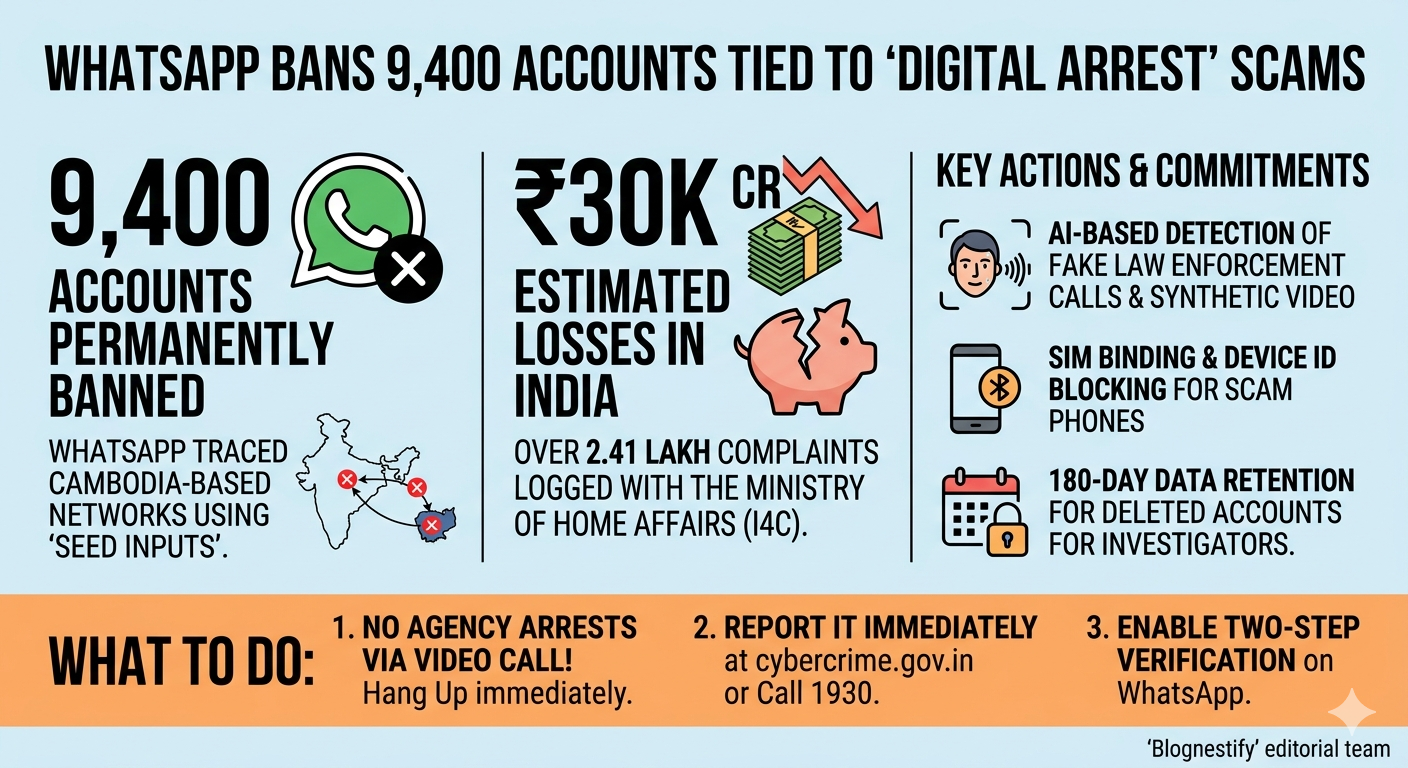
Court documents filed by India's cybercrime coordination agency reveal how WhatsApp took down a Cambodia-based fraud network — and what the government has committed to doing next.
WhatsApp told India's Supreme Court it independently found and permanently banned roughly 9,400 accounts linked to "digital arrest" fraud and organised impersonation of law enforcement. The disclosure came through a status report filed by the I4C on behalf of the Ministry of Home Affairs, with Attorney General R. Venkataramani representing the Ministry in court.
What makes this more than routine content moderation is how WhatsApp says it worked. Rather than just deleting accounts flagged by the government, the platform used each tip as a starting point to trace the entire criminal operation behind it — groups, admins, promoters, affiliated accounts. The result was a network takedown, not a list of removals. Most of that network, the filing confirms, ran out of Cambodia.
What Actually Happens in a Digital Arrest Scam
The term "digital arrest" sounds almost bureaucratic — which is part of why it works. The mechanics are easy to understand once you know them, but in the moment they're genuinely hard to see through.
It starts with a video call, usually on WhatsApp, from someone who looks convincingly like a senior police officer, CBI agent, Enforcement Directorate official, or sometimes a judge. They have a scripted accusation ready: you're implicated in money laundering, a narcotics case, or a national security matter. They flash fabricated FIR documents on screen. The "police station" background behind them looks real because it often is a looped recording or an AI-generated set.
Then comes the isolation. The victim is told they are under "virtual house arrest" — stay on the call, say nothing to family or lawyers, and transfer money immediately or face physical arrest. The psychological pressure is extreme and sustained. Some victims have been kept on calls for hours, occasionally days, while their accounts were drained transfer by transfer.
"These scams not only cause significant financial loss to victims but also lead to a profound sense of violation — they should not be considered merely as economic offenses but as an offense against human dignity."
— Chief Justice Surya Kant, Supreme Court of IndiaOne thing worth pausing on: the victim whose case is now before the Supreme Court is a 78-year-old woman lawyer — represented by advocate Vipin Nair — who was deceived despite decades of legal experience. This fraud doesn't discriminate by education or profession. The scripts are good, the pressure is relentless, and the fear of law enforcement is something most people carry regardless of what they understand about the legal system.
Chief Justice Surya Kant's bench took suo motu cognisance in January, meaning the court initiated proceedings without a formal complaint. That's the judiciary's way of saying this can't wait for someone to petition them.
How WhatsApp's "Seed" Approach Works
The phrase WhatsApp uses — "seed input" — comes from intelligence methodology, and that's not an accident. When law enforcement flags a suspicious account, most platforms review it and remove it if it violates policy. WhatsApp says it does something different: it treats that flagged account as a thread, pulls it, and tries to unravel the full network attached to it.
One Account Leads to an Entire Network
In practice, this means tracing who created a group, who administers it, which other accounts promote scam activity within it, and what infrastructure connects them. The goal is not to remove the single account the government spotted — it's to take down the operation running behind it.
WhatsApp used each government tip as a "seed" to map and dismantle the full criminal network behind it — including Cambodia-based administrators, group creators, and accounts promoting scam activity across groups and channels. The government's tip was a starting point, not the endpoint.
This is the same logic law enforcement uses when it flips an informant: you don't just arrest the one person mentioned, you use that person to reach the whole operation. Applied across a platform with hundreds of millions of Indian users, the potential scale of disruption is real — though so is the limitation. Criminal networks rebuild quickly, and new SIM cards are cheap.
Cambodia: Where the Fraud Actually Runs From
The Supreme Court documents confirm what Indian cybercrime investigators have suspected for years: the administrative hub of India's digital arrest networks is largely in Cambodia. This fits a broader and deeply troubling pattern across Southeast Asia, where cybercrime compounds — many staffed by people who are themselves trafficking victims — run financial fraud targeting people in India, Taiwan, and other countries.
The Cambodia connection is also why domestic enforcement alone can't solve this. WhatsApp removing 9,400 accounts disrupts operational capacity in a way that slow-moving cross-border police work often cannot.
What the Supreme Court Documents Actually Say
The filings came via a status report from I4C — the Home Ministry's nodal cybercrime body. The report covered an inter-departmental committee meeting held in March, chaired by the Special Secretary (Internal Security). WhatsApp sat at the table alongside India's four major telecom providers: Airtel, Vodafone-Idea, Reliance Jio, and BSNL.
| Entity | Role | Status |
|---|---|---|
| Platform investigation; 9,400 bans; AI/ML detection | Ongoing | |
| I4C | Filed status report; coordinates probe agency intelligence | Active |
| Ministry of Home Affairs | Policy lead; 2.41 lakh complaints; ₹30,000 crore losses tracked | Active enforcement |
| Supreme Court of India | Suo motu oversight since January 2025 | Proceedings ongoing |
| Airtel / Jio / Vi / BSNL | SIM binding; device ID blocking; network disruption | Under implementation |
The Technical Commitments: What's Actually Changing
Beyond the account ban figure, the status report sets out specific technical commitments. Some are already underway; others are described as ongoing.
AI Detection for Impersonation and Synthetic Video
WhatsApp says it's strengthening AI and ML systems to catch three things central to digital arrest scams: impersonation of law enforcement, misuse of official government logos, and synthetic video — the AI-generated content scammers use during calls to fake a police station backdrop or flash official-looking documents. The platform has also introduced detection models with user-facing warnings when impersonation patterns appear.
SIM Binding
SIM binding ties a WhatsApp account to one specific physical SIM card. Right now, scammers run operations through SIM farms — dozens of cheap prepaid cards used to create and burn accounts with no persistent identity. Binding makes that approach much harder. WhatsApp confirmed the work is ongoing and committed to compliance with India's IT Rules 2021 on this.
Synthetic Content (SGI) Labelling
India's IT Rules 2021 require platforms to identify and label SGI — AI-generated or manipulated video. For digital arrest scams, this matters because fake police station backgrounds and synthetic "official documents" shown on screen are core to the deception. WhatsApp committing to this means users could eventually see visible warnings when a video call contains synthetic content.
Device ID Blocking
A phone number block has a short shelf life — a scammer can get a new SIM in minutes. Blocking the device's hardware ID is stickier. The Ministry and stakeholders agreed in March to develop mechanisms to identify and block device IDs used in these operations. It's a harder technical lift, but a more durable one.
180-Day Data Retention for Deleted Accounts
This is probably the most practically useful commitment for investigators. When a scammer deletes their WhatsApp account right after a fraud — which they do immediately — the evidence disappears before police can act. WhatsApp has agreed to keep deleted-account data for at least 180 days. That's a real window for cybercrime units to pull forensic material before it's gone.
What This Actually Changes — and What It Doesn't
Nine thousand four hundred accounts is a real number until you set it against the backdrop. The Ministry has logged over 2.41 lakh complaints for this one fraud category alone. Estimated losses: ₹30,000 crore. And those are conservative — most victims don't file complaints. The actual scale of harm is substantially larger.
Account bans also hit a natural ceiling. Criminal networks rebuild fast; operators can spin up new accounts within hours. The more important commitments are the structural ones — device ID blocking, SIM binding, AI detection, data retention — because they raise the cost and friction of running these operations over time, rather than just clearing one wave of accounts.
"Digital arrest scams are the most disturbing and dangerous among cybercrimes — an offence against human dignity."
— Chief Justice Surya Kant, January 2025There's also something worth noting about the judicial dimension here. With I4C filing status reports directly to the Supreme Court, WhatsApp and the telcos are answerable not just to a regulator but to India's highest constitutional court. That's different pressure. Regulatory proceedings can be delayed or diluted; Supreme Court oversight is harder to slow-walk.
What You Can Actually Do Right Now
The institutional response matters, but it takes time. These calls are happening now — and the most reliable protection is knowing how the fraud works before it reaches you or someone close to you.
- 01 No real authority ever arrests anyone via video call. No Indian police force, CBI, ED, or court conducts arrests, interrogations, or bail negotiations through WhatsApp or any other app. If someone is doing this, it's a scam. Hang up.
- 02 End the call immediately. The fraud only works while you're on it. The moment you feel pressure to stay connected, that pressure is part of the scam. Leave the call, leave the room, find another person.
- 03 Verify through independent channels. Call the actual police station or agency using the publicly listed number — never any number the caller gives you. That number is also part of the scam.
- 04 Transfer nothing until you've spoken to a lawyer or trusted family member in person. No legitimate legal process demands instant payment over a video call. None.
- 05 Report it at cybercrime.gov.in or call 1930. The National Cyber Helpline runs 24/7. Early reporting improves the odds of fund recovery and stops the same operators from reaching more people.
- 06 Enable two-step verification on WhatsApp. Settings → Account → Two-step verification. It stops your account from being hijacked and potentially used in scam operations against others.
- 07 Have this conversation with older family members directly. A 78-year-old experienced lawyer got caught. Professional knowledge doesn't protect against sustained psychological manipulation — the warning has to be specific, not generic.
🛡️ Been Targeted? Report It Now.
Early reporting improves the chances of financial recovery and stops the same criminals from targeting others. The national helpline runs 24/7.
Report at cybercrime.gov.in →Platform Responsibility and What "Compliance" Actually Means Here
The long-running argument between WhatsApp and Indian regulators has been about privacy versus traceability — whether the platform should enable message tracking, and at what cost to end-to-end encryption. The digital arrest crisis has moved that debate to more concrete ground. The question now is whether a platform whose infrastructure is being used for industrial-scale psychological fraud has an obligation to act — and WhatsApp's answer, for now, appears to be yes.
The "seed input" methodology is worth looking at carefully, because it draws a distinction that matters. WhatsApp is not executing government deletion orders on demand. It takes the government tip as raw intelligence, runs its own investigation, and decides what to remove based on what it actually finds. That's the company acting on its own read of the evidence — not simply being an arm of the state. Whether you find that reassuring or frustrating likely depends on what you think platforms owe governments in the first place.
The 9,400 figure invites obvious criticism: it's small relative to the scale of harm. That criticism is fair. But the structural commitments — device ID blocking, SIM binding, 180-day data retention — are what will actually determine whether this problem shrinks over the next two years. Account bans are the visible part. The infrastructure changes are what matters underneath.
What's not in dispute: people are being psychologically destroyed by these calls. A retired professional sitting alone, convinced by a confident voice and a fake badge that they're about to be arrested, transferring everything they saved — that is not a regulatory abstraction. Every actor in this chain has a direct obligation to treat it as the emergency it is. The Supreme Court filing, at minimum, shows that some of them are starting to.
Frequently Asked Questions
Based on publicly available court filings, official government statements, and verified sources. For informational purposes only — not legal advice.